
Google Hotel Ads & Free Booking Links: How the Prices Tab Demand Funnel Actually Works
Sources: Google Hotel Center Help (free booking links, Price Accuracy Policy, traveler flow), Google Ads Help (current hotel-campaign bid models), Google for Developers (Room Bundles, integration overview), Skift / PhocusWire on Book on Google sunset + agentic-booking partnerships, Mirai 2021 cohort study at ~4,000 hotels (the bimodal-FBL-outcome evidence). Every primary Google doc was re-verified via headless browser; the Mirai 2021 and Mirai 2024 metasearch funnel data was re-verified verbatim on 2026-05-17 and is now load-bearing for the FBL incrementality framing. Failure mode 6 (partial coverage) was added 2026-10-07 from Google's ARI troubleshooting and bid-adjustment help, with two connector help pages as corroboration. Last reviewed: 2026-10-07.
Key takeaways
Google's hotel demand funnel is three stacked layers, not one. Discovery happens on Google Maps and the Google Hotels list view. Channel selection happens on the per-hotel Prices tab. Which channel wins each click is decided by two parallel ranking systems under the same surface: a paid auction (Hotel Ads) and a free auction (free booking links). Operators treating the Prices tab as "the OTA panel on Google" miss what's actually moving conversion.
Two things in the existing operator playbook are wrong. First, free booking links are not gated on Hotel Ads. An independent without a paid campaign can still appear in the "All options" row beneath the "Ads" badge, provided a connectivity partner sends a price feed. Second, the often-quoted "95 percent price accuracy floor" is not in Google's policy. The actual operator-visible score has five qualitative tiers: Excellent, Fair, Poor, At Risk, Failed.
This is the commercial-mechanics companion to google-hotels-as-a-venue. The parent covers content; this covers the auction, the feed, the score, the bid models, and the things that quietly switch the booking links off.
Why it moves bookings
Three structural facts about Google's hotel surface change the math of what an independent property should do.
The Prices tab is the conversion surface, not Google Hotels itself. A traveler searching "hotels in Barcelona" lands on Google Hotels and sees a list with photos, prices, ratings. The booking decision happens one click deeper, on the per-property page where the "booking module" lays out which channel sells the room at what price. Paid Hotel Ads carry an "Ads" badge; free booking links sit beneath under "All options" 1. The list-view price is "the lowest price provided across all partners for a given property" 1. A single OTA undercutting your direct rate by two dollars buries the direct channel as the headline price.
Free booking links and Hotel Ads share infrastructure but rank separately. Existing Hotel Center partners running Hotel Ads are automatically eligible for free booking links at no extra cost; bids don't affect free-link ranking, and neither does opting out of Hotel Ads 2. The four signals Google names as inputs to free-link ranking: consumer preference, value offered to the user, landing page experience, historical price accuracy 2. That last one is the lever most operators control and most underweight. A hotel with a healthy price feed but a slow mobile checkout loses free-link share to a competitor with a worse rate and a faster page.
Price accuracy is a five-tier qualitative score, not a 95 percent rule. Google evaluates partners on a scale from Excellent to Failed, with the score driving auction position, ad cost, AND free-booking-link placement 3. Below Excellent already costs you. "At Risk" means most ads and free links are turned off. "Failed" means all of them are off. The policy explicitly notes that a new partner without a "consistently Excellent score" cannot get activated 3. There is no public 95 percent threshold.
April 2026 added a fourth pressure layer: per-hotel price tracking. Consumers can set an alert on a specific property; when the rate drops, they see it 4. That makes feed accuracy a visible promise. A traveler who tracks your property, sees a drop, clicks the alert, lands on your booking page, and finds a higher price has been told the system is lying.
FBL outcomes are bimodal, not deterministic. The largest public cohort study on free-booking-link impact, Mirai's eight-week pre/post analysis at roughly 4,000 of their hotels around Google's March 2021 FBL launch, found something most operator pitches gloss over: 28 percent of hotels got at least one booking from FBL, averaging an 11.1 percent lift; the other 72 percent got nothing 5. The all-hotels mean was +4.32 percent in direct-channel sales for properties that did NOT run paid Hotel Ads. Properties that did run paid Hotel Ads added only +0.84 percent in FBL sales on top, because paid largely cannibalized whatever the free placement would have caught 5. Mirai's own framing is the honest one: "every new booking coming from FBL is one less booking coming from an OTA" 5. FBL is largely a channel-shift mechanic, not greenfield demand creation. The economic case for activating it is the avoided OTA commission on that booking, not net-new revenue.
The conversion-rate gap explains why the 17/11 split shows up everywhere. FBL captures roughly 17 percent of metasearch clicks but only 11 percent of sales 5. Paid Hotel Ads converts about 64 percent higher than FBL on the same surface 5, because paid placement gets above-the-fold real estate, room photos, cancellation policy, and meal-plan information that the free row doesn't render. The "all options" row beneath also has more OTA entries undercutting the direct rate, which the paid row's four placements don't suffer to the same degree. None of this is a reason to skip FBL. It's free traffic that captures the bid-loss tail for properties already running paid Hotel Ads, and it's the only Google revenue surface for properties that aren't. But the dollar projection an operator should build is for the 28-percent-cohort case capturing 11.1 percent against current OTA-routed direct demand, NOT the implied "FBL is on, here is $X per month."
What "great" looks like
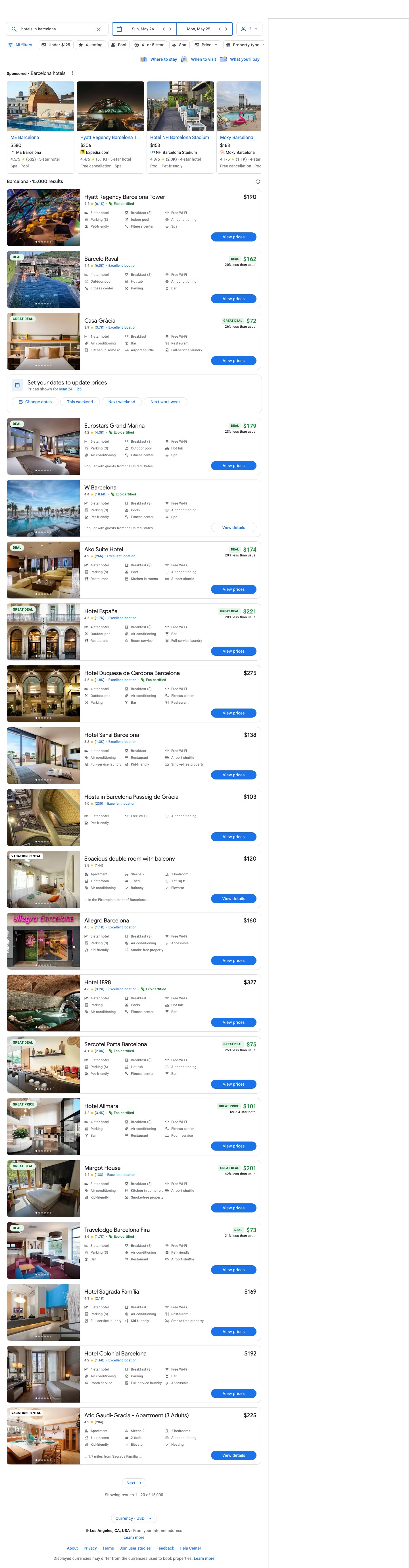
A Google Hotels search for a major city produces this layout: a sponsored row at the top (paid Hotel Ads slots), then organic results sorted by relevance and price. Each organic result shows the lowest price across all partners. The thing the screenshot above doesn't show is what happens when you click into one property. That's where the "booking module" lives, with both the "Ads"-badged paid links and the "All options" free-booking row beneath.
A property that looks good in this funnel has three things working at once.
A live price feed with an Excellent score and a bid model that lets Google do the work. The feed updates as often as prices change on the website 6. The current bid options are Target ROAS (full Smart Bidding), Enhanced CPC (Smart Bidding layered over manual control), Manual CPC, or CPC% 7. Google's bidding overview explicitly marks the two Manual options as "not recommended to use alone." They ship without conversion-aware optimization. Target ROAS is the right default for a hotel with proper purchase-conversion tracking; Enhanced CPC is the bridge model for operators with in-house bidding logic they want partial control over.
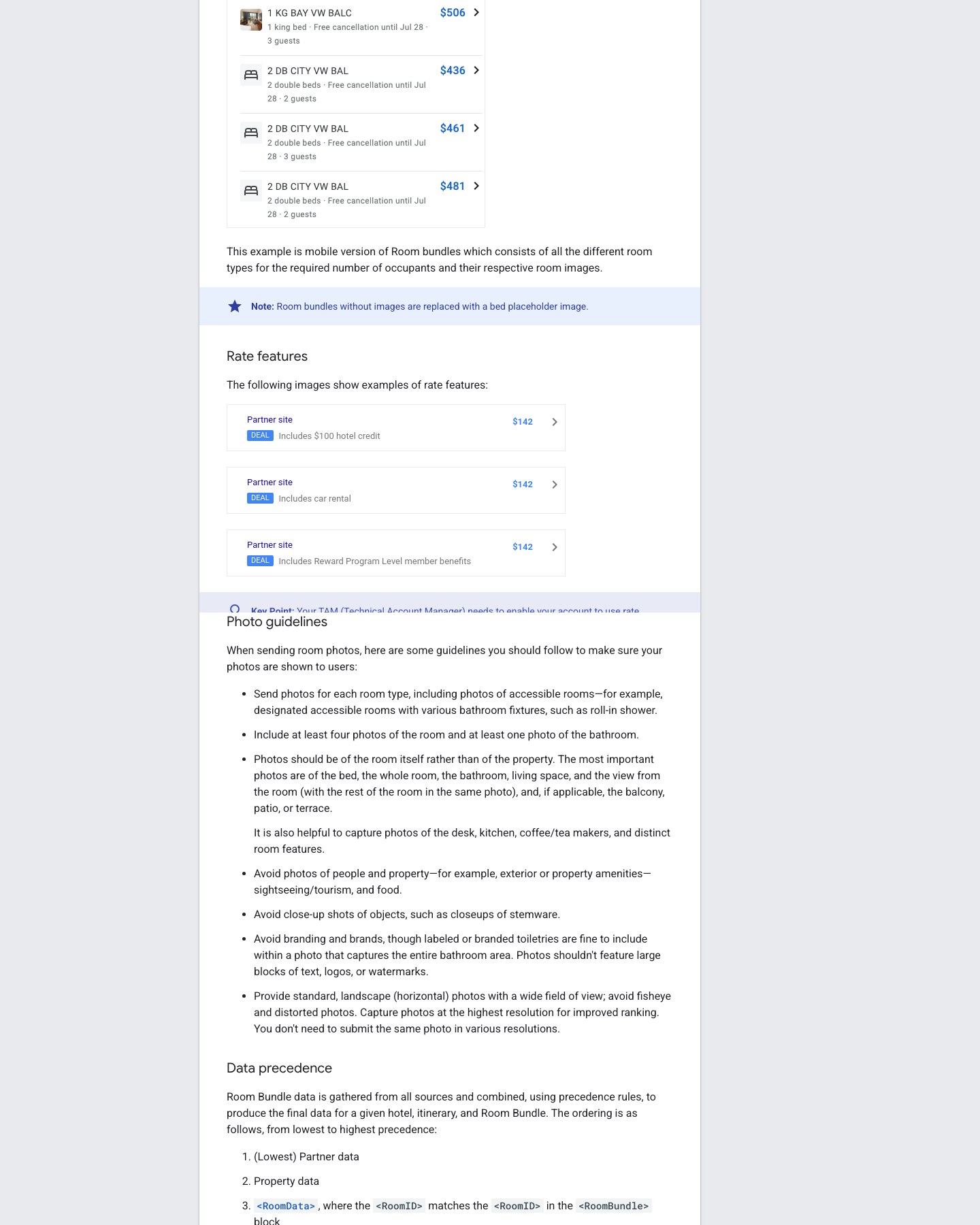
Room Bundles populated with real room photos. Room Bundles are the Prices-tab-only room surface that lets Google render multiple room types per property 8. Google's documentation is direct about the fallback: "Room bundles without images are replaced with a bed placeholder image" 8. The bed placeholder is a generic stock icon. Travelers read it as "this hotel has not finished setting itself up." Photo guidelines for each Room Bundle: at least four photos of the room and at least one photo of the bathroom, landscape format, no fisheye, no closeups of branded stemware, no exterior shots 8.
A direct landing page that holds up under Google's scrutiny. The Price Accuracy Policy spells out the rules: the total price on your booking page must match Google to the cent, including taxes and fees, for the selected itinerary; the selected room and rate must be visible without additional clicks; the page must load in a reasonable time; HTML and DOM changes that block Google's price retrieval lower your score 3. A property with a Smart Bidding-driven Hotel Ads campaign, an Excellent accuracy score, Room Bundles with real photos, and a landing page that survives Google's automated price checks is the one collecting the disproportionate share of the click traffic Google routes its way.
Common failure modes
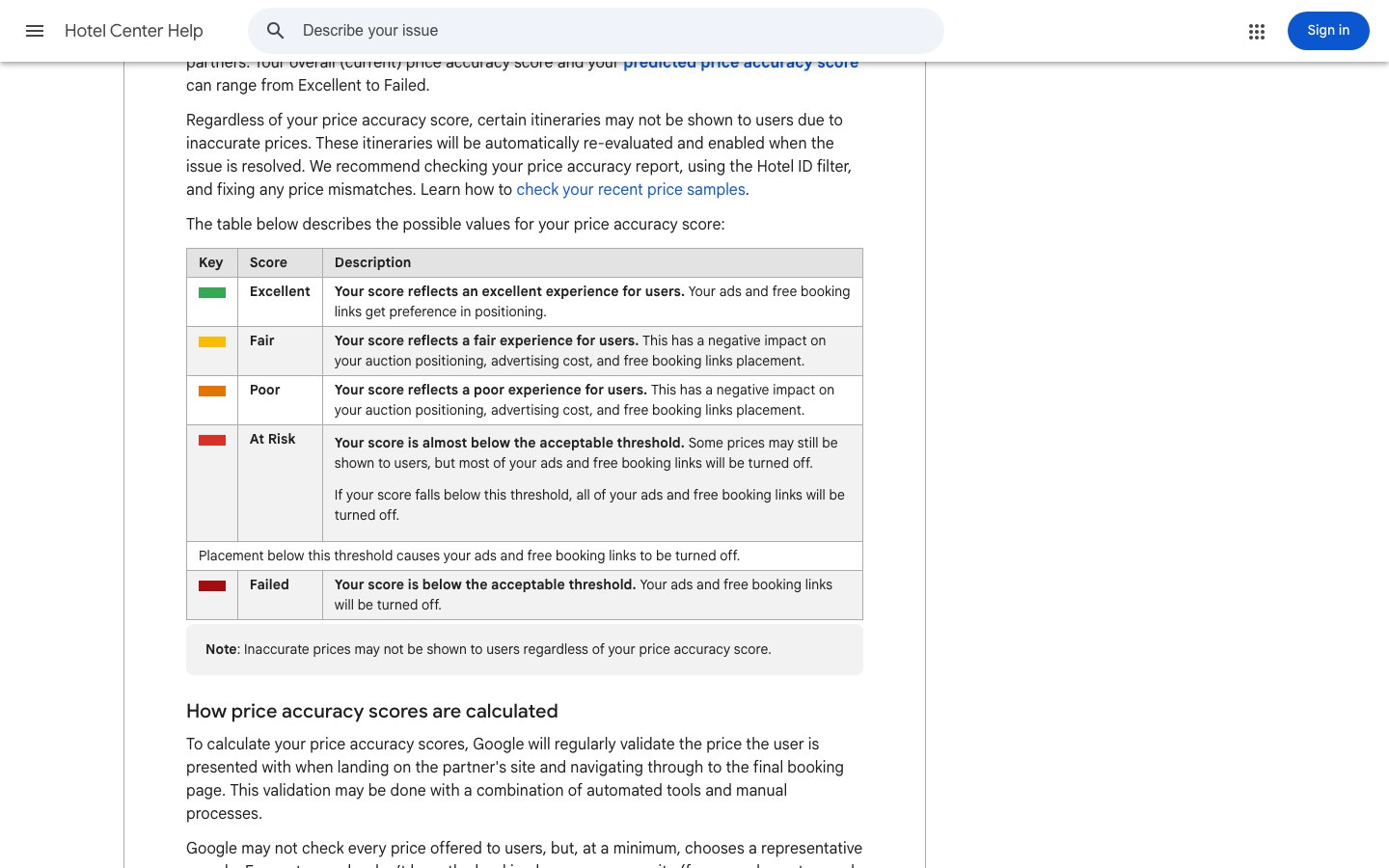
The tier table above is what an operator sees inside Hotel Center under Prices → Accuracy. The descriptive language is verbatim Google policy. "Most of your ads and free booking links will be turned off" (At Risk) and "all turned off" (Failed) are not auction-position penalties. They are operator-visible suspension states. Five recurring failure patterns drive properties into the lower tiers. A sixth is quieter: nothing is suspended, but the direct link is missing on some nights.
1. Letting the feed drift below Excellent and not noticing. The enforcement language is qualitative, not numeric. When a partner slips below Excellent, auction position takes a hit, ad cost rises, free-booking-link placement drops 3. There's no email alert. The dashboard surfaces it, but Hotel Center is the surface most hoteliers don't open weekly. Below "At Risk," suspensions start. Below "Failed," everything is off. Operators discover this after the fact, usually as a quarter-over-quarter direct-booking decline blamed on photos or rate before someone finally checks the score.
2. Channel-manager sync cadence slower than the website's actual price changes. Feed price must update "at least as often as your prices change on your website" 6. A channel manager that batches Google Hotel Center sync on a 30-60-minute cycle fails accuracy enforcement on properties where the PMS updates inventory faster. Google checks landing-page prices via crawl; any mismatch with the cached feed hits the score regardless of which side is stale.
3. Missing Room Bundle photos, so the bed placeholder shows. A property with a Hotel Center feed that includes rate plans but no photo per Room Bundle gets the generic bed-icon fallback on the Prices tab 8. It happens by default when an operator activates a feed via a connectivity partner that doesn't push per-room photos. The traveler sees a price, a channel name, and a stock bed icon where competitors are showing their actual rooms. The operator usually has no idea the placeholder is rendering at all.
4. CRS-collision: another connectivity partner has the bid for your itinerary. Buried in the bidding overview: "For a particular itinerary, only one Central Reservation System (CRS) is eligible to show their ads" 7. If your channel manager bids for the same dates an OTA's CRS bids on, only one of you serves. Selection rules favor active partners with stronger feeds. A hotel running one Hotel Ads campaign while three OTA partners bid through their own CRSes can find its bid silently filtered out. The fix is upstream: pick a primary CRS for Hotel Ads, configure the others not to bid, verify in Hotel Center which CRS is recorded.
5. Picking Manual CPC or CPC% as the only bid strategy. The bidding overview marks both "not recommended to use alone" 7. Manual CPC has no conversion awareness. CPC% bids a percentage of the room rate per click, which sounds elegant but doesn't optimize for the conversion value Smart Bidding sees. The migration path is Enhanced CPC at minimum, Target ROAS once conversion tracking is properly configured (purchase conversions with full booking amount).
6. Your direct link shows on some nights and not others. Google prices each search as an exact itinerary: one check-in date, one length of stay, no other combination counts 79. Hotel Center names the reasons a rate goes missing, per room type and rate plan: a minimum stay, a stay-pattern restriction, a stop sell, a missing nightly rate, an advance-purchase limit, or no vacancy 9. Those rules are set per room type and rate plan, not for the whole property 10. So a gap can be direct-only.
Check the OTAs first. If Booking.com and Expedia show a 1-night price for the night and your direct row doesn't, a property-wide rule is unlikely, because a hotel-wide minimum stay would strip the OTA prices too. Suspect the rate plans your connection sends to Google (your booking engine provider can tell you which plans and room types it sends), then read the pattern.
- Same weekday missing: a minimum stay or closed-to-arrival rule on the direct plan that your OTA plans don't carry, or no direct rate loaded for that weekday 9. Closed to arrival blocks check-in on those dates 10, and connectors can pass such rules through; innRoad's does 11. If it's deliberate, it costs you: 1-night searchers see only OTA prices on those nights.
- Far dates missing: the plan's end date, next season not loaded, or an advance-booking limit. Google takes rates 330 days out 12, so a hole at six weeks is yours. One missing nightly rate blocks the whole itinerary 9.
- Nearest dates missing: check availability first; if you were full, the OTA price may be stale. Otherwise look at which room type and rate plan the connection sends. If your connection sends only some room types, one room's availability gap can pull the link 1314. A plan that must be booked days ahead, sent as the only rate, does the same 913.
- No pattern: updates not reaching Google, or an accuracy score under Excellent. See failure modes 1 and 2.
Bid settings are off this list on purpose. Bid adjustments by check-in day or length of stay exist, and -100% zeroes the bid 15. An exhausted budget drops you from the paid auction 7. Google says bids have no impact on how free links rank 2, and no Google page says a zero bid removes the free link. Check rate plans before bids.
A pattern that used to be on this list but isn't anymore: "treating Book on Google as a channel you control." Book on Google for hotels was discontinued on May 25, 2022 16. Properties on the old hosted-checkout surface fall back to landing pages. What replaced it in 2025-2026 is not a re-launched checkout but Google AI Mode agentic-booking partnerships with Booking, Choice Hotels, Expedia, IHG, Marriott, Wyndham 17. Independents not connected to one of those reach AI Mode bookings only via whatever connectivity partner already routes their inventory to the larger OTAs.
Step-by-step fix
Before the workflow, set the expectation right. Setting up Hotel Center correctly is what gets you eligible for the 28-percent-cohort outcome (the FBL bookings that materialize); doing it badly is what guarantees you join the 72 percent that get nothing. Most of the operator-controllable variance lives in steps 4 through 7 below. The workflow we recommend for a property setting this up from scratch, or auditing an existing setup:
-
Confirm the property meets the Hotel Ads listing requirements. Rooms for paying guests, a physical location open to the public, fixed walls and plumbing, and a minimum-stay requirement of no greater than 7 days 18. Extended-stay properties requiring longer minimums are not eligible. Most boutiques and city hotels clear this trivially. Properties that fail usually misread the rule as a 30-night cap on stays; that's the rate-window cap, not the eligibility cap.
-
Verify the Google Business Profile is set up as a hotel category. If your
primaryTypereads aslodginggenerically or as something non-hotel (corporate_office, restaurant, point_of_interest), the downstream Hotel Center setup fails to link. Fix this first. Wrong-place-link issues are covered in detail ingoogle-hotels-as-a-venue. -
Set up Hotel Center and link it to Google Ads. Hotel Center holds the property catalog, the price feed, and the accuracy dashboard. Google Ads is where bidding happens. The two need to be linked. Most channel managers (SiteMinder, Cloudbeds, RezGain) integrate as the connectivity partner; when Google ended its direct Mews integration on July 1, 2024, Mews pointed customers to paid partners such as Cendyn, D-EDGE, or Triptease 19; smaller PMSes may require a third-party connectivity layer.
-
Verify the price feed lands as Excellent during activation. Google's policy: "Without a consistently Excellent score, your activation will be delayed (or prevented)" 3. New-partner activation is itself a gate. If onboarding feed checks show mismatches between submitted prices and landing-page prices, the account doesn't go live. Monitor the Accuracy tab weekly during the first month.
-
Populate Room Bundle metadata with photos that meet the spec. At least four photos of the room and at least one of the bathroom, per Room Bundle 8. Landscape orientation, wide field of view, no fisheye, no people, no exterior shots in the room set, no closeups of branded objects. The bed placeholder is the cost of skipping this.
-
Pick Target ROAS or Enhanced CPC as the bid strategy. Target ROAS requires conversion tracking with purchase conversions tagged "Purchase" and full booking amount 7. Enhanced CPC works if you want manual base-CPC control with Smart Bidding adjustments. Manual CPC and CPC% are not standalone strategies. If you're getting fewer than 15 direct conversions per month, start with Enhanced CPC; Smart Bidding underperforms at low conversion volume.
-
Build conversion tracking properly. Smart Bidding's effectiveness is bounded by what Google sees. Conversion type must be Purchase. Value must be the full booking amount. A booking engine that doesn't fire Google's hotel-campaign conversion tag flies the bid strategy blind. If your booking engine is provided by a PMS vendor and you don't control the tag firing, the request to your vendor is: install the Google Ads hotel-campaign conversion tag with Conversion Category = Purchase, Conversion Value = full booking amount in the booking currency, fired on the booking confirmation page.
-
Audit the landing page experience. The booking page must prominently display the selected room and rate, match Google's price exactly, follow the Taxes and Fees + Referral Experience policies 3. HTML or DOM changes that block Google's automated price retrieval lower your score even if travelers see the right number. If you redesign the booking page, contact Google two weeks ahead.
-
Set up Hotel Center alerts for accuracy degradation. Configure alerts to fire on any drop below Excellent. This is the operator infrastructure that catches the slow-drift failure mode. Without it, you find out you're at Fair when next month's free-link traffic is down 30 percent.
-
Audit which CRS holds your itineraries. Open Hotel Center → Hotels → Hotel diagnostics and identify the active CRS for each property. If two or more CRSes bid for the same hotel, only one serves 7. Pick a primary, configure the others not to compete for the same property's itineraries, re-verify after the next sync.
Soft recommendations
The hard fix above gets the funnel working. Optional layers that compound, once the basics are clean:
-
Treat the Accuracy tab as a weekly metric, not a quarterly one. A property that catches a slip from Excellent to Fair within a week recovers without losing free-booking-link placement. A property that catches the same slip after eight weeks has been bleeding direct traffic the whole time.
-
Run a quarterly Room Bundle photo audit. Property photos drift. Refurbishments add an accessible variant, a renovation changes the bathroom, a new RoomType gets added without photos. The bed placeholder shows up silently. A quarterly walk through Hotel Center catches the drift before traveler-visible damage compounds.
-
If you have multiple CMs in flight, watch which one's properties score better. The Accuracy score is computed against the feed Google receives. If one CM's properties consistently score worse than another's, the data is telling you which integration is sending cleaner data.
-
Don't outsource the Hotel Center login to a marketing agency without retaining it. Hotel Center contains the operator-visible Accuracy dashboard, Room Bundle photo state, and CRS diagnostics. Agencies log in, run campaigns, report on Google Ads results. The Hotel Center surface that matters for these failure modes is one tab over and rarely opened. Keep your own credentials.
-
Map the Hotel Ads spend against direct-booking attribution before judging ROI. Hotel Ads paid clicks may underperform "free" Google traffic on naive last-click attribution because the free booking links pick up the booking Hotel Ads warmed up. Look at the assisted-conversion path before pausing the paid campaign keeping the funnel healthy.
Self-audit checklist
Run this on your own property without our product:
- My Google Business Profile is verified, the primary category is a lodging type, and the listing is correctly linked to my Hotel Center property.
- My property meets the listing requirements: rooms for paying guests, fixed location, fixed walls and plumbing, minimum-stay requirement of 7 days or less.
- Hotel Center is connected to Google Ads.
- My price feed shows an "Excellent" Price Accuracy score in the Hotel Center Accuracy tab.
- My feed updates at least as often as my website's prices change.
- Every Room Bundle has at least four room photos and at least one bathroom photo. No bed placeholder is rendering anywhere in my Prices tab.
- My Hotel Ads bid strategy is Target ROAS or Enhanced CPC (not standalone Manual CPC or CPC%).
- Conversion tracking is set up with Purchase as the conversion category and the full booking amount as the conversion value.
- My booking landing page passes Google's Referral Experience and Taxes and Fees policies, and loads in a reasonable time.
- Only one CRS is bidding on my property for any given itinerary; I know which one.
- I have Hotel Center alerts configured to notify me if my Price Accuracy score drops below Excellent.
- A 1-night Google Hotels search for a weekday, a weekend night, and a date six weeks out shows my direct link on all three (open "All options"; it often sits below the fold). If not, I know which rate-plan rule, end date, or room type explains it.
- I have not relied on Book on Google copy in any of my onboarding materials (the feature was retired in 2022).
- My FBL revenue projection is built against the realistic 28-percent-cohort outcome (an 11.1 percent lift on current direct sales for properties that get any FBL bookings at all), not the implied "FBL is on, here is $X per month."
How OTALift surfaces this
OTALift's rate-parity report runs two direct-rate checks on every audited property, both on 1-night stays at default occupancy on the audited check-in dates. DirectConnectivityValidator passes if an official direct rate shows on at least one of those dates and fails if none does. On FAIL with a known property website, the recommendation card surfaces "Connect Booking Engine to Google" with an action to activate Free Booking Links via the channel manager. The same validator's slug chain feeds the Revenue dimension of The First Look, so a property whose direct rate is missing from the Prices tab surfaces in both reports.
DirectRateCoverageValidator ("Direct Rate on Every Night") is the check for failure mode 6. It counts eligible nights only: nights where Google showed a price from your own site or from a major OTA (Booking.com, Expedia, Agoda, Hotels.com, Priceline, Trip.com or Airbnb). A night with neither may be closed on every channel, so it isn't read as a gap. The check warns when your direct rate is missing on two or more eligible nights and shows on under 85 percent of them. The warning names the pattern of the gaps (the same weekdays, the far dates, the nearest dates, or no pattern) and the first things to check for it, matching the causes under failure mode 6. It carries no dollar figure and has no FAIL tier: some of those nights may be sold out, and our price check can't see why a night is missing or tell a paid Hotel Ads row from a free link. When the nights can't be compared, the check reports "not measured" instead of passing. That happens in four cases: no direct rate showed at all (the connectivity check already fails); Google returned one night's prices whatever dates we asked about; some prices were for a different night than the one asked about; or fewer than four nights were eligible.
The connectivity FAIL card projects a flat monthly leakage as if FBL activation deterministically returned that amount, tagged as a preliminary estimate unless customer-provided booking volume is on file. The Mirai 2021 cohort study at roughly 4,000 hotels says the outcome is not deterministic. The bimodal 72/28 distribution means the median property activating FBL gets zero incremental bookings; only the upper cohort sees the 11.1 percent lift on direct sales. For a property already running paid Hotel Ads, FBL adds 0.84 percent on top because paid cannibalizes the free row. Treat the validator's "you are losing $X" as the high end of a distribution that includes a meaningful zero outcome, not a point estimate.
The honest current state on the rest of the funnel: OTALift cannot today tell an operator whether their Hotel Center Price Accuracy score is Excellent, At Risk, or Failed; cannot detect whether Room Bundles have photos or are rendering with the bed placeholder; cannot identify CRS-collision; cannot read the current Hotel Ads bid strategy. The article describes what an operator should check in Hotel Center directly. The roadmap follow-on is the proposed GoogleHotelFeedValidator (tracked in product-recommendations.md), which would close those gaps once Hotel Center API access is wired up.
Block 4 figures showing the live bed-placeholder rendering inside a real Hotel Center account are deferred. They require an authenticated screenshot the headless capture environment cannot produce. Live-account captures will follow once we have operator consent to publish a real property's Hotel Center surface.
Related articles
- Google as a Hotel Listing Venue. The parent content-model article. This article extends the commercial mechanics beneath that content layer.
- Canonical Room Definitions. The room-mapping layer that Room Bundles consume; if your canonical room map is wrong, your Room Bundle photos are wrong too.
- Hotel OTAs Content Capability Matrix. Where Google's commercial surface sits versus Booking and Expedia.
- OTA Commercial Visibility Levers. Hotel Ads as one of four cross-platform levers, with eligibility, cost-model, and KPI comparison.
- Pillar: How OTA Ranking Algorithms Actually Work. Hotel Ads as part of Google's ranking model.
Sources and methodology
Authored by Anya Cortez · Reviewed by Tim Anastasiou · Last reviewed: 2026-10-07
Anya Cortez is OTALift's hospitality researcher and writes The Labs. Drafted with AI research tooling under the Anya Cortez and Tim Anastasiou personas; the named editorial entities are accountable for the work.
Footnotes
-
Google Hotel Center Help, "How travelers find hotel booking links." Verbatim load-bearing claims: "Paid booking links are labeled with an 'Ads' badge, and free booking links are listed under 'All options'" and "The price shown for a property is the lowest price provided across all partners for a given property." https://support.google.com/hotelprices/answer/9238462 ↩ ↩2
-
Google Hotel Center Help, "About hotel free booking links." Verbatim load-bearing claim: "If you're an existing Hotel Center partner and you're participating in Hotel Ads, you're automatically eligible to show free booking links. Any property with a bid in a hotel campaign, available rates, and a landing page will be eligible. There's no cost for clicks on free booking links. Bids have no impact on the ranking of free booking links." Plus the four ranking signals: consumer preference, value offered to the user, landing page experience, and historical price accuracy. The page also explicitly notes hotels without Hotel Center accounts can participate via a connectivity partner. This corrects the previous draft's incorrect claim that free booking links are gated on Hotel Ads. https://support.google.com/hotelprices/answer/10472393 ↩ ↩2 ↩3
-
Google Hotel Center Help, "Price Accuracy Policy." Verbatim 5-tier score table (Excellent / Fair / Poor / At Risk / Failed) with descriptive language for each. Verbatim new-partner activation rule: "For new partners: Google performs a price accuracy check before activating your account and listing your rates and availability. Without a consistently Excellent score, your activation will be delayed (or prevented)." This replaces the previous draft's unsourced "≥95% price accuracy" claim, which is not in the policy. https://support.google.com/hotelprices/answer/6064419 ↩ ↩2 ↩3 ↩4 ↩5 ↩6
-
Euronews Travel, "You can now track the prices of individual hotels with Google" (2026-04-20). Consumer-side per-property price tracking launch. https://www.euronews.com/travel/2026/04/20/you-can-now-track-the-prices-of-individual-hotels-with-google ↩
-
Mirai blog, "Google free booking links impact; time for the numbers" (Fran Diéguez, 06/05/2021). Cohort study at roughly 4,000 Mirai-integrated hotels, 8-week pre/post comparison around Google's March 9, 2021 FBL launch. Verbatim bimodal-distribution finding: "28% of hotels got at least one booking from FBL, averaging an increase of 11.1% in sales... Considering all of them, FBL averaged an increase of 4.32% in sales." For hotels already running paid Hotel Ads: "FBL added an average of 0.84% sales." Conversion-rate gap: "Paid campaigns conversion rate was 64% higher than free booking links." Funnel share: "The share of free booking links... averages 17% in clicks and 11% in sales." Channel-shift framing: "every new booking coming from FBL is one less booking coming from an OTA." The largest public published cohort study on FBL incremental sales at scale; corroborated by Mirai's 2024 metasearch funnel Part 3 (https://www.mirai.com/blog/the-metasearch-funnel-in-detail-the-free-booking-links-funnel-and-data-sources-part-3/) which documents that Google reports zero FBL conversion data, so no later study has supplanted it. https://www.mirai.com/blog/google-free-booking-links-impact-time-for-the-numbers/ ↩ ↩2 ↩3 ↩4 ↩5
-
Google Hotel Center Help, "Best practices for free booking links." Verbatim load-bearing claim: "Ensure that your feed price is updated at least as often as your prices change on your website." Plus the recommendation to "Monitor your price accuracy score by going to the 'Accuracy' tab under the 'Prices' section in your Hotel Center account." https://support.google.com/hotelprices/answer/10472993 ↩ ↩2
-
Google Ads Help, "Bidding overview for hotel ads." Current available bid strategies: Target ROAS, Enhanced CPC, Manual CPC (marked "Not recommended to use alone"), CPC% (also marked "Not recommended to use alone"). Verbatim auction-qualification rule: "For a particular itinerary, only one Central Reservation System (CRS) is eligible to show their ads." The same "Qualifying for auctions" section carries the exact-itinerary rule, "Rates from your Hotel Price Feed must match the end-user's exact itinerary ... No other rates for any other combinations of lengths of stays/check-in dates will be considered for the auction," and the budget rule, "If your hotel campaign has exceeded your budget, then your hotels won't be included in the auction." Plus the conversion-tracking requirement for Smart Bidding strategies. Commission-based strategies (Commissions per Stay, Commissions per Conversion) were sunset February 20, 2025 per https://support.google.com/google-ads/answer/14280291. The previously-cited URL https://support.google.com/google-ads/answer/6285330 is a 404. https://support.google.com/google-ads/answer/9244120 ↩ ↩2 ↩3 ↩4 ↩5 ↩6 ↩7
-
Google for Developers, "Room Bundles: Hotel Prices." Verbatim bed-placeholder rule: "Note: Room bundles without images are replaced with a bed placeholder image." Verbatim photo guidelines: "Include at least four photos of the room and at least one photo of the bathroom." Plus the landscape-orientation and no-fisheye guidance. https://developers.google.com/hotels/hotel-prices/dev-guide/room-bundles ↩ ↩2 ↩3 ↩4 ↩5
-
Google Hotel Center Help, "ARI Prices: Troubleshoot." For each room and package combination Google lists why a rate is unavailable, for rates shown in "paid and free booking links." Verbatim reasons include: "There was a minimum stay required to price the itinerary."; "There were min-LOS or max-LOS restrictions for at least one of the dates included in the itinerary."; "There was at least one date in the itinerary that was not available to sell." (stop sell); "The itinerary was missing a nightly rate for at least one of the nights."; "There is no availability for the given itinerary." (no vacancy); and the Min advanced purchase and Max advanced purchase rows for itineraries too soon or too far in the future. Accessed 2026-10-07. https://support.google.com/hotelprices/answer/16352898 ↩ ↩2 ↩3 ↩4 ↩5
-
Google for Developers, "ARI: Availability message reference (OTA_HotelAvailNotifRQ)." Restrictions are set against a rate plan: "RatePlanCode ... Must be specified if
<RestrictionStatus>or<LengthOfStay>is specified." Closed to arrival: "Arrival: This value prevents itineraries with a check-in date during the Start and End date range, inclusive." Minimum-stay types "SetMaxLOS, SetMinLOS, and FullPatternLOS are arrival based." Advance-purchase limits are set as minimum and maximum booking offsets before the arrival date. Accessed 2026-10-07. https://developers.google.com/hotels/hotel-prices/xml-reference/ari-avail ↩ ↩2 -
innRoad Support, "Google Booking Links." Rates sent to Google are "Nightly Rate Plans distributed to the innRoad Booking Engine, including season-level minimum stay, no check-in days, and no check-out days." By default the integration sends every rate and room class distributed to the selected booking engine. Connector-specific: one vendor's behavior, cited as evidence that booking-engine restrictions travel to Google, not as a rule for all connectors. Accessed 2026-10-07. https://support.innroad.com/support/solutions/articles/153000146042 ↩
-
Google for Developers, "Pricing overview." Verbatim: "The booking and LoS values default to the following: Up to 330 days advanced booking. Up to 30-night stays." Hotel Center's best-practices page (see 6) adds that Google supports prices for itineraries up to a year in advance. Accessed 2026-10-07. https://developers.google.com/hotels/hotel-prices/dev-guide/updating-prices ↩
-
Google Hotel Center Help, "Troubleshooting missing or incomplete pricing." Verbatim: "Prices are unavailable due to restrictions: Check whether any restrictions sent for the itinerary might make the product unavailable (MinLOS, MaxLOS, MinAP, MaxAP)." Also: "The count for a date/room-type combination needs to be greater than zero in order for a price to be considered available." Accessed 2026-10-07. https://support.google.com/hotelprices/answer/11190438 ↩ ↩2
-
Cloudbeds Help Center, "Google Hotel Search - Information about Restrictions" (article updated 2024-02-06; live page is bot-blocked, read from the Internet Archive snapshot, https://web.archive.org/web/20250217142746/https://myfrontdesk.cloudbeds.com/hc/en-us/articles/1260803181409-Google-Hotel-Search-Information-about-Restrictions). Verbatim, in the context of a Cloudbeds booking-engine setting that lets guests book specific accommodations: "Google may not show your property link if there is no continuous availability for a particular room." Connector-specific: one vendor's behavior, offered as conditional support only. Accessed 2026-10-07. https://myfrontdesk.cloudbeds.com/hc/en-us/articles/1260803181409-Google-Hotel-Search-Information-about-Restrictions ↩
-
Google Ads Help, "About bid adjustments for hotel ads." Adjustments exist for length of stay, check-in day of week, advance booking window, date type, device, location, audience, and check-in date. Verbatim: "advanced booking window, check-in day of week, check-in date, length of stay, and device bid adjustments have an additional setting of -100% (resulting in a bid of zero)." For Target ROAS: "all bid adjustments are ignored except a -100% device bid adjustment." Note: SERoundtable (2026-06-03) reported some of these adjustments missing from the Google Ads interface as a probable bug; its update says it was fixed by 2026-06-09. Accessed 2026-10-07. https://support.google.com/google-ads/answer/9244121 ↩
-
PhocusWire, "Book on Google for hotels to shut after low take-up" (2022-04). Book on Google for hotels was discontinued on May 25, 2022; properties on Book on Google (paid campaigns and free booking links) fell back to landing pages. The previously-cited Hotel Center Help URL for Book on Google (answer/9220145) is a 404 because the feature no longer exists. https://www.phocuswire.com/book-on-google-for-hotels-will-shut-down-in-may ↩
-
Skift, "Google Is Building Agentic Travel Booking, Plus Other Travel AI Updates" (2025-11). Google partners for AI Mode hotel booking: Booking.com, Choice Hotels, Expedia, IHG, Marriott, Wyndham. Independent hotels reach AI Mode booking flows via the OTA / connectivity partner that already routes their inventory. https://skift.com/2025/11/17/google-is-building-agentic-travel-booking-plus-other-travel-ai-updates/ ↩
-
Google for Developers, "Integration Overview: Hotel Prices." Verbatim listing requirements: rooms for paying guests, a physical presence and fixed location, fixed walls and plumbing, a minimum-stay requirement of no greater than 7 days. The 7-day rule is the property-eligibility cap (the maximum minimum-stay a hotel can require and still list); a separate 30-day cap applies to the itineraries you can submit rates for (Best Practices page). The previous draft's "30-night max stay horizon, 1-year forward horizon" conflated the two; both are corrected in this article. https://developers.google.com/hotels/hotel-prices/dev-guide/data-feeds ↩
-
Mews Community, "Important update: Google Hotel Search integration ending" (2024-05-24). Verbatim: "As of July 1st, 2024, Google will stop supporting its integration with Mews. This means that the current Google Hotel Search connection on Mews Marketplace will no longer work." Mews lists Cendyn, D-EDGE, and Triptease as paid routes to Google Free Booking Links. Accessed 2026-10-07. https://community.mews.com/mews-updates-38/important-update-google-hotel-search-integration-ending-1099 ↩