OTA Commercial Visibility Levers: Genius, VIP Access, One Key, Hotel Ads
Sources: Booking Partner Hub (Genius program page, verified 2026-05-11), plus the three OTALift Labs deep-dives that this article synthesizes: Booking Property Page Score mechanics, Expedia VIP Access & One Key mechanics, and Google Hotel Ads & Free Booking Links mechanics. Each sibling carries primary captures of every load-bearing OTA partner page.
Key takeaways
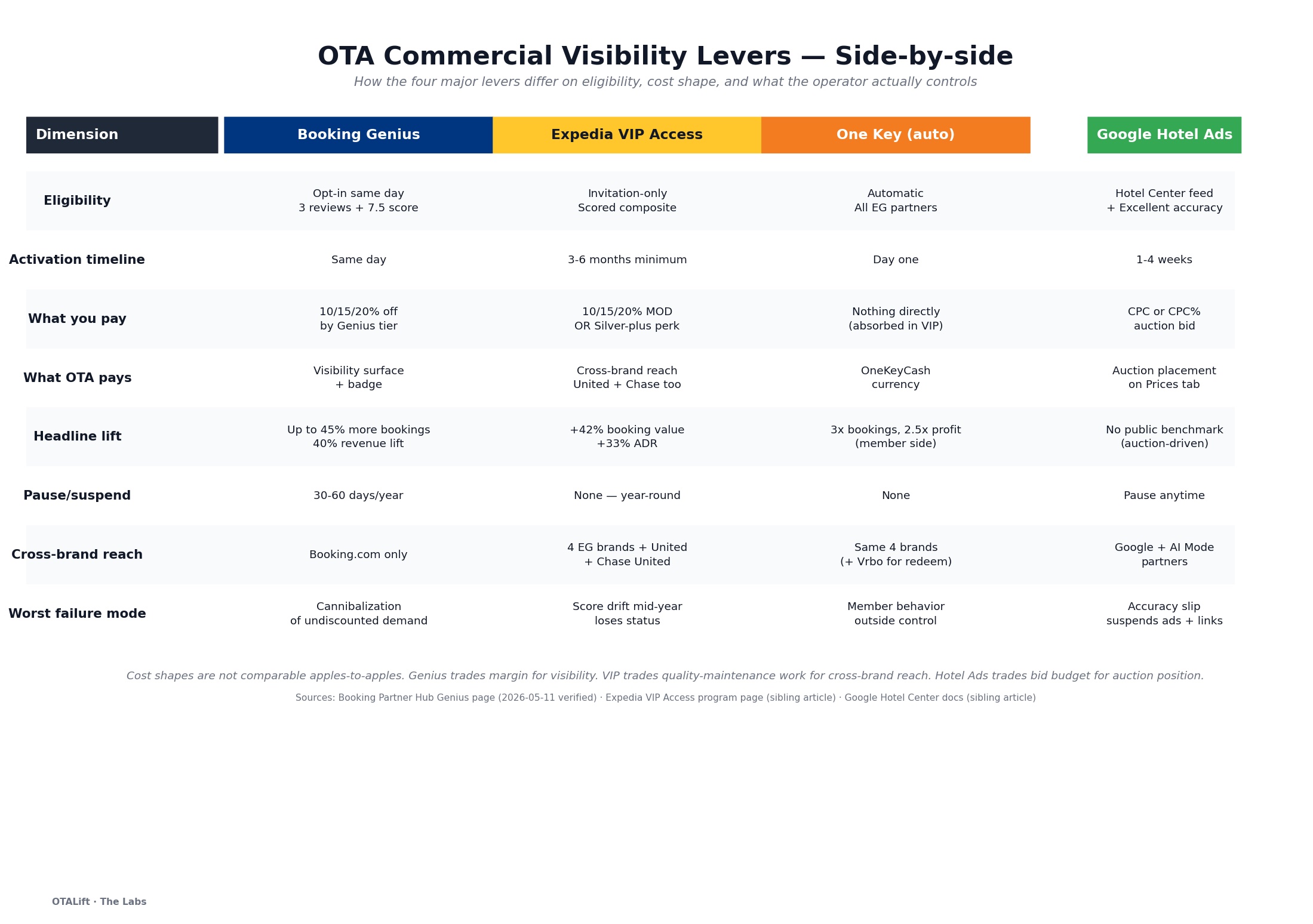
Beyond content completeness, each major OTA exposes a commercial-visibility lever. The four that matter are Booking Genius, Expedia VIP Access, Expedia One Key, and Google Hotel Ads. They are not substitutes. Genius is opt-in discount for badge plus visibility. VIP Access is scored invitation for cross-brand reach. One Key is the automatic loyalty currency that compounds with VIP Access. Hotel Ads is pay-to-play auction. Same property, four parallel commercial systems, four different cost shapes.
What the research shows on cost per incremental booking. Genius commits to 10%, 15%, or 20% discounts across tiers, and Booking publishes the lift at "up to 45% more bookings" plus a 40% revenue lift on average for Genius partners.1 VIP Access publishes +42% booking value and +33% ADR at admitted properties, with a MOD floor at 10/15/20% by member tier or an exclusive Silver-plus perk as the alternative.2 Hotel Ads costs CPC bid; conversion-tracking discipline decides whether it pays back. One Key costs nothing directly because Expedia funds OneKeyCash; the operator's cost lives in the VIP path.3
The practitioner bridge is which lever for which property. The matrix below lays the four side-by-side. The decision tree under "Common failure modes" maps property type to lever priority.
Why it moves bookings
Each lever reaches a different traffic segment. Genius routes Booking's logged-in loyalty members; Booking's own data says Genius partners see "30% more search views from these travelers."1 VIP Access reaches Expedia Group's cross-brand loyalty members concentrated in the top sort positions where 62% of clicks land.2 Hotel Ads reaches Google meta-search traffic where the Prices tab is the conversion surface.4 One Key compounds on top of VIP Access by giving members "up to 3× more Expedia Group funded OneKeyCash" at VIP properties.3 Same hotel, four different traveler funnels.
Eligibility shapes the activation timeline. Genius is opt-in the same day if the property has 3 reviews and a 7.5 score.1 Hotel Ads activation takes 1-4 weeks of Hotel Center setup plus a price-feed accuracy check before ads serve.4 VIP Access is invitation-only, scored on Expedia's offer strength composite (room availability, rate competitiveness, content completeness, photo quality) and the guest experience composite (preventable relocations, property condition, preventable cancellations, cleanliness, check-in, refunds, amenities, staff and service).2 Reaching VIP territory from a sub-4.5 score is a 3-6 month earn at minimum. One Key is automatic on Expedia.3 Genius is the only same-day lever.
Cost models do not compare apples-to-apples. Genius trades discount margin for visibility. Hotel Ads trades bid budget for auction position. VIP Access trades quality-maintenance work for cross-brand reach and a loyalty-multiplier badge. One Key costs the operator nothing directly because Expedia funds the OneKeyCash currency; the cost lives in the MOD or perk you commit to as part of VIP eligibility.3 Pick the lever whose cost shape you can sustain.
Interaction effects matter. Genius opt-in coexists with Hotel Ads bidding because they live on different platforms. Within Booking, Genius stacks with other promotions under specific rules: one discount per category, three discounts maximum, applied sequentially to the base rate.1 Within Expedia, One Key runs automatically alongside VIP Access at admitted properties. The platforms do not coordinate; the property's portfolio coordinates them.
None of them replace content work. The commercial lever amplifies visibility. Content completeness determines what happens when the traffic arrives. Amplifying a 78% Booking Property Page Score with a Genius opt-in routes more travelers to a property where filtered-search visibility is already silently dropping bookings.5 Fix content first; activate commercial levers second.
What "great" looks like
Four parallel commercial systems with four different cost shapes. The matrix below is the operator-readable reference.
Three operator patterns recur across the published case data.
Pattern 1: the Booking-anchored urban transient. A 60-room city hotel with mixed business and leisure demand, $200 ADR, 75% trailing occupancy, 8.2 Booking review score. Genius 1 opt-in is same-day. The 10% discount on the least expensive and most popular room type funnels marginal demand in; 30% of bookings spill over to non-Genius room types where the operator captures full margin.1 Hotel Ads runs in parallel on Google with Enhanced CPC. VIP Access sits on the roadmap; the score work takes 1-2 quarters from a 7.5 baseline.
Pattern 2: the Expedia-anchored leisure resort. A 120-room beach property with 4.6 guest experience score, $380 ADR, leisure-dominant demand. The primary lever is VIP Access because the score work is close to invitation and the +42% booking value lift compounds against the high-ADR base.2 The Cheval Maison case documents the magnitude: 2.1× gross booking, 2.6× bookings, 2.9× room nights vs pre-VIP baseline.2 Genius is layered with peak-date pausing using the 30-day suspension allowance. Hotel Ads runs on Target ROAS because direct-booking conversion tracking is properly configured.
Pattern 3: the Google-anchored mid-scale chain branch. A 110-room mid-scale chain property with $160 ADR, monthly Hotel Ads spend, Excellent accuracy score, conversion tracking firing the full booking amount as Purchase. Genius 1 is the volume play; the chain brand-loyalty layer already exists, so VIP Access is optional. The operator monitors the Hotel Center Accuracy tab weekly and watches free-booking-link click share as the leading indicator.4
Each lever is chosen for what it does, not for what is easiest. The property's ADR band, occupancy pressure, review-score state, and cross-OTA mix decide which lever pays back first.
Common failure modes
The single most common error is treating lever priority as universal. It isn't. The decision tree below is the operator-readable starting point, anchored on the trailing-year review score and the ADR band.
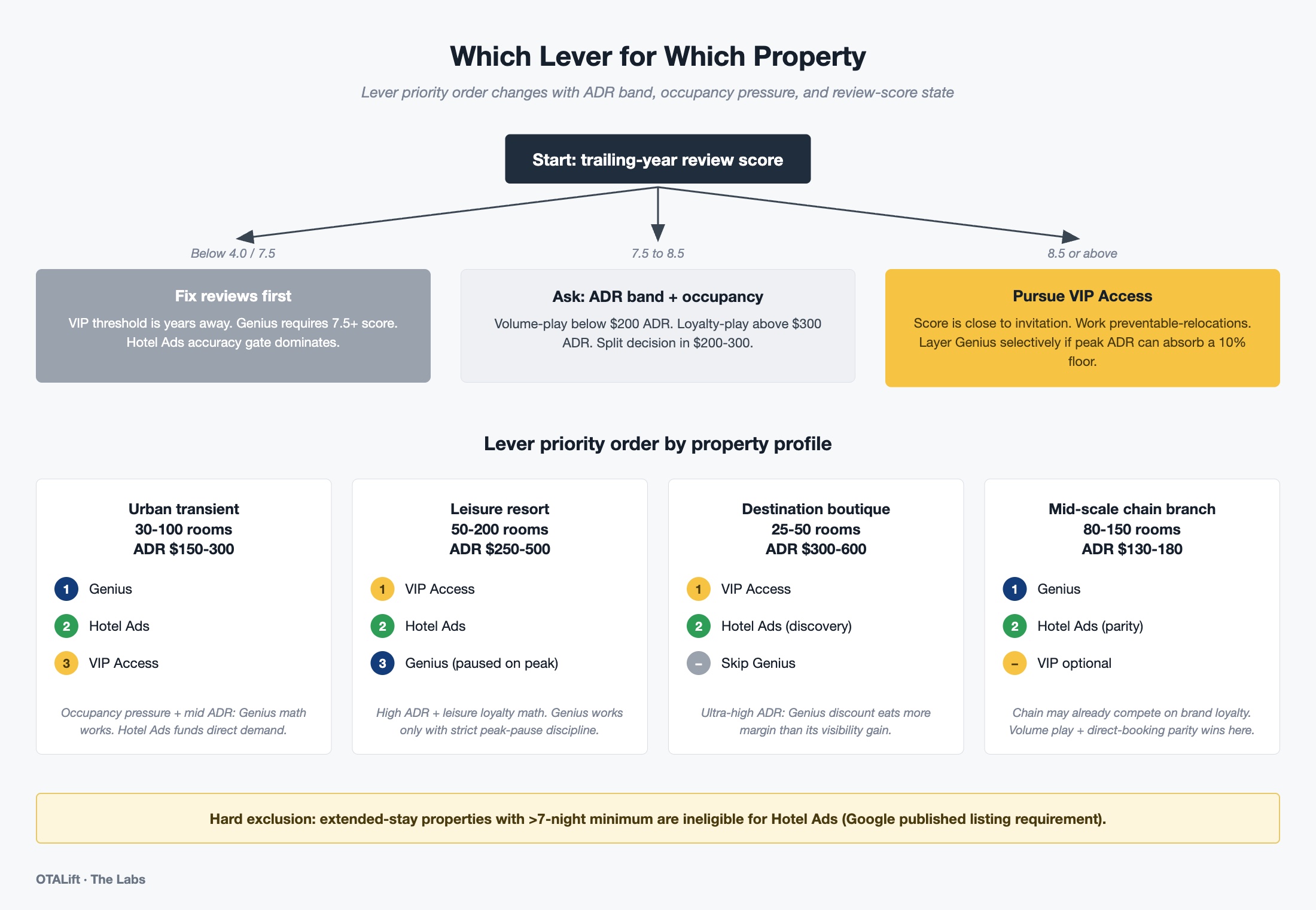
Five recurring failure modes drive the wrong lever choice or undermine a right one.
1. Treating levers as mutually exclusive. They run on different platforms. Running Genius on Booking does not prevent VIP Access on Expedia or Hotel Ads on Google. The properties shipping the strongest commercial results run three or four in parallel and isolate per-lever ROI for attribution.
2. Assuming VIP Access is applied for. It is not. Submitting "VIP interest" forms does not accelerate invitation. Improving the scoring inputs does.2 Expedia's own FAQ language: "To qualify for VIP Access, a partner needs to have excellent guest experience and offer strength scores, and also meet certain operational requirements."2 The two composite scores that drive invitation are the same two that drive default ranking. Working the inputs improves both simultaneously; chasing the badge alone does not work.
3. Using Hotel Ads as the always-on default with the wrong bid strategy. Hotel Ads is the most flexible lever because the operator controls the bid, and the most directly margin-draining if conversion tracking is wrong. Current bid strategies are Target ROAS, Enhanced CPC, Manual CPC, and CPC%; Google marks the two Manual options as "not recommended to use alone."4 Commission-based bid strategies sunset February 20, 2025.4 Operators who set up Hotel Ads years ago and have not revisited the bid strategy are running deprecated configurations.
4. Over-discounting for Genius without modeling cannibalization, or missing the progressive tiers. Genius-member bookings displace some non-Genius bookings that would have happened anyway. The published "+30% search views from Genius travelers"1 does not mean +30% incremental bookings; it means the visibility surface widens, and a fraction of that widening converts incrementally. The 30% spillover to non-Genius room types partially offsets the discount cost.1 Staying at Genius 1 when the market pushes deeper means ceding high-value-member share to Genius 2 and 3 competitors; Genius 3 travelers are 10% less likely to cancel, which is part of the tier-2-vs-tier-3 economics most operators do not model.1
5. Ignoring cross-brand math on One Key and skipping content work upstream of any lever. OneKeyCash earned at your Expedia listing is redeemable at Hotels.com, Orbitz, and ebookers. The multiplier economics are not contained to one platform; feed bugs render on all four. Spot-check after major edits.2 And upstream of everything, amplifying visibility to a half-complete listing multiplies the content-completeness penalty: the Booking Property Page Score gates filtered-search visibility regardless of Genius enrollment, the Expedia offer-strength composite is the same score that drives VIP eligibility, and the Hotel Ads accuracy gate suspends ads outright at "At Risk" and "Failed" tiers.452 Fix content first; activate levers second.
Step-by-step fix
-
Audit content completeness on each platform first. If your Booking Property Page Score is under 90%, your Expedia amenity completeness is under the 90% practitioner threshold, or your Google Hotel Center accuracy is below Excellent, pause commercial-lever work until content is remediated.524
-
Pull your trailing-year review score and ADR band before picking lever priority. Below 4.0 average across platforms or below 7.5 on Booking, fix reviews first. Between 7.5 and 8.5 with ADR below $200, volume play with Genius is the right starting bet. Above 8.5 with ADR above $300, the loyalty-multiplier math on VIP Access dominates.
-
Enroll in Genius as your first lever if eligible. Opt-in in the Extranet, accept the 10% Genius 1 floor on the least expensive and most popular room type, configure pause-day usage for your peak dates (30 dates/year at Genius 1, 60 dates/year at Genius 3 for 15% and 20% suspension).1 Use the Genius Report in the Extranet to track views, bookings, and revenue from Genius travelers.
-
Set up Hotel Ads with a Smart Bidding strategy. Target ROAS is the right default if conversion tracking is properly configured (Purchase conversion category with the full booking amount as the value). Enhanced CPC is the bridge model for partial manual control. Avoid Manual CPC and CPC% as standalone strategies per Google's published guidance.4 Migrate any legacy commission-based bid strategy since commission strategies sunset February 20, 2025.4
-
Work the Expedia offer-strength + guest-experience composite for VIP Access patiently. Start with preventable relocations (the #1 guest-experience factor), then property condition, then preventable cancellations.2 Reaching the practitioner-observed 4.5+ score floor is the prerequisite. From there, the invitation arrives when the offer-strength factors (room availability, rate competitiveness, content completeness, photo quality) are also clean. Expect 3-6 months minimum from a 7.5 baseline.
-
Decide the VIP Access path early: MOD or perk. MOD path commits to 10/15/20% discounts on all rates and rooms, no end date, always-on.2 Perk path commits to free breakfast, waived parking, or on-property credit (one of three) plus complimentary Wi-Fi and special recognition at check-in for Silver-tier-and-above members.2 Half-doing both wastes the discount or perk on travelers who do not see it.
-
Configure One Key automatically; do not conflate it with VIP Access. One Key applies automatically to every Expedia Group partner. OneKeyCash earn rates and the "up to 3× at VIP" multiplier are Expedia-funded; the operator absorbs the MOD or perk cost, not the currency cost.3 One Key alone is participation; VIP Access is the loyalty-multiplier lever on top.
-
Monitor per-lever ROI separately and quarterly. Genius incremental share (Extranet Genius Report), Hotel Ads CPA vs booking value (Google Ads conversion reporting), VIP Access One Key member concentration (Partner Central performance dashboard), free-booking-link click share as a Google leading indicator. Each lever has its own KPI; a unified dashboard obscures per-lever attribution.
-
Do not pull multiple levers in a single quarter. Isolating commercial changes is the only honest way to measure their individual effect. Stagger changes; isolate variables.
Soft recommendations
These are the experiments worth running once the hard fixes are in.
Run the cost-stack math against your own numbers before committing. Genius at 10% on a $200 ADR is $20 per Genius booking. VIP Access MOD at 15% Silver on a $400 ADR is $60 per Silver booking. Hotel Ads CPA equals your CPC bid divided by your conversion rate. Practitioners often see hotel-search conversion rates from sub-1% on cold acquisition up to mid-single-digits on retargeting; calibrate against your own funnel before sizing the spend. A shortcut on Genius: compute cost as discount-depth × Genius-traveler share × (1 minus the cannibalization rate you assume); compare to your blended OTA commission. If Genius cost-per-incremental-booking comes out below your effective Booking commission, the lever pays back.
Treat the Genius pause-day allowance as a peak-protection tool. Genius 1 has 30 dates/year of full suspension; Genius 2 has 30 dates/year on the 15% discount; Genius 3 has 60 dates/year on the 15% and 20% discount tiers.1 Properties that burn through pause days on shoulder weeks have nothing left for peak. Plan the calendar quarterly with your demand calendar in hand.
The OneKeyCash funding model is underrated. Expedia funds OneKeyCash explicitly: "Unlike other travel rewards programs, we cover that cost so it doesn't impact your revenue strategy."3 Operators who model One Key as a hidden tax on Expedia bookings miss that the currency itself is on Expedia; the operator's cost is the MOD depth or perk. The "up to 3× at VIP" multiplier costs nothing additional beyond admission economics.3
Watch the United Airlines and Chase United reach as a separate addressable market. Most partner-facing Expedia coverage skips this. The VIP Access FAQ states: "VIP Access is also available to United Airlines loyalty members and Chase United card members."2 If your market is United-heavy (Denver, Houston, Chicago, San Francisco, Newark), the incremental reach is worth modeling on its own beyond the four EG brands.
The decision to skip a lever is part of the framework. Ultra-luxury properties with no occupancy pressure should consider skipping Genius because the discount destroys ADR economics that drive their pricing power. Extended-stay or serviced-apartment properties with >7-night minimums cannot list on Hotel Ads at all per Google's published listing requirement.4 Properties with chronically sub-4.0 review scores are not VIP candidates for years. The honest "no" is part of operating the framework correctly.
Self-audit checklist
Run this on your own property without our product:
- My Booking listing is enrolled in Genius at the tier I can sustainably offer (1, 2, or 3), or I have an explicit decision not to enroll because of my ADR economics.
- I know my Genius pause-day budget for this calendar year (30 days at Genius 1, 30 days at Genius 2 for 15% suspension, 60 days at Genius 3 for 15% and 20% suspension) and I have planned my peak-date pausing schedule.
- I have active Hotel Ads bidding on Google using Target ROAS or Enhanced CPC (not standalone Manual CPC or CPC%, both of which Google marks "not recommended to use alone").
- My conversion tracking is configured with Purchase as the conversion category and the full booking amount as the value.
- My Google Hotel Center Price Accuracy score is Excellent (anything below already costs me auction position).
- My Expedia listing is either VIP Access or has a documented plan to reach admission: trailing-year guest experience score 4.5+, preventable-relocations and preventable-cancellations under control, content completeness 90%+, and a chosen MOD-or-perk path.
- My One Key perk configuration is active (Silver-plus perk at minimum, Gold/Platinum extras where capacity permits).
- I monitor per-lever ROI quarterly: Genius incremental share via the Extranet Genius Report, Hotel Ads CPA via Google Ads conversion reporting, VIP Access One Key member mix via Partner Central performance dashboard, free-booking-link click share as a leading indicator.
- I have read the three sibling Labs deep-dives (Booking Property Page Score mechanics, Expedia VIP Access & One Key mechanics, Google Hotel Ads & Free Booking Links mechanics) before making per-lever commitments.
- I run content-completeness checks first before activating new commercial levers.
- I isolate lever changes per quarter so I can attribute impact honestly.
- I know the cross-brand propagation of VIP Access and One Key across Expedia, Hotels.com, Orbitz, ebookers, United MileagePlus, and Chase United cardholders.
- I have an explicit decision on which lever to skip and why, not a "we'll do all of them" default.
How OTALift surfaces this
OTALift's listing-audit report today does not include a CommercialLeverReadinessValidator or LeverROIValidator as named code. Current proxies for cross-platform commercial-lever readiness:
ContentFacilitiesValidatorscoring amenity completeness on each connected listing, which feeds Booking's Property Page Score and Expedia's offer-strength composite.PhotoPresenceValidatorandPhotoQualityValidatorenforcing per-platform photo coverage rules across Booking's photo cluster, Expedia's offer-strength photo factor, and Google's Room Bundle photo requirement.PlatformGapValidatorflagging cross-OTA divergence (photo-count, amenity-list, room-type mismatches) as feed-sync integrity signals.
Proposed but not yet shipped: a CommercialLeverReadinessValidator composing per-platform readiness signals (Genius enrollment status, Hotel Ads Accuracy tier and bid strategy, VIP Access readiness composite); a LeverROIValidator ingesting booking-attribution data to flag under-performing levers; a GeniusTierEligibilityValidator reading the Extranet Genius Report and surfacing tier-upgrade opportunities.
The honest reading: OTALift's listing-audit today tells you whether your content layer is ready for commercial-lever activation, not whether the levers themselves are paying back. The lever-ROI layer is roadmap. The Phase 7 RIR for this article captures these as new-validator rows.
Related articles
- Booking.com Property Page Score Mechanics. The Booking-side deep-dive this synthesis draws from. Genius sits on top of a complete Property Page Score.
- Expedia VIP Access & One Key Mechanics. The Expedia-side deep-dive this synthesis draws from. The MOD floor, perk taxonomy, and cross-brand fan-out math live there.
- Google Hotel Ads & Free Booking Links Mechanics. The Google-side deep-dive this synthesis draws from. The Price Accuracy 5-tier gate, Room Bundles, and bid strategies live there.
- Hotel OTAs Content Capability Matrix. The cross-OTA content-layer matrix that pairs with this commercial-tier matrix.
- Pillar: How OTA Ranking Algorithms Actually Work. Commercial levers as ranking multipliers across the three platforms.
Sources and methodology
Authored by Anya Cortez · Reviewed by Tim Anastasiou · Last reviewed: 2026-05-11
Anya Cortez is OTALift's hospitality researcher and writes The Labs. Drafted with AI research tooling under the Anya Cortez and Tim Anastasiou personas; the named editorial entities are accountable for the work.
Footnotes
-
Booking.com Partner Hub, "Genius: A marketing program to highlight your property to loyal Booking.com travelers." Source for: 3-tier structure (Genius 1 / 2 / 3 with 10/15/20% discount commitments); eligibility floor (3 reviews + 7.5 score minimum); performance claims (+30% search views from Genius travelers, up to 45% more bookings, 40% revenue lift, 30% spillover to non-Genius room types); member-side stats (Genius travelers spend 15% more, book 2× further in advance, leave 29% more reviews; Genius 3 travelers 10% less likely to cancel); pause-day mechanic (30 days/year at Genius 1, 30 days at Genius 2 for 15% suspension, 60 days at Genius 3 for 15% and 20% suspension); discount stacking rules (one discount per category, three discounts maximum, applied sequentially to the base rate); Genius Report visibility in the Extranet. https://partner.booking.com/en-us/solutions/genius_program ↩ ↩2 ↩3 ↩4 ↩5 ↩6 ↩7 ↩8 ↩9 ↩10
-
Cross-anchored to sibling article
expedia-vip-access-one-key-mechanics. Source for: VIP Access invitation-only scoring on offer strength + guest experience composites with published factor order; +42% average booking value and +33% ADR vs non-VIP (Expedia internal data); 62% top-10 click share (Expedia internal data June-December 2023); MOD floor (10/15/20% by Blue/Silver/Gold-Platinum tier, all rates and rooms, no end date); Silver-plus perk requirements (free breakfast / waived parking / on-property credit + complimentary Wi-Fi + special recognition at check-in); Gold/Platinum extras (room upgrades, early check-in, late checkout) "when available"; 4-brand fan-out (Expedia, Hotels.com, Orbitz, ebookers) plus United Airlines loyalty + Chase United card members; Cheval Maison - The Palm case (2.1× gross booking, 2.6× bookings, 2.9× room nights post-VIP); Marker Key West Harbor Resort (+20 points guest experience score, +11% revenue YoY 2023 H1). Primary Expedia source: https://partner.expediagroup.com/en-us/industries/hotels/vip-access-program ↩ ↩2 ↩3 ↩4 ↩5 ↩6 ↩7 ↩8 ↩9 ↩10 ↩11 ↩12 ↩13 ↩14 -
Cross-anchored to sibling article
expedia-vip-access-one-key-mechanics. Source for: One Key automatic participation for all Expedia Group hotel partners; OneKeyCash funding statement verbatim ("Expedia Group funds the cost of OneKeyCash™... we cover that cost so it doesn't impact your revenue strategy"); "up to 3× more Expedia Group funded OneKeyCash" multiplier at VIP Access properties for higher-tier members (verbatim from Expedia's One Key hotel strategy blog); One Key member value stats vs non-members (3× gross bookings per customer, 2.5× gross profit per customer, 3× repeat business). Primary Expedia sources: https://partner.expediagroup.com/en-us/solutions/distribute-your-inventory/one-key-travel-rewards and https://partner.expediagroup.com/en-us/resources/blog/one-key-hotel-strategy ↩ ↩2 ↩3 ↩4 ↩5 ↩6 ↩7 -
Cross-anchored to sibling article
google-hotel-ads-free-booking-links-mechanics. Source for: current Hotel Ads bid strategies (Target ROAS, Enhanced CPC, Manual CPC marked "not recommended to use alone", CPC% same); commission-based strategies sunset February 20, 2025; Price Accuracy Policy 5-tier qualitative score (Excellent / Fair / Poor / At Risk / Failed) with verbatim operator-visible consequences; free-booking-link auto-coupling at Hotel Center partners; 4-signal free-link ranking (consumer preference, value offered, landing page experience, historical price accuracy); listing requirements (rooms, fixed location, walls, plumbing, ≤7-day min-stay); Room Bundles photo requirements and bed-placeholder fallback; "Ads" badge vs "All options" placement on Prices tab; conversion-tracking requirement (Purchase category, full booking amount value) for Smart Bidding. Primary Google sources: https://support.google.com/google-ads/answer/9244120 (bidding overview), https://support.google.com/hotelprices/answer/6064419 (Price Accuracy Policy), https://support.google.com/hotelprices/answer/10472393 (free booking links). ↩ ↩2 ↩3 ↩4 ↩5 ↩6 ↩7 ↩8 ↩9 ↩10 -
Cross-anchored to sibling article
booking-property-page-score-mechanics. Source for: Property Page Score as 1 of 5 Booking-published ranking factors as of April 2026 (Conversion, ADR, Cancellations, Property Page Score, Guest Review Score); the "up to 18% more bookings" claim and its asymmetric-cohort framing (100% vs incomplete content); 12 named metric_ids composing the score (5 photos, 3 room details, 2 area info, 2 operational details); content-completeness gate for filtered-search visibility; per-metric weight opacity; Property Scores API witharea_average_scorecohort comparison. Primary Booking sources: https://partner.booking.com/en-gb/help/growing-your-business/analytics-reports/search-results-ranking-and-visibility and https://partner.booking.com/en-gb/help/commercial-insights/keys-success/using-property-page-score-attract-more-guests ↩ ↩2 ↩3