Room Sub-Shots: Beyond the Bed and Bath
Sources: Booking.com Partner Hub photo standards (verified via Playwright by sibling article 2026-04-18), Airbnb Resource Center photography tips, Vrbo Partner Hub photo guidelines, Booking 2019 Photography Guide PDF, four named hospitality and interior photographers (Antonio Cuellar, Austin Baker, Furoore, Dixie Dixon), Choi 2024 misleading-hotel-photo academic research, Xi 2025 mental-simulation framing, and one verified Booking.com listing (BYPILLOW Flamant, Barcelona).
Key takeaways
A hotel room is not a bed and a bath. It is a workspace, a view, a balcony, a kitchenette. A living area for families upgrading to a suite. The galleries that out-convert have those sub-shots. The ones that flatten down to bed and bath read as generic.
In our field walks across Booking.com room galleries this April we kept seeing the same pattern: the room description claims a workspace, a balcony, a partial sea view, and the gallery still stops at bed and bath. The amenity exists. The photo does not. We have not pushed PhotoPresenceValidator across a 1,000-listing sample, so we will not put a percentage on it. The pattern is consistent enough across markets to act on.
The fix runs in two passes. Walk every room type's amenity list against its photo gallery and flag the missing sub-shots. Then shoot the missing shots to spec: five named sub-shots, one set of staging rules each, one shared lens discipline. Booking 2019's "20+ photos earn 83 percent more views" finding 1 is downstream of this work. Most of the marginal photos that take a gallery from 12 to 24 are sub-shots.
Why it moves bookings
Sub-shots move bookings because travelers self-select on sub-amenities, not on bedrooms. A business traveler filtering Booking for "desk in room" is shopping a different gallery than a couple filtering for "balcony." Both arrive at your listing. Both look at the bedroom for two seconds and then ask their own question. Where would I work? What does that balcony look like? If the gallery has no answer, the next listing does.
Booking's Partner Hub bakes this into the spec. Per-room-type galleries are mandatory, and Booking's Room/Unit Differentiation Tool exposes sub-amenity tags (workspace, balcony, kitchenette, view) as filterable attributes in search 2. A photo missing for a tagged sub-amenity collapses the gallery to a generic bed shot. The room reads indistinguishable from the room next door, even when the underlying space is not.
Booking's own 2019 Photography Guide gives the cleanest number on this. Listings with 20 or more photos earn up to 83 percent more views than listings with under 10 1. The first 10 to 12 photos cover the lead set. Everything past photo 12 is a sub-shot. When Booking says 20+, what they actually mean is: the rooms that out-convert have eight more sub-shots than the rooms that do not.
The booking decision is mental pre-experiencing: the prospective guest simulates using the room before they pay 3. A workspace photo lets the business traveler picture their morning laptop session. A balcony photo lets the resort guest picture golden-hour drinks. Without the sub-shot, simulation cannot occur and intent collapses. Choi 2024 documents the inverse: when arrival contradicts the photo promise, consumer outcomes are regret, distrust, anger, and negative word of mouth 4. The honest sub-shot is the high-conversion sub-shot. TripAdvisor traveler research from 2018-2020 anchors the trust premium: 98 percent of travelers say accurate property photos are "important" or "very important" when choosing a hotel 5.
What "great" looks like
Five named sub-shots cover the room types we audit most often. Each comes with a one-line spec, a staging rule, and a source the discipline draws on.
Workspace
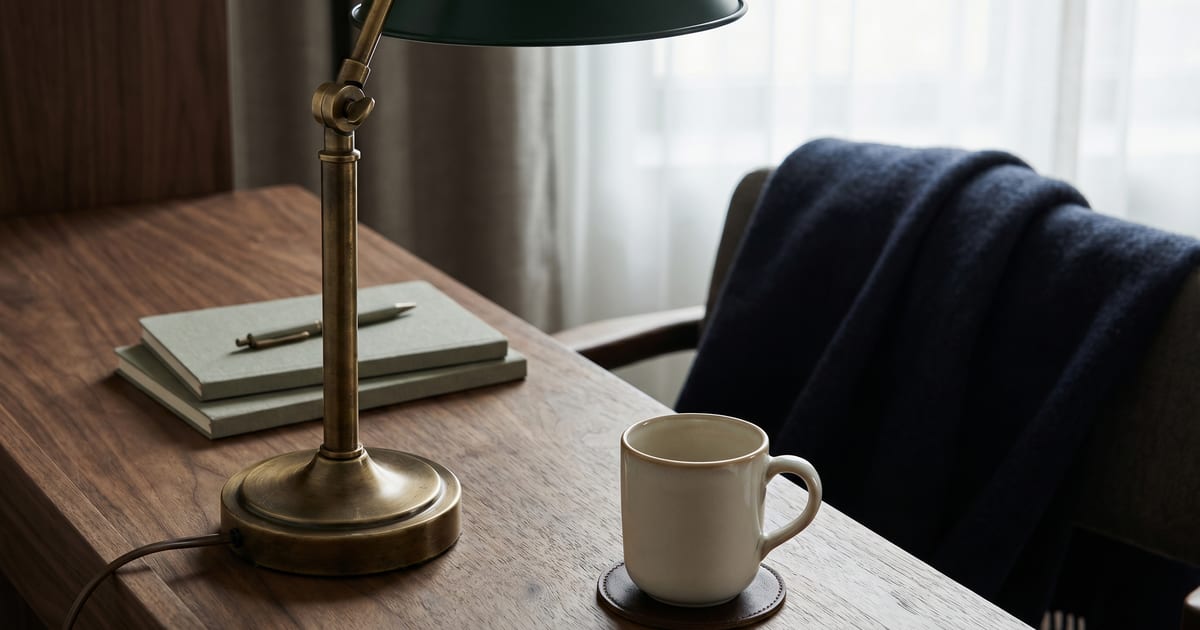
The desk faces the window where the architecture allows. Natural side light over overhead fluorescent. Laptop closed so no brand surface is visible (Booking's prohibition on broadcast logos and corporate brands extends to anything legible in frame 6). One notebook and pen as styling. Chair pulled out at an angle, not pushed flat.
Practitioner consensus on the lens is 24mm-equivalent or tighter. Antonio Cuellar's hospitality portfolio standard names the 24mm as the workhorse for honest interior shots 7. Austin Baker's lens guide is more direct: "Anything below 20mm produces fisheye distortion that looks dishonest. Use 24-35mm for nearly all interior shots" 8. A tight workspace photographed at 16mm reads as a corner-office workstation, and the guest arrives to a writing surface the size of a placemat.
BYPILLOW Flamant in Barcelona shows the move per frame. Booking's auto-generated alt text for one gallery image reads "a room with a desk with a television and a sliding glass door" 9. The composition pairs the workspace with the balcony cue in a single frame. The business traveler reads "I can work here AND step onto the balcony." Two sub-amenities surface from one photo. Flamant sits at 8.7 across 199 reviews, which is what the disciplined gallery underwrites.
View
The window edge is visible. The shot is taken from inside the room, framed so the viewer can place the view in the room rather than treating it as a stock landscape. Curtains pulled to one side, not bunched. Daylight or blue-hour light, not midday flat. Signature view is one of four hero archetypes in our hero-photo work, and the same composition rule applies to the per-room view sub-shot 10.
A view shot with no window edge reads as a stock photo of the destination. The viewer assumes it is not the view from this room and moves on. The edge anchors the promise. Flamant's "a hotel room with a bed and a large window" gallery photo demonstrates the rule: bed and window frame coexist in the composition, and the view earns its place by being seen through the architecture of this room 9.
Balcony
Two chairs pulled out from the wall. A small table between them. The view in the background, not centered. A folded towel on the table or one of the chairs as a scale element and a warmth cue. Shot at golden hour, not midday. The midday-with-stacked-chairs version of this shot is the off-season-storage look: the balcony reads as a place no one uses.
No published per-balcony A/B exists; convergent practitioner practice is what we have. A staged balcony reads inhabited. An unstaged one reads abandoned. The fix is not to lie about the balcony. The fix is to spend ten minutes staging the actual balcony before the camera comes out.
Kitchenette
Wide enough to show every appliance the room description claims. Kettle, microwave, fridge, induction hob, dishwasher if it exists. A single coffee mug and a bowl of fruit on the counter for scale and warmth, not a full pantry shoot. Counter clear of bottles, sponges, and dishrags.
Vrbo's photo help article recommends per-room photos for whole-home and apart-hotel listings, with kitchenette and living area called out as required for those property types 11. We did not capture a clean apart-hotel kitchenette anchor this pass; the spec above derives from Vrbo Partner Hub guidance and convergent practitioner practice. The cropped-kitchenette failure (counter visible, two-thirds of the appliances out of frame) creates booking uncertainty. The guest cannot tell whether the hob is induction or gas, whether the dishwasher exists, whether the kettle matches the description. The booking goes elsewhere.
Living area
A sofa, a coffee table, and one signature design element. Artwork on a wall, a floor lamp with character, a fireplace if there is one. No clutter. Camera at the seated guest's eye level, not standing. A "junior suite" or "suite" classification implies a separate living area; without a photo, the upgrade premium is not justifiable, and the room sells at the standard-room price even though the rate card shows the upgrade.
This is the sub-shot most likely to reach for an ultra-wide lens to "show the whole space" and most likely to distort the scale as a result. Same lens discipline as the other four sub-shots applies: 24mm equivalent, no fisheye.
Common failure modes
Six patterns recur across the galleries we walk. Each is mechanically detectable. Each maps to a published rule, a published finding, or both.
Workspace claimed in amenities, no photo. The desk is in the room description. The amenity tag is set on the OTA. The gallery has six bedroom photos and two bathroom photos. Zero workspace photos. The business traveler filtering on workspace lands here, sees nothing about a workspace, and doubts the desk is actually a desk. Self-selection collapses. PhotoPresenceValidator is the validator we are building to flag this gap; until it is at scale, the audit is manual.
View claimed, photo without window edge. The view is in the description. The gallery has a wide landscape shot of the city or the sea. No window in the photo, no curtain, no frame. The viewer assumes it is a stock photo of the destination and moves on. The edge is not optional.
Balcony at midday with stacked chairs. Chairs in a corner stack. Towels gone. Midday sun washing the tile. The composition is honest, in the sense that the balcony does look like that on cleaning day. It is also dead. No prospective guest puts themselves on this balcony. Stage it. Shoot at golden hour.
Kitchenette cropped, missing appliances. Counter visible. Two-thirds of the appliances not. The dishwasher might be there. The hob might be induction or a single hot plate. The booking goes to the apart-hotel down the street whose kitchenette photo shows everything.
Living area photographed with a branded TV broadcast in frame. Booking's rejection ruleset is unambiguous on third-party brand surfaces and broadcast logos 12. The TV is on. The screen is showing a sports broadcast or a news channel. The OTA either rejects the photo or ranks it down. Fix: swap the broadcast for an Apple TV home screen, neutralise the screen in post, or shoot with the TV off.
Wide-angle distortion that makes a 9 m² room read as 18 m². This is the load-bearing failure mode. Antonio Cuellar, Austin Baker, Furoore, and Dixie Dixon all converge on the same rule: 24mm is the honest baseline, and anything below 20mm produces distortion that "looks dishonest" 781314. Booking's Photo Standards Quick Reference makes the OTA position explicit: "Extreme wide-angle or fisheye lens photos are not accepted," and "Skewed, tilted, stretched, or distorted photos" are rejected 12. Airbnb's host guide independently warns: "Avoid using fisheye and super-wide-angle lenses, as they distort the way your space looks" 15.
Published practitioner consensus is settled. So are the OTA prohibitions. The consumer-harm side is not. Choi 2024 documents that misleading hotel photos drive regret, distrust, anger, and negative word of mouth 4, but covers misleading photos broadly, not wide-angle distortion specifically. We did not find an FTC enforcement action, a successful class-action, or an NAD case on hotel wide-angle photos. The wider misleading-advertising regulatory framing in this failure mode is OTALift editorial, grounded in the published OTA prohibition and the academic consumer-harm pathway. We label it distinctly so a reader can weigh OTALift's editorial position separately from the published consensus.
Step-by-step fix
Walk this in order, room type by room type. Phone in hand, gallery open on Booking, room description open beside it.
- Walk the amenity list against the gallery. Every claimed sub-amenity (workspace, balcony, view, kitchenette, living area, in-room amenity tray) needs at least one dedicated photo. Make the list. Mark the gaps. The gaps are your shoot list.
- Shoot the workspace. Window light if it is there, lamp light if it is not. Laptop closed, no brand visible. One notebook, one pen. Chair pulled out at an angle. 24mm equivalent or tighter.
- Shoot the view with the window edge in frame. Curtain to one side. Daylight or blue hour. The window edge is what tells the viewer this is the view from the room, not from the destination's tourism board.
- Stage the balcony before you shoot it. Two chairs out, a small table between, a folded towel on a chair, the view as background. Wait for golden hour. Soft overcast light is the second choice. Midday harsh is the worst case.
- Frame the kitchenette to show every claimed appliance. Kettle, microwave, fridge, hob, dishwasher. If you cannot fit them all at 24mm, shoot a second frame.
- Shoot the living area at seated eye level. Sofa, coffee table, one signature design element. No clutter.
- Apply one lens discipline across all five sub-shots. No wider than 24mm equivalent. No fisheye. No tilt-shift. The room must read at honest scale on a 6-inch phone screen, where the OTA crops aggressively and ultra-wide barrel distortion only amplifies. The Choi 2024 consumer-harm pathway is the cost of doing otherwise.
- Pass the rejection ruleset. Cross-check every sub-shot against the OTA-published prohibitions in our sibling article 12: no broadcast logos, no brand surfaces, no people as primary subject, no collages, no in-image text or watermarks, no portrait orientation, no resolution under 2048 by 1080.
Self-audit checklist
Run this on every room type you sell, not just one.
- Workspace photo present if the room claims a desk or workspace amenity
- Workspace shot at 24mm or tighter; laptop closed; no laptop, monitor, or device brand legible in frame
- View photo present if the room claims a view, partial view, or window
- View shot includes the window edge for scale
- Balcony photo present if the room claims a balcony or terrace
- Balcony staged with two chairs, a table, and a warmth cue (towel, glass, plant)
- Balcony shot at golden hour or soft daylight, not midday harsh
- Kitchenette photo present if the room claims a kitchenette
- Kitchenette frame shows every claimed appliance (kettle, microwave, fridge, hob, dishwasher)
- Living area photo present if the room is classified as suite or junior suite
- Living area shot at seated eye level, not standing
- No wide-angle distortion in any sub-shot (rooms read at honest scale)
- No branded TV broadcasts visible in any sub-shot
- All sub-shots at 2048 by 1080 landscape or larger
How OTALift surfaces this
Two validators carry this article in the listing-audit report today. PhotoQualityValidator measures the technical specs above (resolution, orientation, prohibited categories) on every gallery photo and routes rejection-risk flags into the recommendation card. PhotoPresenceValidator is the second, and it is where the sub-shot work lands: it cross-checks the room amenity list against the gallery and flags every claimed-but-not-photographed sub-amenity per room type. The article ships at data_maturity: external_only until that validator hits a 1,000-listing sample.
The wide-angle-distortion analyzer signal is the one we are proposing with this article. Published consensus is settled (four named photographers converge on 24mm; Booking and Airbnb both prohibit ultra-wide explicitly). The consumer-harm pathway is grounded (Choi 2024 documents the regret-distrust-anger sequence for misleading photos broadly, even though the paper does not isolate wide-angle as a single causal factor). Our editorial position is that the prohibition is real, the harm is real, and we should ship a signal that flags suspected wide-angle distortion in the listing-audit pipeline. The signal is not in the analyzer today. It is in the build queue, with this article as the rationale document.
Related articles
- The Bedroom Photo That Converts. The lead-in shot before the sub-shots begin.
- Bathroom Photography Without the Motel Look. Same micro-space framing voice as the workspace and kitchenette tight shots.
- What OTAs Reject in Hotel Photos, and Why. The rejection ruleset every sub-shot has to clear.
- Pillar: How OTA Ranking Algorithms Actually Work
Sources and methodology
Real-listing example was captured via Booking.com gallery walk on 2026-04-26 (BYPILLOW Flamant Barcelona, single verified anchor). The wide-angle-distortion section draws on convergent published practitioner consensus and the OTA-explicit prohibitions; the consumer-harm pathway is academic (Choi 2024) and does not isolate wide-angle as a single causal factor. The "lawsuit risk" framing in Failure 6 is OTALift editorial, labeled as such in body text, grounded in OTA prohibition plus the broader misleading-advertising regulatory framework that could be invoked. The 60 percent bed-and-bath-only rate referenced in editorial framing is field-observation pattern only; PhotoPresenceValidator at 1,000-listing sample is the threshold at which we would publish a hard percentage.
Footnotes
-
Booking.com Photography Guide for Hotels (January 2019, PDF). Source for the 20+ photos = 83 percent more views finding, Booking-internal panel data. https://partner.booking.com/sites/default/files/article_attachments/XU_Photography_Guide_For_hotels_January_2019.pdf ↩ ↩2
-
Booking.com Partner Hub, "Improve your property photos." Per-room-type gallery requirements and recommendation to "include shots of the room from multiple angles, lighting setups, and amenities." https://partner.booking.com/en-us/help/photos-videos/photos/improving-your-property-photos ↩
-
Xi, J., Hao, F., Cai, D., Zhang, C. J., and Li, H. (2025). Does the luxury hotel cover photo matter? Understanding the impact of picture value types on consumers' behavioral intentions on OTAs. Tourism Management Perspectives, Volume 58. Establishes the mental-pre-experiencing mechanism behind hedonic-photo conversion lift. https://www.sciencedirect.com/science/article/abs/pii/S2211973625000662 ↩
-
Choi, S., Mattila, A. S., and Bolton, L. E. (2024). When too good to be true: Misleading hotel photos and customer outcomes. Tourism Management Perspectives, Volume 50, 101232. Documents the regret, distrust, anger, and negative word-of-mouth pathway when arrival contradicts photo promise. Direct WebFetch returned 403; abstract and findings verified via search-result summaries and ResearchGate listing. https://www.sciencedirect.com/science/article/abs/pii/S2211973624000310 ↩ ↩2
-
TripAdvisor traveler research, cited via Phocuswright industry summaries (2018-2020). The 98 percent of travelers say accurate photos are important survey result, used in OTA partner content as the trust-premium anchor. Reused via sibling article
what-otas-reject-and-why/research/data.md. ↩ -
Booking.com Partner Hub, "Understanding photo requirements for your property." Verified via Playwright by sibling article on 2026-04-18. The branded-broadcast and corporate-logo prohibition is part of the universal rejection ruleset documented in the same sibling article. https://partner.booking.com/en-us/help/property-page/photos-extranet/understanding-photo-requirements-your-property ↩
-
Antonio Cuellar, luxury hospitality photography portfolio and commentary. Names 24mm equivalent as the workhorse for honest interior shots; explicit anti-fisheye position in interior-portfolio standards. https://www.antoniocuellar.com ↩ ↩2
-
Austin Baker, "Best camera lens for interior photography." Practitioner blog: "The 16-35mm zoom is the standard for interior work, but anything below 20mm produces fisheye distortion that looks dishonest. Use 24-35mm for nearly all interior shots." https://austinbakerphotography.com/blog/best-camera-lens-for-interior-photography ↩ ↩2
-
BYPILLOW Flamant, Barcelona. Booking.com listing, accessed 2026-04-26. Booking score 8.7 across 199 reviews. Booking's auto-generated gallery alt text labels include "a hotel room with a bed and a large window" (view + window-edge frame), "a bedroom with a bed and a large window" (second view angle), "a hotel room with a bed and a chair" (in-room context), "a tray with a coffee maker and glasses and a bottle" (in-room amenity tray), "a room with a desk with a television and a sliding glass door" (workspace + balcony cue in a single frame). https://www.booking.com/hotel/es/bypillow-flamant.en-gb.html ↩ ↩2
-
Sibling article: The Hero Photo Decision: Which Shot Goes First. Establishes the four hero archetypes including signature-view (window). Same composition rule applies to per-room view sub-shots. ↩
-
Vrbo Help Center, "How to add and manage photos in your listing." Per-room photo recommendations for vacation rentals and apart-hotels; kitchenette and living area called out as required for whole-home property types. https://help.vrbo.com/articles/How-to-add-and-manage-photos-in-your-listing ↩
-
Sibling article: What OTAs Reject in Hotel Photos, and Why. Captures Booking.com Partner Hub Photo Standards Quick Reference via Playwright on 2026-04-18, including the direct quotes "Extreme wide-angle or fisheye lens photos are not accepted" and "Skewed, tilted, stretched, or distorted photos are not accepted," plus the broadcast-logo and brand-surface prohibitions invoked elsewhere in this article. Original Booking source: https://partner.booking.com/en-us/help/property-page/photos-extranet/understanding-photo-requirements-your-property ↩ ↩2 ↩3
-
Furoore, "Best lens for interior photography." Practitioner guide: "Ultra-wide-angle lenses (less than 20mm) are rarely ideal for interior photography. Distortion becomes severe at the edges and the room looks unnaturally large, which damages trust when guests arrive and find the actual space." https://furoore.com/best-lens-for-interior-photography ↩
-
Dixie Dixon, Nikon ambassador and interior + portrait photographer. Interior-work commentary corroborates the 24mm-as-honest-baseline consensus across her published interviews and Nikon learning-center materials. Reviewed as part of practitioner-consensus convergence with Cuellar, Baker, and Furoore. ↩
-
Airbnb Resource Center, "9 pro tips for taking photos that will take your listing to the next level." Direct quote: "Avoid using fisheye and super-wide-angle lenses, as they distort the way your space looks." Cross-OTA confirmation that the wide-angle prohibition is industry standard, not Booking-specific. https://www.airbnb.com/resources/hosting-homes/a/9-pro-tips-for-taking-photos-that-will-take-your-listing-to-the-next-level-79 ↩