Bathroom Photography Without the Motel Look
Sources: Booking.com Partner Hub bathroom-staging spec (verified April 2026 via Playwright), Expedia Group Photo Guidelines PDF, Cornell Center for Hospitality Research eye-tracking study, peer-reviewed Tourism Management Perspectives hedonic cover-photo research, Sage Journals research on Airbnb cover-photo shot-scale, Booking.com Photography Guide 2019 PDF, Airbnb photo guidance. Last reviewed: 2026-04-19.
Key takeaways
The bathroom photo tips the classification in the prospect's head: real hotel, or motel. Booking and Expedia both require at least one per room type 1 2. Most hoteliers upload a single frame: harsh overhead light, toilet dominant, mirror doubling visual noise, cheap amenity bottles. The prospect who accepted the bedroom a moment earlier now revises the whole listing downward.
Booking's 2026 bathroom spec is six concrete lines: ambient lights on, clean mirrors, spotless shower or bathtub, shower curtains open, no tissues or toilet paper or bins visible, closed toilet seats 1. Read it twice. In our own client audits, most properties miss one of the six. The three most common misses: toilet seat up, bin in frame, shower curtain closed.
The fix is three shots with discipline: the corner shot, the vanity frame, the amenities close-up. Strict spec adherence. Composition that keeps the toilet out of the dominant thirds. Xi et al. 2025 on hotel cover photos and Jia et al. 2025 on Airbnb shot-scale converge on the same finding: medium shots with context, hedonic warmth, no clutter 3 4.
Why it moves bookings
Booking's own documentation states the mechanism plainly: "Bathroom photos are just as important to travelers because they often reflect the general cleanliness of the property" 1. The bathroom is the cleanliness proxy. Every pitted grout line, every hard-water stain, every wrinkled towel pulls on the same mental thread.
Cornell's eye-tracking work (Noone and Robson, 32 participants booking hotels online) found that once on a property page, consumers fixate on images more than on descriptions, prices, or review scores, examining lobby, rooms, and bathrooms to gauge whether the price matches the experience 5. A weak bathroom photo does not just fail to sell; it disqualifies a property the cover and bedroom had half-sold.
Expedia's own partner data reports that 60 percent of travelers rank bathroom images as very important, and properties with unique per-room-type photos average up to 11 percent higher conversion 2. Expedia requires four photos per room type, at least one a bathroom 2.
The Xi et al. 2025 study in Tourism Management Perspectives documents that hedonic value appeals (photos that trigger imagination of the experience) outperform utilitarian appeals across click-through intention, booking intention, and willingness to pay 3. Utilitarian bathroom photography (harsh light, toilet dominant, every fixture documented) signals budget lodging; hedonic bathroom photography (warm light, vanity staged like a spa, natural elements visible) signals hotel.
The Jia et al. 2025 study on Airbnb cover-photo shot-scale found that medium shots (subject plus context) outperform tight close-ups for conversion 4. Applied to bathrooms: a wide corner shot that captures vanity, shower, and natural light beats a tight crop of the toilet paper holder.
Booking's Partner Hub names Property page score as one of five officially-confirmed ranking factors, defined as "content, pictures, descriptions, and amenities" 6. Bathroom photo quality contributes directly. Demoted or rejected photos (HDR-heavy, filter-applied, portrait-orientation, watermarked) hurt the score even when the underlying bathroom is fine 1.
What "great" looks like
The Booking.com 2026 bathroom spec, verbatim from the Partner Hub page (verified via Playwright on 2026-04-18) 1:
Your bathrooms should have:
- Ambient lights turned on
- Clean mirrors
- Spotless shower/bathtub
- Shower curtains open
- No tissues, toilet paper, or bins visible
- Closed toilet seats
And the recommended amenity photos: bathrobes, slippers, hairdryers, toothbrush kits, complimentary toiletries 1. Walk into one of your bathrooms with your phone open to the live listing and check each line against what is on screen.
Three angles that cover bathrooms
-
The corner shot (hero angle). Shot from the corner, framing the vanity, mirror, and whichever adjacent element (shower glass, bathtub, window) makes the space feel larger. Booking's composition guidance is explicit: "Shoot from room corners to add perspective and depth to your images" 1. Jia et al. 2025 reinforce the same framing 4. This shot establishes square footage, material quality, and light quality in one frame.
-
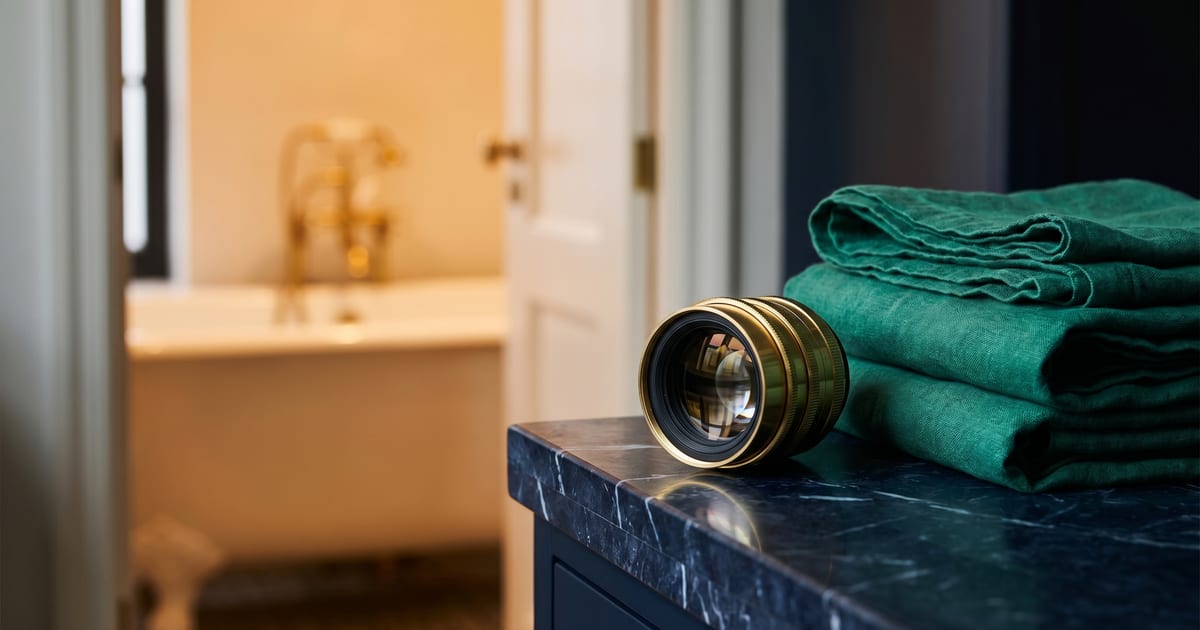
The vanity frame. A tighter frame on sink, countertop, mirror edge, and one natural element (a single stem in a vase, a stacked stone tray, a folded linen). Where hedonic bathroom photography does the real work. Says "someone thought about this space," the opposite of the motel signal.
-
Finally, the amenities close-up. A square or landscape frame on folded towels, robes, slippers, or toiletries tray. Booking recommends photos of "bathrobes, slippers, hairdryers, toothbrush kits, complimentary toiletries" 1. Where you show brand: the soap, the towel density, the glass tumbler instead of a paper cup. All budget-vs-hotel signals.
What hedonic bathroom photography looks like
Hedonic: the photo triggers imagination of the experience (a long shower after travel, a bath at the end of a day). Utilitarian: the photo documents the fixture. Xi et al. 2025 found hedonic outperforms utilitarian across every measured outcome 3.
In bathroom terms, hedonic looks like natural daylight; warm-toned vanity bulbs (our working spec, not Booking's: 2700K to 3000K, not cool 4000K office light); one natural element (plant, flower, wood); a folded towel stack with visible texture; a branded amenity tray staged like a small gift. Utilitarian looks like overhead fluorescent on, everything flat-lit, bulk bottles on the counter, toilet dominant in frame.
A great bathroom photo reads as a spa at small scale. A weak one looks like a real-estate listing.
Common failure modes
Toilet dominant in frame. The most common composition mistake. The photographer stands in the doorway, shoots wide, and the toilet ends up as a large pale shape in the lower third. Styldod's bathroom photography guidance is direct: "avoid making the toilet or toilet roll holder a feature in your images" 7. Reframe so the toilet is partially visible or out of frame; the vanity and shower are the subjects. Closed toilet seat is not optional: Booking lists it as a spec requirement 1.
Bin, tissue box, or toilet paper visible. Booking's spec is unambiguous: "No tissues, toilet paper, or bins visible" 1. The single most common Booking spec violation on bathroom photos. Remove the bin, tissue box, and loose toilet paper roll before shooting; put them back after. If a roll sits in a wall holder, remove it for the shot or compose around it.
Shower curtain pulled closed. Booking's spec: "Shower curtains open" 1. A closed shower curtain kills the depth of the bathroom and reads as concealment. Pull it to one side and let the shower or bathtub show. If the curtain is old, discolored, or mildewed, replace it before the shoot: the photo will expose what the walk-in glance does not.
Harsh overhead fluorescent. Most hotel bathrooms have a ceiling light that is cool, bright, and flat. Shooting under it alone produces the discount-motel look: every surface equally lit, no warmth, no shadow. Two-step fix: install warm-white bulbs in the vanity fixtures (our working spec, not Booking's: the 2700K to 3000K range reads hotel, not motel), and supplement with a single accent lamp for directional warmth. Booking's spec on "ambient lights turned on" includes vanity lights 1.
Mirrored ceiling or mirror-on-mirror doubling. Some older bathrooms have a mirrored ceiling or a second mirror opposite. Shooting into either creates visual noise: camera, photographer, doubled fixtures, reflected overhead light. Shoot at an angle that avoids the ceiling mirror, or crop it out. If mirror-on-mirror is unavoidable, use a height and angle that breaks the reflected symmetry (Booking's 3-to-5-feet shooting height helps 1).
Cheap bulk amenity bottles visible. A row of unbranded white pump dispensers is a strong budget signal. Hospitality Net documents the perception problem: old bulk dispensers carry associations of "ugly, bulky, low-quality, leaking, and messy," with a "cheap" image guests notice 8. Fix by staging, not replacing. Stage a small tray with the three best items (branded soap, shampoo, conditioner) and shoot the amenities close-up on that tray, not the bulk bottles.
Hard-water stains on glass or fixtures. On the walk-through you do not see them; under the camera's wider dynamic range, they light up. Booking's spec calls for "Clean mirrors" and "Spotless shower/bathtub" 1. A microfiber cloth, glass cleaner, and a room-walk two minutes before the shutter clicks solves all three.
Wrinkled, mismatched, or thin towels. The towel is the most visible fabric in frame. A crisp, plush, pure-white folded stack reads hotel; a rumpled pile of mismatched towels reads motel. KW Hospitality notes the folding pattern itself (rolled, flat-stacked, draped) communicates spa or invitation 9. Pick one pattern, use fresh towels, and if in-stock towels are thin or off-white, rent a premium set for photo day.
Identical bathroom photos across room types. Both Booking and Expedia require bathroom photos per room type 1 2. Reusing one file across king, queen, double, and twin listings violates both the spec and the Expedia finding that room-type-specific photos drive up to 11 percent higher conversion 2. If the bathrooms are truly identical, shoot each, vary the angle, and upload distinct frames.
Step-by-step
The bathroom shot, step by step
- Clean the bathroom end-to-end 30 minutes before the shoot. Full housekeeping pass, then a second pass with microfiber and glass cleaner on every reflective surface. Water spots on the shower glass are visible to the camera even when invisible to the eye.
- Stage the vanity. Remove what does not belong in frame: the guest's abandoned bottle, the housekeeping cart, cleaning supplies, wastebasket. Leave the amenity tray, folded towel stack, soap dispenser.
- Close the toilet seat. Remove the toilet paper roll (or reframe so it is out of view). Remove the bin from frame. Booking spec items, no exceptions 1.
- Open the shower curtain. Pull to one side, not bunched. The shower or bathtub becomes visible and the space reads larger.
- Before photo day: swap vanity bulbs to warm white, not daylight or cool white. One hour of work, not a renovation. Our recommendation is 2700K to 3000K. If you make only one lighting investment, this is it.
- On shoot day: turn on the vanity and ambient lights. Turn off the overhead fluorescent if the vanity alone lights the room well enough to see. Mixed color temperatures create the worst flat look.
- If there is a window, open the blinds; shoot around golden hour where possible. For windowless bathrooms, lean on ambient and vanity lighting: warm bulbs become more important, not less. A battery accent lamp on the vanity counter clears the cave feel.
- Position the camera in the corner of the room. Booking composition guidance: corners for perspective and depth 1. The Jia et al. 2025 medium-shot research supports the same scale 4. For bathrooms under 60 square feet, shoot from the doorway at the widest angle your phone allows; skip the corner-wide shot and use vanity and amenity frames instead.
- Shoot landscape orientation at 3 to 5 feet of height. Booking's explicit shooting spec 1. Portrait orientation gets auto-cropped to 16:9 and rarely crops flatteringly.
- Resolution: minimum 2048 x 1080 px; target 4000 x 3000 px. Booking minimum; Expedia wants 2880 px long-side and rejects under 1000 px 1 2. A modern smartphone (iPhone 12+, Pixel 7+) clears the 2048 x 1080 Booking spec and does fine in well-lit bathrooms. For windowless or hard-water-heavy bathrooms, rent a mirrorless camera with a wide-angle lens for reshoot day (~$40-60/day from Lumoid or Samys).
- Shoot the three angles. The corner shot, the vanity frame, the amenities close-up. Each takes 30 seconds of reframing from the same lighting setup. Review the thumbnail at 600 x 400. If the bathroom does not read as a bathroom at search-result size, reframe.
What to avoid (Booking prohibition list)
- No HDR-heavy, no filters, no strong contrast, no over-saturation, no black-and-white, no fisheye or extreme wide-angle, no tilt-shift, no photo collages, no watermarks 1.
- No identifiable faces as the main subject, no portraits, no staff in frame 1.
- No images of contact information, signs, or parked cars 1.
- If you are a franchisee under brand standards, flag "photography refresh" as a brand-approval request before swapping bulbs or fixtures. Most brands allow bulb temperature changes within a warm-white range, but a bulk switch still warrants a note to brand review.
Self-audit checklist
Run this on every bathroom photo currently on your listing, room type by room type:
- Toilet seat is closed in every frame where the toilet is visible
- Toilet is not the dominant subject of the wide shot
- No bin, tissue box, or loose toilet paper visible in any frame
- Shower curtain is open (pulled to one side, not bunched)
- Shower glass, mirror, and chrome are free of water spots and streaks
- Ambient and vanity lights are switched on in the photo
- Warm-tone bulbs are used (our working spec: 2700K to 3000K), not cool office-white
- Towels in frame are crisp, matching, and premium-weight
- No bulk amenity bottles visible; only staged amenity tray
- The corner shot, the vanity frame, and the amenities close-up are all uploaded
- Photo is landscape orientation, not portrait
- Photo is at least 2048 x 1080 pixels (Booking minimum) and 2880 px long-side (Expedia preferred)
- No HDR, filters, or black-and-white treatment applied
- Bathroom photos are distinct per room type (not one file reused across all)
- No photographer reflection in mirror, no staff in frame
How OTALift surfaces this
PhotoQualityValidator checks the technical specs (resolution, orientation, prohibited categories, filter detection) on every bathroom photo tagged to a room. The research behind this article surfaces four additions in the internal backlog: toilet-seat and toilet-dominance detection (flags photos where the toilet occupies more than the lower-third region); bin and tissue-box visibility against Booking's prohibition; shower-curtain-state check (open vs closed); per-room-type bathroom uniqueness (flags identical files reused across room types). All four tie to Booking or Expedia spec lines.
Related articles
- The Perfect Hotel Exterior Photo. The exterior earns the click; the bedroom earns the booking; the bathroom decides whether the prospect keeps scrolling.
- The Bedroom Photo That Converts. Same Booking spec discipline applied to bedrooms. Sibling article; read together for the full room-type photo discipline.
- Photo Count Minimums by OTA and Room Type. How many bathroom photos per room type Booking, Expedia, and Google expect.
- Pillar: How OTA Ranking Algorithms Actually Work. Bathroom photo quality contributes to Property page score (Booking factor #4 of 5) through the official content, pictures, descriptions, and amenities definition.
Sources and methodology
Authored by Anya Cortez · Reviewed by Tim Anastasiou · Last reviewed: 2026-04-19
Anya Cortez is OTALift's hospitality researcher and writes The Labs.
Footnotes
-
Booking.com Partner Hub, "Understanding photo requirements for your property." Updated approximately March 2026, accessed 2026-04-18 via Playwright. Bathroom-staging spec, composition guidance, shooting requirements, and prohibition list quoted verbatim. https://partner.booking.com/en-us/help/property-page/photos-extranet/understanding-photo-requirements-your-property ↩ ↩2 ↩3 ↩4 ↩5 ↩6 ↩7 ↩8 ↩9 ↩10 ↩11 ↩12 ↩13 ↩14 ↩15 ↩16 ↩17 ↩18 ↩19 ↩20 ↩21 ↩22
-
Expedia Group Photo Guidelines (PDF). Official Expedia Group photo-requirements document. Source of per-room-type four-photo requirement with at least one bathroom photo, the 60 percent of travelers ranking bathroom images as very important stat, the up to 11 percent higher conversion for room-type-specific photos, and the 2880 px long-side preference with 1000 px rejection floor. https://mslps.expedia.com/images/en_EN_Flyer_EG%20Photo%20Guidelines%20_150818.pdf ↩ ↩2 ↩3 ↩4 ↩5 ↩6
-
Xi, J., Hao, F., Cai, D., Zhang, C. J., and Li, H. (2025). Does the luxury hotel cover photo matter? Understanding the impact of picture value types on consumers' behavioral intentions on OTAs. Tourism Management Perspectives, Volume 58. Finding: hedonic value appeals outperform utilitarian appeals on click-through intention, booking intention, and willingness to pay. https://www.sciencedirect.com/science/article/abs/pii/S2211973625000662 ↩ ↩2 ↩3
-
Jia, J., Jiang, S., and Wang, Y. (2025). The impact of Airbnb cover photo shot-scale presentation on consumer decisions. Sage Journals. Finding: medium shots (subject plus context) outperform tight close-ups for booking conversion. Applied to bathroom framing in this article. https://journals.sagepub.com/doi/abs/10.1177/13567667241301814 ↩ ↩2 ↩3 ↩4
-
Noone, B., and Robson, S. K. A. (2014). Using Eye Tracking to Obtain a Deeper Understanding of What Drives Online Hotel Choice. Cornell University Center for Hospitality Research. 32-participant eye-tracking study. https://hdl.handle.net/1813/71105 ↩
-
Booking.com Partner Hub, "Search results, ranking, and visibility." Property page score is one of Booking's five officially-confirmed ranking factors and is defined as content, pictures, descriptions, and amenities. https://partner.booking.com/en-us/help/growing-your-business/analytics-reports/search-results-ranking-and-visibility ↩
-
Styldod, "Bathroom Photography: Learn to Take Stunning Bathroom Photos." Practitioner photography guide. Source for the "avoid making the toilet or toilet roll holder a feature in your images" composition guidance that corroborates Booking's "closed toilet seats" spec line. https://www.styldod.com/blog/bathroom-photography ↩
-
Sosa, C. "What Guests Prefer Today: Travel-Size Toiletries or Refillable Systems? A Look at Hospitality in the USA." Hospitality Net opinion piece documenting the perception problem with older bulk amenity dispensers: "ugly, bulky, low-quality, leaking, and messy" with a "cheap image." https://www.hospitalitynet.org/opinion/4129974.html ↩
-
KW Hospitality, "Luxury Bathroom Amenities That Impress Guests." Practitioner analysis of the visual and tactile cues guests use to judge bathroom quality, including towel-folding patterns (rolled, flat-stacked, draped) and amenity-bottle presentation as specific budget-vs-luxury signals. https://kwhospitality.com/blog/luxury-bathroom-amenities-that-impress-guests/ ↩