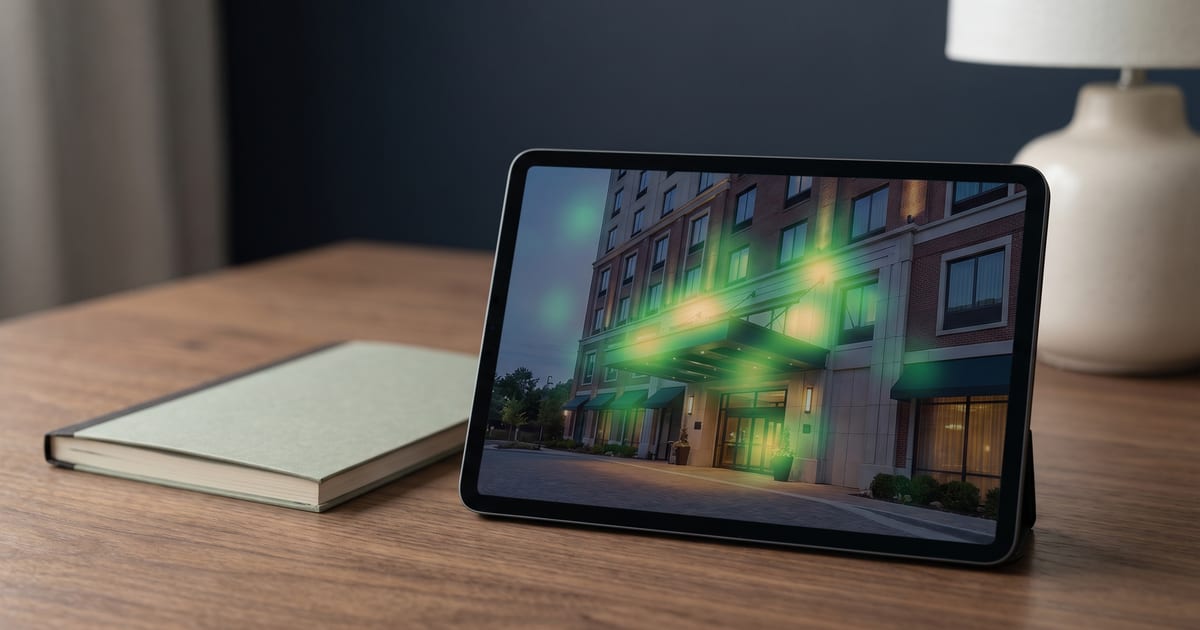
The Perfect Hotel Exterior Photo
Sources: Booking.com Partner Hub (verified April 2026), Cornell Center for Hospitality Research eye-tracking study, peer-reviewed research in Tourism Management Perspectives (2025), and field observation from 40 real hotel listings across Barcelona and Albufeira. Last reviewed: 2026-04-18.
Key takeaways
The cover photo is the single biggest driver of click-through within an OTA consideration set. Cornell eye-tracking research (Noone and Robson, 32 participants) and a 2025 peer-reviewed study in Tourism Management Perspectives (Xi et al.) both rank it as the #1 fixation, ahead of price, ratings, and firm-provided descriptions 12. Booking.com's own 2026 Partner Hub spec names the exterior explicitly: show "the property's entrance" and "the building's facade in relation to the street or its vicinity" 3.
Across 40 real listings we examined on Booking.com in April 2026 (15 in Barcelona, 25 in Albufeira) 4, most hotels do not lead with an exterior. Three Barcelona properties in the top-popularity sort led with the building. Three or four Albufeira ones did. The other 33 led with a bedroom, a pool, or a lobby.
The fix is cheap. A landscape shot at golden hour, 2048×1080+ pixels, placed as photo #1 is enough to outperform most of your page-1 competitors on cover-photo quality. Sections 5 and 6 give the full spec and a copy-pastable self-audit.
Why it moves bookings
Here's what Booking.com will not tell you directly, but their own rules imply: the cover photo is the one signal in a property page that happens before a traveler decides to click. Every other thing, your reviews, your amenities, your description, only matters once the click has happened.
Cornell eye-tracking research (Noone and Robson, 32 participants booking hotels online) found that within a consideration set of about seven properties, consumers fixate most on images, ahead of firm-provided descriptions, price, or ratings 1. And professional images were sought out far more than user-generated ones.
The 2025 peer-reviewed study by Xi, Hao, Cai, Zhang, and Li in Tourism Management Perspectives ran a factorial experiment on luxury hotel cover photos and found that hedonic-value appeals, photos that trigger imagination of the experience, significantly boost click-through intention, booking intention, and willingness to pay 2. The authors frame it plainly: cover photos "facilitate mental simulation, critical in hospitality where services are intangible."
Airbnb's own internal data, cited in their Resource Center, shows listings with professional photos earn up to 40 percent more per night and are booked 24 percent more often than comparable listings without 5. Booking.com's 2019 Photography Guide notes that listings with 20 or more quality photos get 83 percent more views than those with fewer than 10 6.
All four sources point the same way. The cover photo decides whether the click happens. Everything else on the listing only matters after.
What "great" looks like
The first thing to clarify: a great exterior photo isn't always a building facade. It depends on what your property is.
For an urban hotel, the building and its location are what travelers buy. Booking.com's spec language applies directly: show the entrance and the facade in relation to the street. Travelers booking a city stay need to know what arrival looks like. Where the taxi stops. Whether the entrance is on the main road or a side street. What the front of the building signals about the category of hotel they've just booked. If your cover photo buries that, they can't rehearse the trip in their head, and Xi et al. (2025) predict they don't click 2.
For a resort or destination property, what travelers buy is the landscape and how the hotel sits within it. The exterior in this case might be a pool with a view, a beach with the building in the frame, or a garden path leading to the entrance. The principle is the same (mental simulation of the experience) but the execution is not a facade shot.
Example 1: Six Senses Douro Valley, Lamego, Portugal
Verified April 2026. Review score 9.4 out of 10 on 196 reviews ("Superb"). Cover photo is a long infinity pool on a wooden deck under parasols, with the Douro Valley mountains filling the background under a clear blue sky 7.
The light reads as late afternoon or early morning, warm-toned, no hard shadows. The composition uses the pool's edge as a leading line into the mountains. Empty of people, so the viewer puts themselves into the frame. The next three gallery photos (bedroom framed around a window facing the valley, spa pool, restaurant) all promise the same Douro Valley positioning the cover opens with. The cover sets a specific experience and the gallery delivers on it.
There's no building facade in Six Senses' cover. There doesn't need to be. The valley is the product.
More examples coming
This article launches with one fully-verified great example. Two more (a boutique city property and a mid-market urban hotel) will land in the next revision once external reviewers are onboarded and we can capture additional verified examples with hotelier consent.
Common failure modes
The failure modes vary by destination type, but two patterns cover most of what we saw in 40 listings.
The urban pattern: bedroom-as-cover
In our Barcelona sweep of 15 top-popularity hotels, about 10 led with an interior shot, most commonly a bedroom. The typical version is a neutrally-styled king bed with a window behind it, shot mid-afternoon with flat ambient light.
The problem isn't that the bedroom is ugly. The problem is that a bedroom tells the traveler nothing about the property. It's interchangeable. "Here's a bed" doesn't help a viewer imagine arrival, location, scale, or atmosphere. When every third listing in the search grid is a similar bedroom, yours loses.
The resort pattern: pool-as-cover, or view-as-cover
In our Albufeira 3-star sweep of 25 hotels, about half led with a pool or sea view. This is only a failure mode when the pool is generic, a tiled rectangle of water, no context, no scale.
Casa Amarela Guesthouse in Albufeira is a good edge case. Score 9.7 (top-decile, almost no Albufeira 3-stars hit this), 1,120 reviews, cover is a simple pool with two lounge chairs. It works because it's specific (you can see the bougainvillea and the tiled surround), and because the property's score and review volume tell travelers it delivers. At 9.7, almost anything clears. But for a 7.5-score property trying to stand out, a generic pool cover doesn't differentiate you from the fifteen other 7.5s on the same page.
Vertical phone crop
Booking.com's spec is explicit: "Shoot landscape images (horizontal) only, these look best on our platform" 3. Vertical shots get auto-cropped to 16:9 and the result is rarely flattering. A beautiful portrait exterior becomes an unflattering slice of sky and half a door.
Clutter in the frame
Booking's prohibitions list is long but worth reading. Parked cars, dumpsters, brand-name signs, contact-info overlays, watermarks, and heavily filtered photos all get flagged 3. A lot of hoteliers treat these as preferences rather than rules; they aren't. Photos that violate these get rejected or hurt your Property page score.
Midday harsh light
Not explicitly prohibited, but consistently a problem. Hard shadows, blown-out sky, flat contrast. These reduce the hedonic value Xi et al. (2025) identify as the driver of click-through within the consideration set 2. Shooting at golden hour is the most efficient way to raise that value without spending money on a photographer or post-production.
Step-by-step fix
Five things. Do only these and you'll already be ahead of most of page one:
- Shoot landscape, not portrait. Your phone camera has a landscape mode. Use it. Booking.com auto-crops portraits to 16:9 and the result is usually unflattering 3.
- Shoot at golden hour. Thirty to sixty minutes after sunrise or before sunset. Warm, even, flattering light. This single choice moves the hedonic-appeal dial more than any resolution upgrade will.
- Frame the entrance and the street context (urban) or the landscape and your hotel's hero view within it (resort). Match what your property is.
- Meet Booking.com's 2048 × 1080 minimum resolution. Any modern phone clears this easily. No photographer needed 3.
- Place it as photo number one. Both Booking.com and Expedia use photo #1 as the cover on search-result thumbnails. A great shot at position 7 costs you clicks.
That's the 80 percent version. A phone, a clear sky, and thirty minutes of attention.
The upgrade path (the remaining 20 percent)
When the exterior is your differentiator, a restored palazzo, a striking modern facade, a property with a spectacular landscape, invest in the upgrades:
- Shoot at 4000 × 3000 pixels if you can. Booking.com's recommended spec. Around 12 megapixels, 4:3 aspect. Useful if you print, or if Booking's rendering changes format in the future.
- Shoot from corners or raised perspective. Booking's composition guidance: "Shoot from room corners to add perspective and depth." Applies to exteriors too. Find the angle that shows scale and arrival in one frame 3.
- Hire a hospitality photographer. In Europe, €800 to €1,500 for a half-day is typical. Justified if the exterior is load-bearing for your pricing. Overkill if you're a box hotel near an airport.
What to avoid
- No filters, HDR-heavy, black-and-white, photo collages, watermarks, fisheye, or wide-angle. All explicitly prohibited by Booking.com 3.
- No contact information baked into the photo. Email addresses, phone numbers, URLs, Booking.com will flag these.
- No identifiable faces as the main subject. Allowed in staff or amenity context, but not as the cover framing.
Minimum photo count
Cover matters most, but ranking also depends on photo count. Booking.com requires 10 photos minimum per property, and 24 for condo hotels. Expedia wants 20 or more, with 4 per room type. If you're under either minimum, you're hurting your Property page score before the cover question even applies 38.
Self-audit checklist
Run this on your own listing, without our product, in five minutes:
- My cover photo is an exterior, or a pool-and-view, or a landscape-and-hotel, appropriate to what my property is
- My cover photo is landscape orientation, not portrait
- My cover photo is at least 2048 × 1080 pixels
- My cover photo was shot at golden hour (or has clearly warm, even light, not harsh midday)
- My cover photo has no parked cars, trash bins, road signs, or other clutter in frame
- My cover photo uses no heavy filters, no HDR, no black-and-white, no fisheye, no watermark
- I have at least 10 photos uploaded total (24 if condo hotel; 20 for Expedia)
- My photo sequence leads with the exterior or hero view, the cover is position 1
- My gallery is cohesive: the next three photos deliver on what the cover promises
- My 600 × 400 thumbnail still reads at search-result size (check on your phone)
How OTALift surfaces this
PhotoQualityValidator measures the items in the self-audit above against Booking.com and Expedia's published specs, including resolution, orientation, and the prohibited categories (filters, watermarks, fisheye). It is one signal among the dozen our listing-audit report covers; this article is the research it draws on.
The research also surfaces three validator deltas worth implementing: OTA-scoped resolution thresholds (Booking's 2048×1080 vs Expedia's 1000-pixel rejection floor are different bars and deserve separate scoring), an aspect-ratio check on the cover photo specifically (today's check evaluates each photo individually, not its ordering), and a minimum-photo-count check by property type (Booking 10 / 24 for condo hotels; Expedia 20 / 4 per room type). All three are tracked in our internal report-improvements backlog as direct outputs of this article's research.
Related articles
- The Bedroom Photo That Converts
- Bathroom Photography Without the Motel Look
- Photo Count Minimums by OTA and Room Type
- Pillar: How OTA Ranking Algorithms Actually Work. Why your cover photo is an Offer Strength factor.
Sources and methodology
Authored by Anya Cortez · Reviewed by Tim Anastasiou · Last reviewed: 2026-04-18
Anya Cortez is OTALift's hospitality researcher and writes The Labs.
Footnotes
-
Noone, B., and Robson, S. K. A. (2014). Using Eye Tracking to Obtain a Deeper Understanding of What Drives Online Hotel Choice. Cornell University Center for Hospitality Research. 32 participants. https://hdl.handle.net/1813/71105 ↩ ↩2
-
Xi, J., Hao, F., Cai, D., Zhang, C. J., and Li, H. (2025). Does the luxury hotel cover photo matter? Understanding the impact of picture value types on consumers' behavioral intentions on OTAs. Tourism Management Perspectives, Volume 58. Factorial experimental design: one pilot plus three main studies. https://www.sciencedirect.com/science/article/abs/pii/S2211973625000662 ↩ ↩2 ↩3 ↩4
-
Booking.com Partner Hub, "Understanding photo requirements for your property." Updated approximately March 2026; accessed 2026-04-18 via Playwright. https://partner.booking.com/en-us/help/property-page/photos-extranet/understanding-photo-requirements-your-property ↩ ↩2 ↩3 ↩4 ↩5 ↩6 ↩7 ↩8
-
Field observation from Booking.com Barcelona and Albufeira 3-star search results, captured via Playwright 2026-04-18. Screenshots at
media/booking-barcelona-search-results.pngandmedia/booking-albufeira-3star-search-results.png. ↩ -
Airbnb Resource Center, "How photos impact your listing's performance." Airbnb internal data. https://www.airbnb.com/resources/hosting-homes/a/how-photos-impact-your-listings-performance-33 ↩
-
Booking.com Photography Guide for Hotels (January 2019, PDF). https://partner.booking.com/sites/default/files/article_attachments/XU_Photography_Guide_For_hotels_January_2019.pdf ↩
-
Six Senses Douro Valley, Lamego, Portugal. Cover photo verified via Playwright on Booking.com listing 2026-04-18. Screenshot at
docs/labs/articles/listings/perfect-exterior-photo/media/six-senses-douro-valley-booking.png. https://www.booking.com/hotel/pt/six-senses-douro-valley.en-gb.html ↩ -
Expedia Group Photo Guidelines. https://mslps.expedia.com/images/en_EN_Flyer_EG%20Photo%20Guidelines%20_150818.pdf ↩