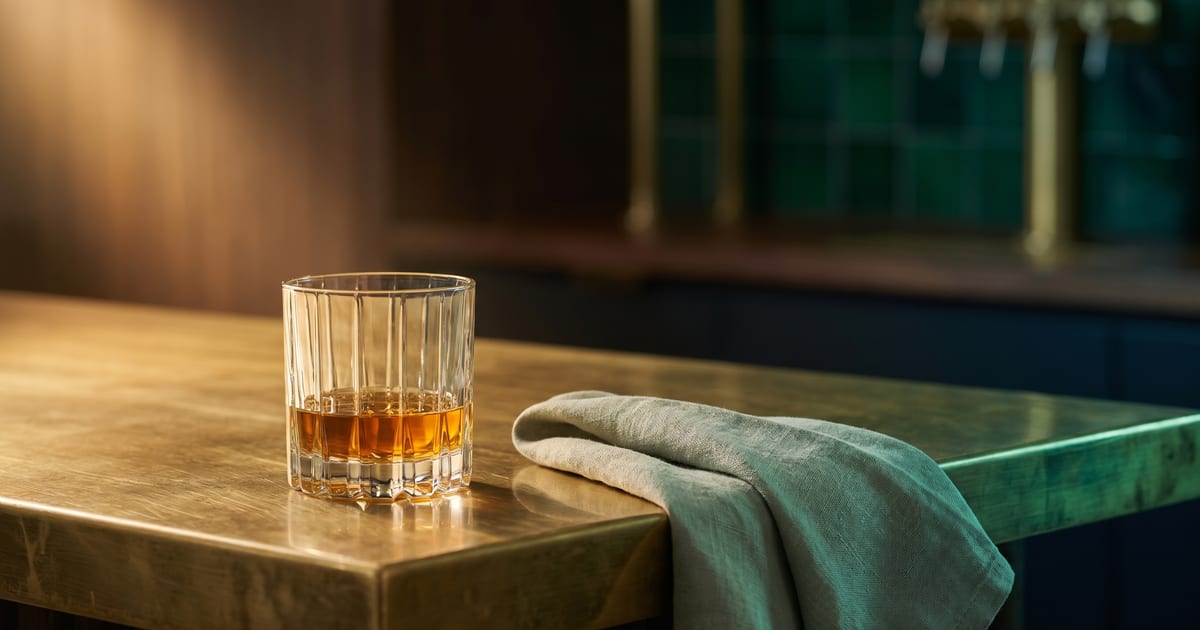
Restaurant and Bar Photography for Hotel Listings
Sources: OTA partner documentation (Booking.com, Expedia, Vrbo), Skift Research and Phocuswright distribution data, peer-reviewed research from Cornell CHR and Annals of Tourism Research, named-photographer references (Don Riddle, Lou Manna), and seven real-hotel listings inspected on Booking.com via Playwright in April 2026.
Key takeaways
Restaurant and bar photography is the OTA category most likely to be over-edited. The lighting that flatters a plated dish (warm, golden, almost lifestyle-magazine) clashes with the documentary lighting OTAs ask for in venue shots. Most hotels split the difference and end up with neither. The result is a gallery where every photo signals "we paid someone for this" but none signal "this is the room you'd actually eat in tonight."
Skift Research's 2024 distribution outlook says 70% of travelers actively weigh food and beverage in their booking decision, with the share rising to 74% among Millennials and 71% among Gen Z 1. The Cornell eye-tracking work behind every photography article in this Lab places hotel images as the single most-fixated content type on a property page 2. F&B is where these two findings collide. A great venue or breakfast shot helps the traveler rehearse the trip in their head; a generic empty-restaurant photo at noon does the opposite.
Across seven Booking.com listings we inspected on 2026-04-27, the gap between the well-converters (The Soho Hotel, The Ned, The Langham, Soho House Istanbul) and the under-performers (Guy Fawkes Inn, The Fat Badger, Judge's Lodging) was not photo quality in the technical sense. It was implied presence. The rest of this article names what to shoot for each F&B archetype, calls out the failure modes by example, and gives the step-by-step fix.
Why it moves bookings
F&B is no longer a tie-breaker on most OTAs. It is a primary filter.
Skift Research's Hotel Distribution Outlook 2024 puts the headline bluntly: 70% of travelers say food and beverage is part of their booking decision, with 74% of Millennials and 71% of Gen Z saying dining is a core part of how they choose where to stay 1. Phocuswright's 2024 lodging study comes at the same booking-decision question from a different angle: 22% of US travelers cite lodging price as the top factor in destination choice, with F&B pulling weight inside the lodging shortlist 3. The shift is real. F&B is now load-bearing on the way the booking decision unfolds, not decorative copy.
Cornell nailed down why photos in particular drive that decision over a decade ago. Noone and Robson's 2014 eye-tracking study (34 leisure-bookers, three US cities) found that hotel photos draw "the highest number of fixations of all material related to the hotel" on a detail page, and that hotel-generated professional photos pulled significantly more attention than user-generated ones 2.
The 2025 Annals of Tourism Research paper by Xi, Hao, and Cai went one layer deeper. Hedonic cover photos (atmospheric, mood-led, designed to trigger mental pre-experiencing) significantly outperform utilitarian cover photos on click-through, booking intention, and willingness to pay 4. The mechanism is mental simulation: the photo lets the traveler rehearse what dinner at this restaurant or a drink at this bar would feel like. F&B is the natural home for that effect. A set table at golden hour, a half-poured cocktail, plates mid-service, a bartender with their back to the camera. Each is a hedonic prompt, and each earns the click in a way an empty room at noon does not.
Booking.com treats F&B as weight-bearing in its own taxonomy. The Partner Hub photo-requirements page lists "Restaurants" and "Breakfast spreads" as named sub-categories under Common facilities 5. Property Page Score rolls coverage of these categories into the score that influences how a listing surfaces in search.
The three findings line up: Skift names the audience, Cornell names the surface, and Xi et al. name the mechanism. F&B is the only category where audience, surface, and mechanism converge on the same shot.
What "great" looks like
Four archetypes cover almost everything a hotel needs to shoot for F&B. Each maps to a specific staging discipline, and each has a named real-listing reference on Booking.com.
Venue mid-service
The textbook venue shot has people in it, even if the people are out of focus or back-of-camera. The Ned in London leads its 89-photo gallery with a restaurant interior carrying Booking's auto-generated alt text "a crowd of people sitting in a restaurant with a piano" 6. The piano signals evening service. The crowd at the tables signals "this room is used." Together, they read as a hedonic prompt: a traveler can rehearse the experience.
A simpler version works for compact listings. The Soho Hotel in London (Firmdale Hotels) carries 16 gallery photos but uses two slots for F&B 7. The dining-room shot reads "a dining room with tables and chairs and flowers" in Booking's image-recognition: tables dressed with linens and flowers, chairs pushed in, the room about to be used. Implied presence without a visible diner.
Soho House Istanbul carries 74 photos in its Booking gallery, anchored by a Cecconi's interior shot tagged "a restaurant with tables and chairs and a glass ceiling" 8. The Cecconi's brand attached to the F&B program is itself a conversion driver, and the architectural specificity of the glass ceiling means a traveler can identify exactly which room they would be eating in.
The principle: shoot the venue at the moment a guest would walk in for service. Linens on, glassware out, candles lit if candle-lit service, ambient lamps on. Five minutes before guests arrive is the window.
Bar at the open hour
A closed bar reads dead. An open-hour bar reads invitation. The Langham London anchors its 63-photo gallery with a bar/lobby shot tagged "a lobby with chairs and a bar with chandeliers" 9. No bartender in frame, no drink in frame, but the chandeliers, the chair count, and the light level tell a story about evening service. The Langham doesn't need to show a pour.
For F&B-led boutiques where the bar is more central to the brand promise, a working pour is the strongest move. Don Riddle's portfolio for Four Seasons Vail's Remedy Bar is the textbook reference: bartender mid-pour, two glasses on the counter, bottles backlit on the back-bar, the room visible behind 10. Riddle's luxury-hospitality client list (Four Seasons, Ritz Carlton, Rosewood) treats this working-bar shot as the F&B hero, and his Hospitality Snapshots feature on the Four Seasons Hotel Montreal project covers the staging discipline 11.
Food close-up at 45 degrees, side natural light
Lou Manna, ex-NYT staff photographer (1975 to 1990) and author of Digital Food Photography, has been explicit for years: lighting is the single thing that determines whether a plated-dish photo works. His Phoblographer interview puts it plainly: "ninety percent of food photography is lighting" 12. Side natural light at 45 degrees to the plate, plus one white bounce on the shadow side, beats every flash-on-camera variant.
In practice: a signature dish (the property's actual menu hero) shot at 45 degrees from the camera-to-plate axis, with window light coming from the side. No top-down for a single dish. No flash. No saturation pump.
The trap is the catalog look. A perfectly centered, perfectly sharp, perfectly saturated plate on a white background reads as menu photography, not as the restaurant's actual food. Travelers can tell.
Breakfast spread, top-down or 30 degrees
The breakfast equivalent of the venue shot is the spread. Top-down or 30-degree angle. Juice, coffee, pastries, fruit, plates. Show what guests actually receive, not a mocked-up arrangement. Buffet-style services shoot differently from in-room: shoot the buffet at full set, with one or two plated examples in the foreground for scale.
If breakfast is the only F&B amenity the property offers, the spread doubles as both venue and close-up. One well-shot spread plus a wider room shot covers the archetype set without forcing a four-photo program.
What ties the four archetypes together is the implied-presence rule. Set tables. Lit lamps. Open curtains. A drink half-poured. Plates mid-service. Each tells the traveler the room is used and they will use it next.
Common failure modes
The failure modes for F&B photography are five. Each shows up in real Booking.com listings and each has a named example.
Failure 1: empty restaurant at midday
Lead example: The Fat Badger, York. The 27-photo gallery (well below the recommended minimum for a property advertising restaurant and bar; see photo count minimums by OTA) carries two F&B venue shots. Booking's image-recognition tags them as "a restaurant with wooden tables and a bar at The Fat Badger" and "a restaurant with wooden tables and a fireplace at The Fat Badger" 13. Both are empty. No diner. No staff. No drink. No plate. Empty rooms at midday read as "this venue is not used," the opposite of the implied-presence prompt that drives mental simulation 4.
The fix is not to put guests in the frame. It is to stage the room as if guests are about to walk in: linens, candles, glassware, ambient lamps on.
Failure 2: over-edited food
Saturation pumped, sharpening cranked, a heavy vignette. The plate looks more like advertising than food. The photo reads as not-real, which kills the mental-simulation effect Xi et al. document 4. Booking's Partner Hub avoids "filters" and overly post-processed photos in its general image guidelines 5. Manna's lighting-first philosophy is the practitioner answer: get the light right at capture and you don't need the saturation slider 12.
Failure 3: stock food
Stock food photos almost never make it onto Booking.com listings in our sample. We checked seven listings and did not find a single obvious stock-food example. The absence is the finding.
Booking's content-moderation policy says photos must be "useful, informative and related to the actual travel experience" 14, and stock food fails that test on its face. Operators self-correct because stock food is so obviously fake that they catch themselves before upload. The failure mode is more common on independent property websites than on OTA listings, where the moderation pipeline plus operator self-awareness keeps it rare.
If you would be embarrassed to serve a guest the dish in the photo, that is the photo to pull.
Failure 4: branded condiments in frame
A Heinz bottle on a breakfast table or a Coca-Cola in a bar shot. Neither shows up in any of the three major OTAs' published rejection rules. Booking's Partner Hub does not mention them 5. Vrbo's prohibition list bans watermarks, text, and copyrighted material but is silent on condiments 15. Expedia names "Logos, maps, floor plans, or illustrations" in its rejection list as the closest hard rule, though it is generic and the rejection (when it happens) is silent 16.
So branded condiments are not a hard reject. The reason to treat them as a reject anyway is consumer-side trust risk. A breakfast spread anchored by a Heinz bottle reads as "this property does not source its own condiments." A bar shot featuring Coca-Cola reads as a beverage program a traveler does not pay a destination-cocktail premium for. The failure is brand-trust, not platform-rejection. We treat it as a reject because the consumer signal is real, not because Booking will catch it.
We did not find a branded-condiment failure in our seven-listing sample, which is consistent with the rule being a craft self-correction more than an OTA gate. Manna's professional food work and Riddle's hospitality-bar work both default to plain glass bottles or property-own logo-free vessels 1012. The discipline shows up at capture, not at moderation.
Failure 5: token coverage
Lead example: Judge's Lodging, York. The 52-photo gallery includes exactly one F&B-categorized image: "a plate of breakfast food on a wooden table at Judge's Lodging" 17. No dining room, no bar, no service moment. A single token plate reads as box-checking, not as a coherent F&B story. Score 8.7 against the city-leading Grand at 9.3.
The companion failure is the F&B coverage gap. Guy Fawkes Inn in York carries 58 photos, of which exactly one is F&B (an empty outdoor restaurant) 18. The property advertises restaurant and bar but offers a single venue shot. The photo itself is fine. The gap around it is the failure.
The fix for both is the four-archetype model. Venue. Bar. Close-up. Spread. If a property claims restaurant and bar amenities, the gallery should support each archetype with at least one photo. Two is better.
Step-by-step fix
Walk every F&B photo through these checks before pushing to any OTA. In order.
- Shoot the venue at open hour, not midday. Lighting set for service, not for the camera. Linens on, glassware out, candles lit if candle-lit service, ambient lamps on. Five minutes before service starts is the window.
- Stage implied presence. A set table beats an empty room, and a plated dish on the pass beats a sterile background. Would a stranger say "this room is used" or "this room is empty"? If it is the second, restage.
- Use natural side light for food close-ups. 45 degrees from the plate-to-camera axis. One white bounce on the shadow side. No flash. No top-down for a single dish 12.
- Photograph what guests actually eat. No styled mock-ups. No stock food. The dish on the photo should be the dish on the menu, prepared the way the kitchen prepares it for service.
- Pull branded condiments out of frame. Heinz, Tabasco, Coca-Cola, mass-market sauce bottles. Replace with plain glass bottles, property-own logo-free vessels, or a ramekin of the same condiment. The reason is brand-trust, not OTA rejection.
- Keep a wide-to-detail ratio of roughly 2:1. Two venue or spread shots for every detail close-up. A wall of plate close-ups exhausts a viewer; a wall of empty rooms bores them.
- Shoot landscape, minimum 2048 by 1080 pixels. Booking's gallery spec 5. Vrbo accepts 1024 by 683 15 and Expedia requires 2,880 pixels on the longest edge 16, but the safe-everywhere floor is Booking's.
- Run the rejection ruleset from the sibling article. What OTAs Reject in Hotel Photos covers people as primary subject, third-party brand surfaces, watermarks, collages, and the resolution floors. Each applies to F&B as much as to facade shots.
Before pushing: re-export every photo at sRGB JPEG, under 5 MB, with consistent color across the gallery. Match white balance between venue and food close-up, or the gallery reads as multiple shoots stitched together.
Self-audit checklist
Run this on your own gallery, every F&B photo, before pushing to any OTA.
- At least one venue shot per F&B amenity claimed in the listing copy (restaurant, bar, breakfast)
- Venue shots stage implied presence (set table, lit candle, glassware out, lamps on)
- Implied presence achieved without people in frame as the primary subject (set tables, lit candles, glassware, ambient lamps)
- Bar shots taken at open hour, not closed
- At least one food close-up per F&B program, shot at 45 degrees with natural side light
- At least one breakfast spread photo if the property serves breakfast
- No branded condiments visible (Heinz, Tabasco, Coca-Cola, mass-market sauce bottles)
- No over-edited food (saturation, sharpening, heavy vignette)
- No stock food photos
- No plate styling that does not match what the kitchen serves
- All photos landscape, at least 2048 by 1080 pixels
- White balance consistent across the F&B gallery sub-set
How OTALift surfaces this
OTALift's listing-audit report runs PhotoPresenceValidator and PhotoQualityValidator across every gallery photo. PhotoPresenceValidator flags F&B coverage gaps when a property claims restaurant, bar, or breakfast amenities but the gallery is missing a photo in one of the four archetypes (venue, bar, close-up, spread). PhotoQualityValidator flags over-edited food, low-quality output, and the rejection-risk patterns covered in the sibling rejection article. Each flag deep-links to this article so the operator sees the OTA's own published rule and the named-photographer reference, not just our interpretation.
The branded-condiment check sits in the analyzer backlog as an aesthetic-only signal, not a hard reject. When the detection ships, the framing will match this article: brand-trust, not platform-rejection. The four-archetype coverage check is the next presence-validator extension we are scoping.
Related articles
- The Perfect Hotel Exterior Photo
- The Bedroom Photo That Converts
- What OTAs Reject in Hotel Photos, and Why
- Pillar: How OTA Ranking Algorithms Actually Work
Sources and methodology
Real-listing examples were captured via Playwright direct browse of Booking.com search results in London, Istanbul, and York markets on 2026-04-27. Booking's auto-generated alt text was used as machine-readable evidence for the photo content claimed in each example. The four well-converters are urban luxury or boutique listings; this is acknowledged as an aspirational benchmark, not a target for a 2-star roadside inn. The three failure-mode listings are mid-tier York properties chosen as a comparable city: clear top performer (The Grand at 9.3) plus a long tail of mid-tier inns with F&B amenities they are not photographing well.
Footnotes
-
Skift Research (verified primary source). Hotel Distribution Outlook 2024. 70% of travelers cite F&B as part of booking decision; 74% of Millennials and 71% of Gen Z report dining is a core part of travel. https://research.skift.com/reports/hotel-distribution-outlook-2024/ ↩ ↩2
-
Noone, B., and Robson, S. K. A. (2014). Using Eye Tracking to Obtain a Deeper Understanding of What Drives Online Hotel Choice. Cornell University Center for Hospitality Research. 34 leisure-bookers across three US cities. Hotel photos draw the highest number of fixations of all material on a hotel detail page; professional photos drew significantly more fixations than user-generated. https://ecommons.cornell.edu/items/597c9034-f61c-4a3d-a3f1-fd167ea0bfcd ↩ ↩2
-
Phocuswright (verified primary). A look at how U.S. travelers plan and book lodging (2025). 22% of US travelers cite lodging price as the top factor in destination choice; F&B amenity context in companion 2024 lodging study. https://www.phocuswright.com/Travel-Research/Research-Updates/2025/a-look-at-how-us-travelers-plan-and-book-lodging ↩
-
Xi, J., Hao, F., and Cai, D. (2025). Does the luxury hotel cover photo matter? Understanding the impact of picture value types on consumers' behavioral intentions on OTAs. Annals of Tourism Research. Hedonic cover photos significantly increase click-through, booking intention, and willingness to pay; mediated by mental pre-experiencing and perceived luxuriousness. https://www.sciencedirect.com/science/article/abs/pii/S2211973625000662 ↩ ↩2 ↩3
-
Booking.com Partner Hub (verified primary; accessed 2026-04-27 via Playwright, WebFetch returns 403). "Understanding photo requirements for your property." Lists "Restaurants" and "Breakfast spreads" as named sub-categories under Common facilities. https://partner.booking.com/en-us/help/exposure-ranking/photos/understanding-photo-requirements-your-property ↩ ↩2 ↩3 ↩4
-
The Ned, London. Booking.com listing inspected via Playwright on 2026-04-27. 89-photo gallery anchored by F&B hero "a crowd of people sitting in a restaurant with a piano at The Ned in London" (image 471092471). https://www.booking.com/hotel/gb/the-ned.en-gb.html ↩
-
The Soho Hotel, Firmdale Hotels, London. Booking.com listing inspected via Playwright on 2026-04-27. 16-photo gallery includes "a dining room with tables and chairs and flowers at The Soho Hotel" (image 336767576) and "a bar with a row of chairs in a restaurant at The Soho Hotel" (image 336767665). https://www.booking.com/hotel/gb/the-soho.en-gb.html ↩
-
Soho House Istanbul. Booking.com listing inspected via Playwright on 2026-04-27. 74-photo gallery includes Cecconi's restaurant glass-ceiling shot "a restaurant with tables and chairs and a glass ceiling at Soho House Istanbul" (image 790026870). https://www.booking.com/hotel/tr/soho-house-istanbul.html ↩
-
The Langham London. Booking.com listing inspected via Playwright on 2026-04-27. 63-photo gallery includes "a lobby with chairs and a bar with chandeliers at The Langham London" (image 135901799). https://www.booking.com/hotel/gb/the-langham-london.en-gb.html ↩
-
Don Riddle Photography (verified portfolio). Luxury hospitality F&B; clients include Four Seasons, Ritz Carlton, Rosewood, Marriott, Hyatt; named-source anchor for Remedy Bar at Four Seasons Vail. https://www.donriddle.com/about ↩ ↩2
-
Don Riddle on Hospitality Snapshots (verified secondary). Featured project: Four Seasons Hotel Montreal F&B photography. https://hospitalitysnapshots.com/photographer/don-riddle/ ↩
-
Lou Manna interview with The Phoblographer (verified secondary). Ex-NYT staff photographer (1975 to 1990); author Digital Food Photography. Lighting-first philosophy on plated-dish work. https://www.thephoblographer.com/2014/07/01/pixels-pate-conversation-food-photographer-lou-manna/ ↩ ↩2 ↩3 ↩4
-
The Fat Badger, York. Booking.com listing inspected via Playwright on 2026-04-27. 27-photo gallery includes two empty venue shots: "a restaurant with wooden tables and a bar at The Fat Badger" (522373702) and "a restaurant with wooden tables and a fireplace at The Fat Badger" (522373695). Score 8.3 vs city-leading 9.3. https://www.booking.com/hotel/gb/the-lamb-and-lion-inn.en-gb.html ↩
-
Booking.com Content Moderation Policy (verified primary). Image and editorial guidelines accordion. Photos must be "useful, informative and related to the actual travel experience." https://www.booking.com/content-moderation-policy/content-guidelines.en-gb.html ↩
-
Vrbo Help Center (verified primary). "Photo guidelines for Vrbo listings." Bans watermarks, text overlays, copyrighted material; silent on branded condiments. Minimum resolution 1024 by 683 pixels; minimum 6 photos or indefinite suspension. https://help.vrbo.com/articles/Vrbo-photo-guidelines ↩ ↩2
-
Expedia Group EG Connectivity Hub, Image API Learn page (verified primary). Rejection list: "Logos, maps, floor plans, or illustrations." Property API does not send error messages when an image is rejected. Resolution requirement: 2,880 pixels on the longest edge, 15 MB max, JPG/PNG/BMP. https://developers.expediagroup.com/supply/lodging/docs/property_mgmt_apis/image/learn/ ↩ ↩2
-
Judge's Lodging, York. Booking.com listing inspected via Playwright on 2026-04-27. 52-photo gallery includes one F&B image "a plate of breakfast food on a wooden table at Judge's Lodging" (image 249012552). Score 8.7 vs city-leading 9.3. https://www.booking.com/hotel/gb/judges-lodgings-a-thwaites-in-of-character.en-gb.html ↩
-
Guy Fawkes Inn, York. Booking.com listing inspected via Playwright on 2026-04-27. 58-photo gallery includes one F&B image "an outdoor restaurant with tables and chairs and lights at Guy Fawkes Inn" (image 827312304). Score 8.1. F&B coverage-gap. https://www.booking.com/hotel/gb/the-guy-fawkes-inn.en-gb.html ↩