
The Booking.com Permitted Rate Spread: Why a 22% Gap Isn't Always a Leak
Sources: Booking.com Partner Hub Mobile Rate page and Genius program page (both captured via Chromium 2026-05-17 and 2026-05-11), Booking.com consumer Genius page, Booking Holdings Q4 2024 earnings call transcript, the OTALift rate-parity validator code. Last reviewed: 2026-05-17.
Key takeaways
A guest sees your room on Booking.com for 22% less than your direct rate. The first instinct is to open a parity ticket. The second instinct, the right one, is to ask whether the guest is a Genius member on mobile. Booking's published Mobile Rate page sets a 10% minimum mobile discount with a 15% recommended setting 1. Booking's published Genius program page sets a 10% / 15% / 20% commitment ladder for Levels 1, 2, and 3 and confirms that "Discounts are applied one after another to the base rate" 2. When a Genius L1 member on mobile sees a price, they see the compounded stack. The math is multiplicative, not additive.
The compounded permitted spread band runs from 19% off baseline at the floor (Genius L1 plus Mobile minimum, 1 - 0.9 * 0.9) to 32% off baseline at the worst case (Genius L3 plus Mobile recommended, 1 - 0.8 * 0.85). The most common stack, Genius L1 plus Mobile recommended at 15%, lands at 23.5% off baseline. Anything inside that band on Booking is most likely the published discount applied automatically to a member on mobile, not a misconfiguration.
OTALift's rate-parity validators apply a 5% relative gap floor and a three-night demote-to-PASS rule for small projected exposure. The 5% floor was chosen to sit well below the 19% bottom of this band, so the validator does not flag gaps that are structurally inside Booking's program stack. The demote rule is a separate noise-floor protection for small dollar exposures regardless of cause. The diagnostic split worth memorizing: if the gap fits inside 19-32% on Booking, treat as permitted. If it exceeds the band, or it shows up on non-Booking-affiliated resellers, treat as leakage to investigate. The rest of the article walks the math, the channel architecture under it, and the operator move when the audit fires.
Why it moves revenue, not just bookings
Two facts about Booking's program structure make this article necessary. First, the Genius discount is a publishing commitment: the operator agrees to offer 10% off "least expensive and most popular room type(s)" at Level 1 as the minimum entry commitment, with Level 2 at 15% and Level 3 at 20% 2. Second, the Mobile rate is a published-discount layer Booking applies on top, with a 10% floor and a Booking-recommended 15% setting that operators are nudged toward in the Extranet's Opportunity Center 1. Both are enrolled at the operator level. Both apply automatically when an eligible guest sees the listing.
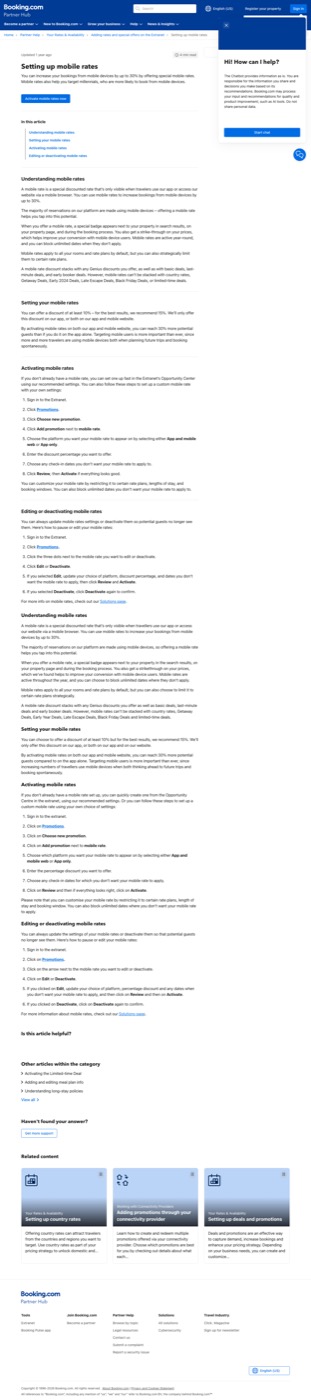
Booking Partner Hub Mobile Rate page captured 2026-05-17. The "we recommend 15%" line is the source of the 23.5% compounded floor when stacked with Genius Level 1.
The compounding rule is what makes the band as wide as it is. The Genius Partner Hub page is explicit: "You can stack up to three discounts in total. Discounts are applied one after another to the base rate" 2. The Mobile Rate page confirms Mobile compounds with Genius (and with basic deals, last-minute deals, and early-booker deals) 1. Multiplicative compounding produces 19-32% off baseline depending on which Genius level the guest holds and how the operator configured Mobile.
Two narrower compounding constraints matter for the audit. Mobile rate does NOT stack with country rates, with limited-time deals, or with the seasonal "Deals" promotions (Getaway, Early Year, Late Escape, Black Friday) 1. A property running one of those programs reduces the maximum stack on the dates those programs are active. The audit window matters because the same hotel can show a 23.5% gap one week (Mobile plus Genius L1, no other active deals) and a 15% gap the next week (Limited Time Deal active, Mobile suppressed for the same booking).
The "you can't just turn Genius off" framing is the third fact. In the Booking Holdings Q4 2024 earnings call, CEO Glenn Fogel stated that travelers in Genius Levels 2 and 3 "represent over 30% of our active travelers" and that those travelers "booked a mid-50s percentage of Booking.com's room nights in 2024" 3. Exiting the program is technically allowed. Doing so removes the operator from a cohort that fills more than half of Booking.com's room-night volume at the network level. Most operators stay enrolled. The article is for those operators.
What a permitted spread looks like in the audit
Consider a 60-room property at $200 ADR on a Tuesday three weeks out. The direct rate is $200. Booking.com, for a non-Genius guest on desktop, shows $200. Booking.com, for the same room presented to a Genius L1 member on mobile with the operator's Mobile rate set to Booking's recommended 15%, shows $153. The gap is $47, or 23.5% off baseline.
The math is exactly the compounded floor: (1 - 0.10) * (1 - 0.15) = 0.765. The guest sees $200 * 0.765 = $153. This is the most common Booking stack an operator with Genius enrolled and Mobile rate at 15% will see in any given week. The published Booking pages 1 2 describe this as the normal program output.
When the rate-parity report scans the same date and finds Booking.com pricing $47 below the direct rate, the gap clears the 5% relative floor (5% of $200 is $10) and lands inside the validator's "this might be a leak" window. The validator then asks whether the projected monthly exposure is above three nights of revenue at this ADR ($600). For a 12-room property at $80 ADR with the same percentage gap, the dollar exposure on a 14-day audit window often falls below the three-night threshold and the validator demotes the verdict to PASS with a diagnostic note that the exposure is below the noise floor of seasonality and weekday mix where operator time to investigate would exceed recovery 4. The validator never claims the demote was triggered by Genius specifically. It only observes that the small dollar exposure is not worth chasing. The Booking program stack is the most common reason such small spreads appear in the first place, but that causal link lives in this article, not in the report's diagnostic note.
Two other shapes count as permitted. A Genius L3 traveler on mobile with the operator running Booking's recommended 15% Mobile setting sees (1 - 0.20) * (1 - 0.15) = 0.68, or 32% off baseline. A Genius L2 traveler on the operator's choice of Mobile minimum (10%) sees (1 - 0.15) * (1 - 0.10) = 0.765, or 23.5%. The 19% bottom of the band (L1 plus Mobile minimum) and the 32% top of the band (L3 plus Mobile recommended) bracket every combination Booking documents.
What separates a permitted spread from leakage is not the size of the discount. It is whether the discount appears on the channels Booking owns or controls. Genius applies on Booking.com. Mobile rate applies on Booking.com and its mobile app. Both are published. Both are visible on the operator's Extranet. Neither shows up on Vio.com, Super.com, MyTrip, Hotelbeds-fed aggregators, or any of the resellers downstream of a bed-bank contract. The next section is about what does.
Common failure modes
Reading a Genius L1 mobile booking as a parity break. This is the failure the article exists to prevent. A 23.5% gap on Booking.com that exactly matches the Genius L1 + Mobile-recommended stack is not a misconfiguration. It is the program firing as designed. Open the Extranet's Genius report and Mobile rate settings before opening a parity ticket.
Booking.com search results showing a Genius price badge visible to the guest. Captured 2026-05-17. The badge appearing in the listing card is the upstream visual the rate-parity audit later observes as a "gap."
The opposite error is just as expensive. Treating the 19-32% band as a license to ignore every Booking-area gap misses real leakage when the same percentage appears on Super.com, Vio.com, or another wholesale-fed aggregator. The Genius stack is not the cause there. Wholesale and bed-bank contracts inherit different rate plans, and a 22% gap on Super.com points to either a leaking opaque rate or a wholesale resale violation. The sibling article on OTA channel tiers and the supply chain walks the four-step investigation order.
Assuming the compounded floor never moves. It moves when the operator activates a Limited Time Deal, Country rate, or a seasonal deal that Booking documents as Mobile-incompatible 1. On the days those deals are active, Mobile rate is suppressed and the maximum spread collapses from 32% down to the Genius-only ceiling of 20%. A 28% Booking gap on a Limited-Time-Deal week should not exist if the operator's configuration is consistent. That is a real signal worth investigating.
Conflating Genius L2/L3 optional extras with the discount is another quiet misread. Genius L2 and L3 add free breakfast and free room upgrades on top of the headline discount 2. Those are inventory-side concessions, not rate concessions, and they do not show up in the rate-parity audit. The article and the validator both measure the rate. If a property is bleeding revenue through breakfast or upgrades, that lives in a different audit lane.
Ignoring the Genius eligibility floor for the property. Booking's eligibility rule is "any property listed on our platform with at least three guest reviews and a review score of at least 7.5" 2. A new listing or a freshly recovering property below 7.5 cannot be in Genius at all, which means the compounded band does not apply. For those properties, every gap above the 5% relative floor is a candidate signal, not noise. The audit should be read accordingly.
Step-by-step diagnostic when the audit fires
- Read the gap as a percentage of the direct baseline, not as a dollar amount. A $47 gap on $200 ADR is 23.5%. A $5 gap on $20 ADR is 25%. Both sit at the compounded floor for Genius L1 plus Mobile recommended. The dollar number alone tells you nothing.
- Identify which channel is showing the gap. If it is Booking.com and the gap fits 19-32%, proceed to step 3. If it is Super.com, Vio.com, MyTrip, Hotelbeds-fed inventory, or any non-Booking-affiliated reseller, skip to the OTA channel tiers playbook in the revenue drainage channels article and the supply-chain article.
- Match the observed gap against your active program stack. Log in to the Extranet (or, if you push rates from SiteMinder, Cloudbeds, Mews, or another channel manager, open that platform's Booking.com rate-plan view since the Mobile rate field may live there instead). Open the Genius dashboard and confirm which Genius level commitments are active (10% L1, 15% L2, 20% L3). Open Promotions and confirm Mobile rate setting (minimum 10%, recommended 15%). Compute the compounded stack for each visible Genius level:
1 - (1 - genius) * (1 - mobile). The observed gap should match one of those numbers within rounding. - Check whether a Mobile-incompatible deal is active on the audit dates. Country rates, Limited Time Deals, Getaway / Early Year / Late Escape / Black Friday deals all suppress Mobile rate during their windows 1. If a Mobile-incompatible deal was running, the compounded stack should collapse. A gap larger than the Genius-only ceiling (20% off) on those dates is a real signal.
- Check the date filter on the audit. A 23.5% gap that appears on three of fourteen audit dates is consistent with mobile traffic on those dates seeing the Mobile rate while desktop traffic on the same dates did not. A 23.5% gap on every audit date is consistent with the gap being baked into your published direct rate, which is the parity question worth opening a ticket on, not a Genius/Mobile question.
- For non-Booking channels showing the same gap, run the wholesale investigation. The four-step order: Tier 1 extranet rate plans, Tier 1 affiliate distribution settings (Hotwire / Orbitz / Travelocity inherit Expedia; Booking-affiliated brands inherit Booking), wholesale and bed-bank contracts (Hotelbeds, WebBeds, Bonotel), regional rate plans bleeding globally. The wholesale leakage validator's action item walks the same order 4.
- Open the parity ticket only when the band is exceeded or the deal-window math does not reconcile. Anything inside the documented Booking permitted spread is not a parity break. It is the program. Filing a ticket for a 23.5% gap that exactly matches the compounded floor wastes operator time and Booking partner-support cycles.
Soft recommendations
Once the audit is clean, two further moves are worth experimenting with:
- Track Mobile rate performance separately from Genius in the Extranet's reporting. The Genius report names views, bookings, and revenue from Genius travelers 2. Mobile rate has its own promotion-level metrics under Promotions. Comparing the two over a few weeks tells you which lever is doing the work on your property, which matters when deciding whether to push Mobile from the 10% floor toward Booking's recommended 15%.
- Pause Genius discounts on peak dates rather than exiting the program. Genius allows 30 (L1/L2) or 60 (L3) suspendable dates per calendar year 2. Mobile rate is unlimited-blockable. Properties with strong demand on specific dates (NYE, conference weeks, summer school holidays) can preserve the demand without forfeiting Genius L2/L3 traveler visibility on the rest of the calendar.
Self-audit checklist
Run this when the rate-parity report fires on a Booking.com gap:
- I converted the dollar gap into a percentage of the direct baseline
- I confirmed the channel showing the gap is Booking.com (not a downstream reseller)
- I checked my active Genius level commitments in the Extranet
- I checked my Mobile rate setting (minimum, recommended, or off)
- I computed the compounded stack
1 - (1 - genius) * (1 - mobile)for each plausible guest type - The observed gap matches one of the compounded numbers within rounding
- I checked whether any Mobile-incompatible deal (Country rate, Limited Time Deal, seasonal) was active on the audit dates
- If the gap appeared on a non-Booking-affiliated reseller, I ran the wholesale investigation order in the supply-chain article
- If the gap exceeds 32% or fails the deal-window reconciliation, I have escalated to a Booking partner-support ticket
- If the gap is inside the band and matches the program, I have NOT opened a ticket
How OTALift surfaces this
The rate-parity report applies a 5% relative floor (max($1, baseline * 0.05)) before counting any gap as a candidate signal. Anything below the floor is dropped as rounding noise 4. Gaps above the floor are aggregated across the audit window into a monthly exposure number, and a three-night demote-to-PASS rule converts low-exposure findings into diagnostic notes rather than action items. The 5% floor was chosen to sit well below the 19% bottom of the Booking permitted spread band documented in this article. Anything narrower than 5% is structurally inside the program stack and not worth flagging. The three-night demote rule is a separate noise-floor protection: small projected exposures get logged for the audit trail but not raised as action items, because operator time to investigate would exceed recovery.
When the validator passes with a diagnostic note, the note describes the noise-floor reasoning behind the demote. The note does not claim the spread was caused by Genius specifically. That causal interpretation lives in this article, and the operator confirms it by checking the Extranet for active Genius enrolment and the Mobile rate setting. When the validator fails, the gap either exceeds the band or appears on a channel Booking does not control, and the action item names the next place to look.
Related articles
- Rate Parity Fundamentals. The post-DMA legal terrain that governs whether an EEA property can offer a public direct rate below the OTA rate.
- Where Your Revenue Leaks: The 7 Drainage Channels. The full leakage taxonomy. Permitted Booking spread sits outside the seven channels; this article is the calibration anchor for distinguishing the two.
- Direct Bookings Without Breaking Parity. The operator's counter-moves on the direct side.
- OTA Channel Tiers: Why You Don't 'List On' Half the Channels Selling Your Rooms. What to do when the gap appears on Vio.com or Super.com, not on Booking itself.
- Pillar: How OTA Ranking Algorithms Actually Work. Where the pricing signal fits in the broader ranking framework.
Sources and methodology
Authored by Anya Cortez · Reviewed by Tim Anastasiou · Last reviewed: 2026-05-17
Anya Cortez is OTALift's hospitality researcher and writes The Labs.
Footnotes
-
Booking.com Partner Hub, "Setting up mobile rates." Captured via Chromium 2026-05-17 because Booking Partner Hub bot-blocks WebFetch. Verbatim quotes: "You can offer a discount of at least 10%, for the best results, we recommend 15%." "A mobile rate discount stacks with any Genius discounts you offer, as well as with basic deals, last-minute deals, and early booker deals. However, mobile rates can't be stacked with country rates, Getaway Deals, Early 2024 Deals, Late Escape Deals, Black Friday Deals, or limited-time deals." Full capture in
research/captures/booking-mobile-rate-page.md. URL: https://partner.booking.com/en-us/help/rates-availability/rates-special-offers/setting-mobile-rates ↩ ↩2 ↩3 ↩4 ↩5 ↩6 ↩7 -
Booking.com Partner Hub, "Genius program for partners." Captured via Chromium 2026-05-11 (cross-anchored from the ota-commercial-visibility-levers capture). Verbatim quotes: "Offer a 10% discount to target travelers at this level" (Genius 1). "Offer a 15% discount to target travelers at this level" (Genius 2). "Offer a 20% discount to target travelers at this level" (Genius 3). "You can stack one discount per category... You can stack up to three discounts in total. Discounts are applied one after another to the base rate." "Guest reviews: Any property listed on our platform with at least three guest reviews and a review score of at least 7.5." URL: https://partner.booking.com/en-us/solutions/genius_program ↩ ↩2 ↩3 ↩4 ↩5 ↩6 ↩7 ↩8
-
Booking Holdings Inc., "Q4 2024 Earnings Call Transcript," February 20, 2025. Glenn Fogel (CEO), prepared remarks: "We are encouraged to see more of our travelers moving into our higher Genius tiers of Level's 2 and 3, which represent over 30% of our active travelers. And these travelers booked a mid-50s percentage of Booking.com's room nights in 2024." Confirmed in the same call by Ewout Steenbergen (CFO): "For our Genius loyalty program, the mix of Booking.com room nights booked by travelers in the higher Genius tiers of as Level's 2 and 3 was in the mid-50% range in 2024, and this mix increased year-over-year." Downloaded as PDF and extracted via pdftotext; cached transcript at
research/captures/booking-holdings-q4-2024-earnings.md. URL: https://s201.q4cdn.com/865305287/files/doc_financials/2024/q4/CORRECTED-TRANSCRIPT-Booking-Holdings-Inc-BKNG-US-Q4-2024-Earnings-Call-20-February-2025-4-30-PM-ET.pdf ↩ -
OTALift's own validator calibration (not published Booking policy), defined in
backend/src/features/reports/report/rate-parity/types.tsand applied invalidators/TierOneParityValidator.tsandvalidators/WholesaleLeakageValidator.ts. Constants:PARITY_GAP_RELATIVE_FLOOR_PCT = 0.05,PARITY_GAP_ABSOLUTE_FLOOR_USD = 1,parityGapFloor(baseline) = Math.max($1, baseline * 0.05),PARITY_DEMOTE_THRESHOLD_NIGHTS = 3. The 5% relative floor was chosen to sit below the documented Booking permitted spread band described above, so the validator does not flag gaps that are structurally inside the program stack. The three-night demote-to-PASS rule is a separate noise-floor protection for small projected exposures (regardless of cause). The validator's own diagnostic note describes the noise floor reasoning, not the Genius rate stack. Full Phase 0 audit at_audit.md. ↩ ↩2 ↩3