
Anatomy of a Direct-Booking Website
Sources: Cloudbeds 2026 commission + State of Independent Hotels data (via Labs #14), Kalibri Labs channel-cost research, Google Hotel Center docs (via Labs #28), Nicolas Sitter Hotel Schema.org Adoption Study 2026 (121,425 hotels), Seyfarth Shaw ADA Title III litigation report 2025, Phocuswright "The AI Surge," and live captures of two real hotel surfaces. Last reviewed: 2026-06-28.
Key takeaways
Your own website is the one booking channel you do not rent. Every OTA booking carries a commission, roughly 15 to 25% of the room rate for an independent hotel 1; a direct booking carries none. That single fact is why a working direct site matters, and why a brochure site that cannot take a booking is a quiet, recurring cost.
We pulled what the research actually says about each part of that site and checked two real hotel surfaces against it. The pattern is consistent: most independents either have no direct site or have one that looks fine and books badly. Across 105,002 hotel homepages parsed in a March 2026 crawl, only 10.6% carried good structured data and the median quality score was zero 2. The basics are rarer than the vendor pitches suggest.
This article is a practitioner checklist, framed as must / should / nice. Must-have is the bar a site clears before it counts as a booking channel at all. Should-have turns it into one that earns bookings. Nice-to-have is the edge once the basics hold. The full Monday-morning version, plus a self-audit you can run without any tool, is in the step-by-step section.
Key numbers
- Independent-hotel OTA commission: roughly 15 to 25% of the room rate; a direct booking carries none 1.
- Hotels with good structured data on their homepage: 10.6% (median quality score: 0), across 105,002 parsed homepages, March 2026 2.
- Mobile share of hotel website visits: about 62%; a one-second delay costs roughly 7% of conversions on the web generally, and 53% of mobile visitors leave a page that takes over three seconds to load 34.
- US federal website-accessibility lawsuits in 2025: 3,117, up 27% year over year, 36% of all ADA Title III filings 5.
- US travelers who used AI to plan, book, or manage at least one trip in the last 12 months: 56%; among Gen Z and millennials, 72% and 74% 6.
Why it moves bookings
Does a hotel need its own website if it is already on Booking.com?
Yes, because the OTA listing is rented and the website is owned. Sell every room through Booking.com and Expedia and you still want a direct site, for one reason that does not change with fashion: commission. An independent pays roughly 15 to 25% of the room rate to acquire a guest through an OTA 1. Kalibri Labs puts direct bookings at about 12.5% more profitable on average, with acquisition costs of 3 to 8% direct versus 13 to 17% through an OTA 7. A direct booking is cheaper to win and keeps the guest relationship on your side of the table.
OTA share of independent bookings keeps climbing. Cloudbeds put it at 63.4% across roughly 90 million bookings in 180 countries, and the same data shows OTA bookings cancel at 21.8% against 10.6% for direct 8. A direct guest is cheaper to acquire and roughly half as likely to cancel. None of that is a forecast. It is the standing cost of selling only through channels you do not own.
There is a second reason, and it is where most direct strategies quietly fail. Being cheaper to you does no good if the guest never sees the direct option. Google is where that comparison happens now. A traveler searching a hotel by name lands on a panel that lists the booking channels side by side, and the headline price is "the lowest price provided across all partners" 9. If your direct rate is missing from that panel, or present but two dollars above an OTA, the direct channel loses the click before the website loads. The site and its visibility on Google are one system, not two. We cover the Google mechanics in google-hotel-ads-free-booking-links-mechanics; here it is one of the must-have tests.
What "great" looks like
A direct-booking site that counts as a channel clears six must-have tests. None of them is a design flourish. Each maps to a booking, a visibility surface, or a risk.
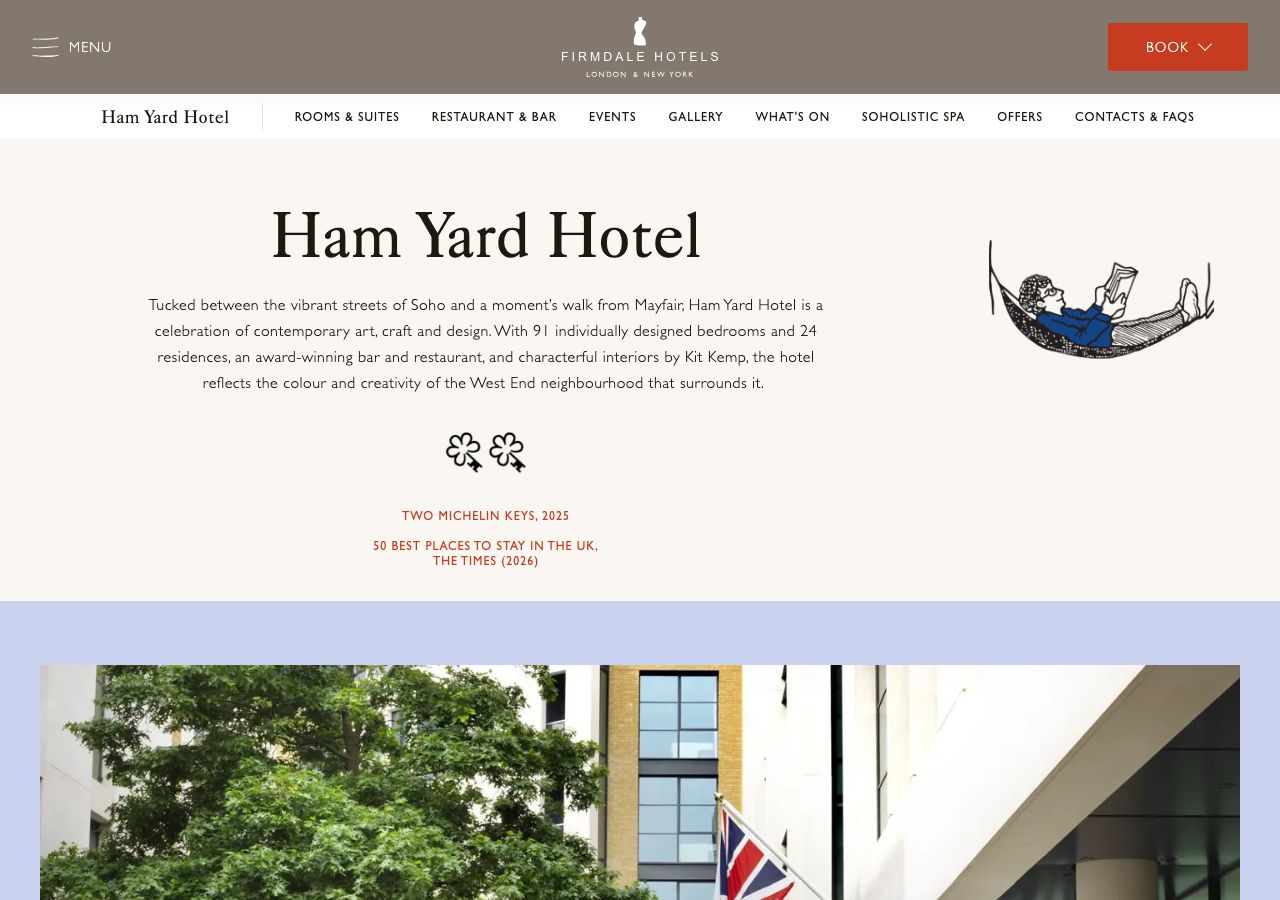
The screenshot above is Ham Yard Hotel, part of the owner-operated Firmdale group in London. Not a chain template. A few things work at once: a BOOK control pinned to the header and repeated in the nav, room copy specific to this property ("91 individually designed bedrooms... interiors by Kit Kemp") rather than OTA boilerplate, and trust signals on the page (Two Michelin Keys 2025, The Times "50 Best Places to Stay in the UK 2026"). Behind the BOOK control is a real booking engine: date pickers, room and guest steppers, a promo-code field, a check-availability step. That is the spine. Here is the full must-have set.
A booking engine on live inventory. Real-time rooms and rates a guest can book in a few steps, not a "request a reservation" email form. The engine has to be wired to your channel manager and your OTAs so the direct rate moves with everything else. Without that sync, the direct rate drifts out of parity and you create the exact problem the rate-parity report exists to catch.
One source of truth across your channels. The rooms, rates, photos, and copy on the direct site should be the same set you keep aligned on every OTA, not a separate island that goes stale. A direct site maintained by hand, apart from the OTA listings, becomes one more thing to reconcile and the first thing to fall behind.
Found on Google. Three pieces: a complete Google Business Profile set to a lodging category, structured data (schema.org Hotel) so search engines read the property correctly, and your direct rate on Google's free booking links so it sits next to the OTAs on the prices panel instead of below them. Free booking links are not gated behind paid ads; a connectivity-partner feed is enough to appear 10. Whether your rate shows at all is decided by Google's price-accuracy score, a five-tier scale from Excellent to Failed 11.
Fast on a phone. Mobile is about 62% of hotel web traffic 3. On the web generally, a one-second delay costs roughly 7% of conversions, and 53% of mobile visitors abandon a page that takes over three seconds 4. Not hotel-specific numbers, but the direction is not in dispute, and Google ranks on mobile performance through Core Web Vitals. Speed is a booking, not a vanity score.
Accessible and secure. Built to WCAG 2.1 AA, served over HTTPS, with secure payment. This is a risk test, not a nicety. In 2025, 3,117 website-accessibility lawsuits were filed in US federal court, up 27% in a year and 36% of all ADA Title III filings 5. The booking widget is the part that gets hotels sued: a guest who cannot complete a reservation with a keyboard or screen reader has a claim even when the building itself is accessible 12. WCAG 2.1 AA is the standard courts apply.
A clear path to book. A clean layout, an obvious call to book on every screen, the fewest steps to a confirmed reservation. Every extra field and every redirect is a chance for the guest to give up and reopen the OTA tab they already had.
Common failure modes
What is the most common mistake on a hotel website?
The most common mistake is a site that looks finished and cannot take a booking. Five patterns show up again and again.
The brochure site. Photos, a phone number, maybe a contact form, no booking engine. It looks like a website and books like a printed flyer. Every guest who lands on it and wants to book gets pushed back to an OTA, and you pay the commission you built the site to avoid.
The direct rate missing from Google. The site exists and takes bookings, but the direct rate never appears on the Google prices panel because no feed connects the booking engine to Google. The guest comparing options sees only OTA rows and books one. This is the exact signal our rate-parity report flags, and the fix is a connectivity-partner feed plus a healthy price-accuracy score, not a paid campaign 1011.
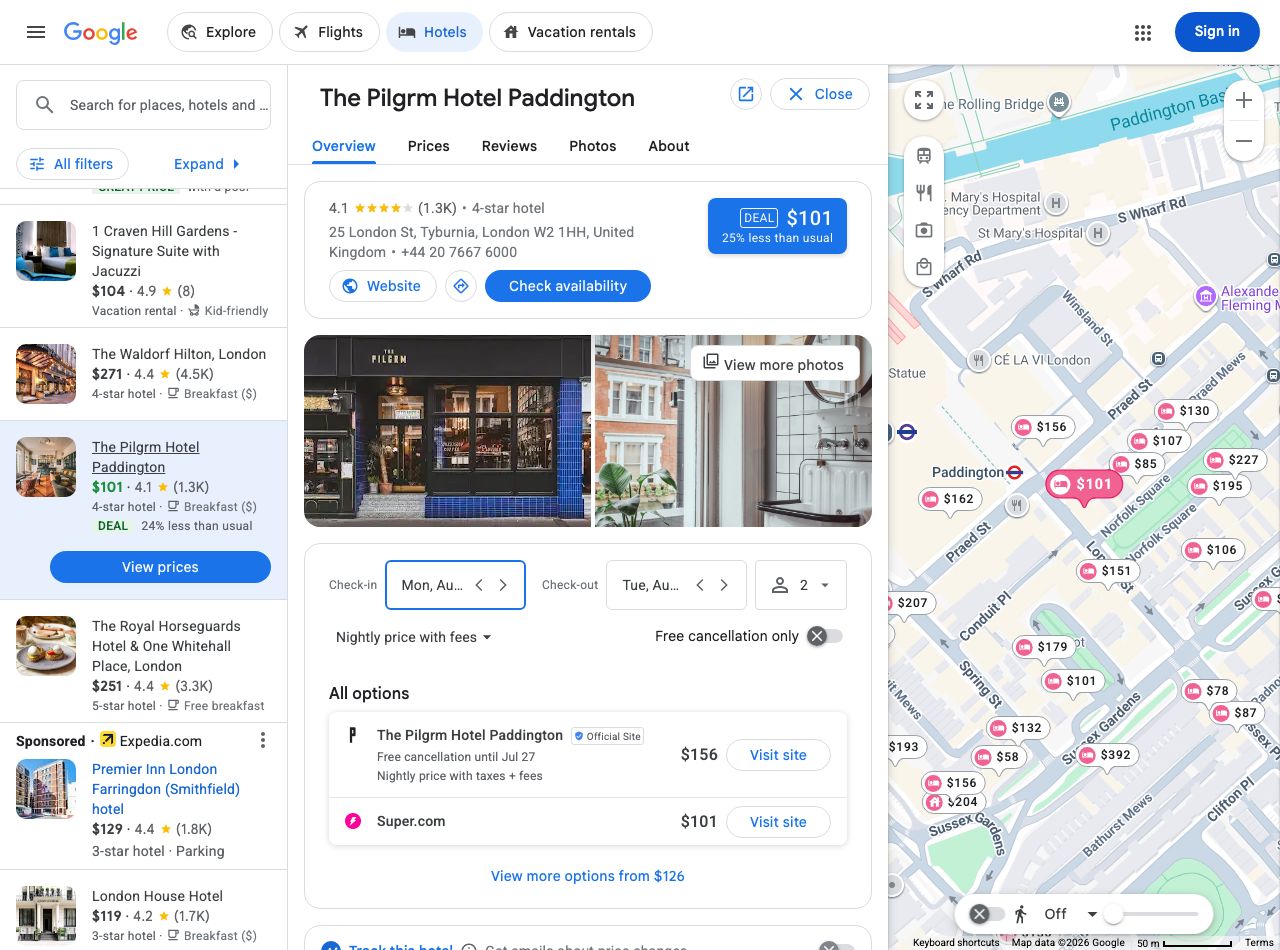
The direct rate present but beaten. Subtle, and the screenshot above shows it on a real independent. The Pilgrm in Paddington is connected: its "Official site" rate appears in the "All options" list at $156. But a secondary OTA, Super.com, shows $101 for the same stay, and that lower number is the headline Google leads with. The property did the hard part and still loses the click, because the direct rate is not competitive on the surface where the comparison happens. A direct rate that is visible but two dollars high is buried as effectively as one that is absent 9. Getting it seen is necessary; keeping it competitive without breaking parity is the discipline in direct-bookings-without-breaking-parity.
The booking engine that locks people out. A booking flow that fails with a keyboard or screen reader, has unlabeled date fields, or traps focus in a calendar widget. It is the single most-litigated part of a hotel site 12, and it silently loses every guest who relies on assistive technology. A widget bolted on without accessibility in mind fails both tests at once.
The site search engines cannot read. No structured data, or the wrong kind. In the March 2026 crawl, 36.3% of hotels had none at all, and 41.1% of those that used JSON-LD described themselves with a generic Organization type instead of a lodging type, which scores zero for hotel purposes 2. A site that does not tell Google it is a hotel, in machine-readable terms, leaves its rich results and its answer-engine visibility on the table.
Step-by-step fix
Run this in order. The first six are the must-have audit; do them before anything below. Most can be checked Monday morning without a tool.
-
Open your own site on a phone and try to book a room. Time it. If there is no real booking engine, or it takes more than a few steps, or it bounces you to a third-party page that looks nothing like your site, that is the first fix. A booking engine on live inventory, synced to your channel manager, is the floor.
-
Search your hotel by name on Google and read the prices panel. Is there an "Official site" row? Is its price at or below the cheapest OTA row? No row means your direct rate is not feeding Google, so connect free booking links through your channel manager 10. A row that is higher than an OTA means a parity or wholesale problem to chase, not a website problem. See
google-hotel-ads-free-booking-links-mechanics. -
Confirm one source of truth. The rooms, rates, photos, and copy on your site should match what you keep aligned on the OTAs. If your site is maintained separately and lags the OTA content, consolidate so there is one set to update, not two.
-
Run a free speed test on your homepage and a room page. Google's PageSpeed Insights gives you the Core Web Vitals. If the mobile score is poor, or pages take over three seconds, fix images and hosting first; those are the usual culprits 4.
-
Test the booking flow with a keyboard only. Unplug the mouse. Can you pick dates, select a room, and reach payment using Tab and Enter? If the calendar traps you or fields are unlabeled, that is both an accessibility-litigation exposure and lost bookings 512. Target WCAG 2.1 AA, and confirm the site is on HTTPS with secure payment.
-
Check your structured data. Paste your homepage URL into Google's Rich Results Test. If it finds no
HotelorLodgingBusinessschema, or reports a genericOrganization, your site is not telling search engines what it is 2. Add validHotelschema with name, address, geo, rating, and amenities. -
Then, and only then, add the should-haves. Once the six basics hold, add the layers that turn a site into a booking channel: SEO pages for your area, room types, and the questions guests ask; the languages your guests book in; your real reviews on the page; analytics so you can see what books; a gallery from your own photos; and direct-only perks (promo codes, packages) that reward booking direct without breaking parity 1.
Soft recommendations
These are the nice-to-have layer. None is required, and none should come before the six must-haves. Treat them as experiments worth running once the basics are clean.
-
Make the site answer-engine ready. A growing share of travelers research trips through AI assistants now; Phocuswright found 56% of US travelers used AI for at least one trip in the last 12 months, 72% for Gen Z and 74% for millennials 6. Those assistants read structured data before prose, which is the same
Hotelschema the must-have section already calls for. One honest caveat: half of travelers who saw an AI answer in search still clicked through to the source site 6. AI visibility shortens the path to your site; it does not replace it. -
Consider an on-page concierge. A chat that answers a guest's question and helps them book without leaving the page, drawing on the property knowledge you already maintain. Useful once traffic and content support it, not a first move on a thin site.
-
Build content and a reason to return. Pages that earn their own search traffic over time, light personalization for returning guests, a standing reason for a past guest to come to your site before an OTA. This compounds slowly and rewards properties that have nailed the basics.
Self-audit checklist
Run this on your own property without our product:
- I can book a room on my own site, on a phone, in a few steps, through a real booking engine on live inventory.
- My booking engine is synced to my channel manager so the direct rate stays in parity with my OTAs.
- My rooms, rates, photos, and copy are one source of truth, not a separate island from my OTA listings.
- Searching my hotel by name on Google shows an "Official site" row, and its price is at or below the cheapest OTA row.
- My homepage and a room page pass Core Web Vitals on mobile and load in under three seconds.
- I can complete a booking using only a keyboard; date fields are labeled; the site is WCAG 2.1 AA and on HTTPS with secure payment.
- Google's Rich Results Test finds valid
HotelorLodgingBusinessstructured data on my homepage, not a genericOrganization. - My real reviews and trust signals appear on the page near the booking decision.
- I have analytics and conversion tracking so I can see what books and what does not.
- I offer at least one direct-only perk (promo code or package) that beats the OTA experience without publishing a lower public rate that breaks parity.
How OTALift surfaces this
OTALift's rate-parity report runs DirectConnectivityValidator on every audited property. It checks one thing on Google Hotels: whether your official direct rate appears alongside the OTA prices in the audit window. It passes if a direct rate shows on at least one date, fails otherwise, and on a fail surfaces an action to connect your booking engine to Google once the price-accuracy feed is healthy. The same signal feeds the Revenue dimension of The First Look. That is the one part of this article the report measures directly: presence of the direct rate on Google.
The honest scope: the report sees the symptom, not the whole site. It cannot today tell you whether your booking engine is accessible, whether your pages pass Core Web Vitals, whether your structured data is valid, or how many steps your booking flow takes. Those are read by a person. The direct-booking-website add-on is how OTALift builds and maintains a site that clears the full must-have bar, on the listing the concierge already keeps in parity.
Related articles
- Direct Bookings Without Breaking Parity. The commission economics and the four fences that let a direct rate undercut OTAs without breaching parity. The discipline behind the competitive-direct-rate must-have.
- Google Hotel Ads & Free Booking Links. How the prices panel, the feed, and the accuracy score decide whether your direct rate is seen on Google.
- Where Your Revenue Leaks: The 7 Drainage Channels. The website closes one of seven; the Super.com-style undercut in this article is another.
- Pillar: The Hotel Revenue Flywheel. How photos, reviews, ranking, and direct demand compound over time.
Frequently asked questions
Does a hotel need its own website if it is on Booking.com?
Yes. An OTA booking costs an independent roughly 15 to 25% of the room rate in commission; a direct booking carries none 1. The OTA listing is a channel you rent and cannot control; your own site is the one channel you own. Most independents either lack a direct site or have one that cannot take a booking.
What features must a hotel website have?
A booking engine on live inventory synced to your channel manager, the direct rate visible on Google's free booking links, fast mobile performance, WCAG 2.1 AA accessibility on HTTPS, valid Hotel structured data, and a clear path to book in a few steps 910. Those are the must-haves; SEO, languages, on-page reviews, and direct-only perks are the next layer.
Does a hotel website have to be ADA accessible?
In practice, yes. US courts apply WCAG 2.1 AA to private business websites under the ADA, and 3,117 federal web-accessibility lawsuits were filed in 2025, up 27% year over year 5. The reservation system is the part most often litigated; a non-compliant booking flow can trigger a claim even when the physical hotel is accessible 12.
How do I get my hotel's direct rate to show on Google?
Connect your booking engine or channel manager to Google as a connectivity partner and activate free booking links; a paid Hotel Ads campaign is not required 10. The rate only shows if your price-accuracy feed scores well on Google's five-tier scale, so confirm the feed is healthy before relying on it 11.
Sources and methodology
Authored by Anya Cortez · Last reviewed: 2026-06-28
Hospitality researcher. Writes The Labs. Drafted with AI research tooling under the Anya Cortez and Tim Anastasiou personas; the named editorial entities are accountable for the work.
Footnotes
-
Cloudbeds, "A Guide to OTA Commission Rates in 2026." Independent-hotel commission averages around 15%, ranging roughly 10 to 25% by market and policy; the marketing-facing figure used across OTALift is "roughly 15 to 25%." Cross-anchored from Labs #14
direct-bookings-without-breaking-parity(footnote 6). https://www.cloudbeds.com/online-travel-agencies/commissions/ ↩ ↩2 ↩3 ↩4 ↩5 -
Sitter, Nicolas. "Hotel Schema.org Adoption Study 2026." Crawl of 121,425 hotel homepages across 7 countries (IT, DE, FR, ES, US, UK, NL), 105,002 parsed (86.5% reachability); crawl March 2026, updated June 2026. Verbatim: "10.6% have what we'd consider a good implementation"; 36.3% have no structured data at all; median quality score 0; 41.1% of JSON-LD hotels use an incorrect business type (34.7% generic
Organization, 28.3% a correct lodging type). https://www.nicolassitter.com/research/hotel-schema-adoption-study-2026 — accessed 2026-06-28. ↩ ↩2 ↩3 ↩4 -
Roomstay / Statista, hotel website conversion and traffic-by-device benchmarks, 2025-2026. Mobile is about 62% of hotel website visits; desktop conversion runs 1.8 to 2.3x mobile (median ~2.9% desktop vs ~1.4% mobile), so mobile performance has outsized booking impact. https://www.roomstay.io/blog/optimising-hotel-average-conversion-rate ; https://www.statista.com/statistics/1350599/conversion-rate-travel-tourism-websites-by-device-worldwide/ — accessed 2026-06-28. ↩ ↩2
-
Google mobile-speed research (Think with Google) and the widely-cited web-performance literature (Akamai / Deloitte lineage), summarized by WIRO and Huckabuy: a one-second delay reduces conversions by roughly 7%, and 53% of mobile visitors leave a page that takes longer than three seconds to load. These are general web-conversion findings, not hotel-specific; the formal thresholds are Google's Core Web Vitals (LCP, INP, CLS). https://www.wiro.agency/blog/how-a-1-second-delay-costs-you-a-7-drop-in-conversions ; https://huckabuy.com/20-important-page-speed-bounce-rate-and-conversion-rate-statistics/ — accessed 2026-06-28. ↩ ↩2 ↩3
-
Seyfarth Shaw LLP, ADA Title III blog, "Federal Court Website Accessibility Lawsuit Filings Bounce Back in 2025" (Kristina M. Launey and Minh N. Vu, March 25, 2026). Verbatim: "the total number of lawsuits filed in federal court alleging that plaintiffs with a disability could not use websites... in 2025 was 3,117. This number is 665 more than 2024's total of 2,452, representing a 27% increase." And: "Website accessibility lawsuits accounted for 36% of the total number of ADA Title III lawsuits filed in federal court in 2025 (3,117 out of 8,667 cases)." https://www.adatitleiii.com/2026/03/federal-court-website-accessibility-lawsuit-filings-bounce-back-in-2025/ — accessed 2026-06-28. ↩ ↩2 ↩3 ↩4
-
Phocuswright, "The AI Surge: Travel's Fastest Behavioral Shift in a Decade" (2025-2026). 56% of US travelers used AI for planning, booking, or in-destination assistance for at least one trip in the past 12 months (up from 43% in 2H25, 33% in 1H25); millennials 74%, Gen Z 72%, Gen X 50%, boomers 27%. Roughly half of travelers who used AI in search still clicked through to source websites afterward. https://www.phocuswright.com/Travel-Research/Consumer-Trends/The-AI-Surge-Travels-Fastest-Behavioral-Shift-in-a-Decade — accessed 2026-06-28. ↩ ↩2 ↩3
-
Kalibri Labs research on guest-acquisition cost and channel profitability: hotels pay 13 to 17% of a night's room rate to acquire through an OTA versus 3 to 8% through brand.com, and direct bookings run about 12.5% more profitable on average. Aggregator citation (Kalibri's primary research is paywalled); cross-anchored from Labs #14 (footnote 5) via Hotel Management. https://www.hotelmanagement.net/operate/new-study-from-kalibri-labs-shows-direct-bookings-push-working ↩
-
Cloudbeds, "2026 State of Independent Hotels Report" (March 2026). Analysis of roughly 90 million bookings across 180 countries: OTA share of independent hotel bookings 63.4%; OTA cancellation rate 21.8% versus 10.6% for direct bookings. Cross-anchored from Labs #14 (footnote 7). https://www.cloudbeds.com/hospitality-industry-report/ ↩
-
Google Hotel Center Help, "How travelers find hotel booking links." Verbatim: "The price shown for a property is the lowest price provided across all partners for a given property," with paid links labeled "Ads" and free booking links under "All options." Cross-anchored from Labs #28
google-hotel-ads-free-booking-links-mechanics(footnote 1). https://support.google.com/hotelprices/answer/9238462 ↩ ↩2 ↩3 -
Google Hotel Center Help, "About hotel free booking links." Free booking links are available to Hotel Center partners at no cost and are not gated on a paid Hotel Ads campaign; a property can participate via a connectivity partner without its own Hotel Center account. Cross-anchored from Labs #28 (footnote 2). https://support.google.com/hotelprices/answer/10472393 ↩ ↩2 ↩3 ↩4 ↩5
-
Google Hotel Center Help, "Price Accuracy Policy." Partners are scored on a five-tier qualitative scale (Excellent, Fair, Poor, At Risk, Failed); below Excellent costs auction position and free-booking-link placement, "At Risk" turns most ads and free links off, and "Failed" turns them all off. Cross-anchored from Labs #28 (footnote 3). https://support.google.com/hotelprices/answer/6064419 ↩ ↩2 ↩3
-
Vizergy via HotelNewsResource, "Top 5 ADA Website Accessibility Issues Triggering Hotel Lawsuits" (March 11, 2026). Verbatim: "The reservation system is often the primary focus of hotel ADA lawsuits. Even if a property is physically accessible, a non-compliant booking experience can still trigger legal action." Used for the hotel-specific framing only; the federal-filings counts come from the Seyfarth Shaw primary at 5. https://www.hotelnewsresource.com/article140351.html — accessed 2026-06-28. ↩ ↩2 ↩3 ↩4