
AI Review Summaries Are the New First Impression
Sources: Which?'s July 2026 investigation into TripAdvisor's AI review summaries, OTA partner documentation from Google, Booking.com, Expedia, and Airbnb, published trade coverage, and live field checks of real hotel listings.
Key takeaways
A UK consumer group's July 2026 investigation found TripAdvisor's AI-generated review summary calling a resort's rooms "spacious" and its cleanliness "spotless," while the underlying reviews for the same property contained 102 mentions of food poisoning and a group legal claim from 412 former guests 1. Google's AI Overview, reading roughly the same review corpus at the time, flagged "outbreaks of illness" for that property instead 2. Same input, two different outputs. That divergence, not a blanket "AI summaries are broken" story, is the real finding here.
We checked what Booking, Expedia, Airbnb, Google, and TripAdvisor actually document about what feeds these summaries, and ran our own live checks on real listings rather than trusting a paraphrase. None of the five states that management responses are an input. Booking's numeric score is explicit that recency is an input 3. TripAdvisor's AI chat assistant draws on recency too, but its static AI summary works differently: a flat 12-month window, refreshed monthly, weighted equally regardless of star rating 2 4. That is a narrower, more useful answer than "nobody knows," because these summaries are becoming the reputation snapshot guests read before anything else.
So do hotel review responses still matter now that an AI summary leads? Response practice is not decoration sitting behind a summary guests never scroll past. It is still what keeps your score current, and it is still what gives a summarizer, when it works correctly, something honest to read. The step-by-step fix below covers exactly what to do about it.
Key numbers
- 102 mentions of food poisoning appeared in the full review corpus for one Which?-flagged resort; TripAdvisor's AI summary called it "spotless" 1.
- 14 of the most recent 32 one- and two-star reviews for that same property specifically described guests falling seriously ill 1.
- Zero of five platforms checked (Google, Booking, Expedia, Airbnb, TripAdvisor) document owner or management response text as an AI-summary input 5 3 6 7 8.
- Booking's Guest Review Score has weighted the most recent three months most heavily since January 2025 3.
Why Hotel Review Responses Still Matter With AI Summaries
Does responding to reviews still matter now that an AI summary is what guests see first?
Yes, for close to the same reasons it mattered before a generated paragraph sat above the review list. Your response still feeds the score that drives ranking, and it still reaches every guest who reads past the summary, which most of them do 9 10. What actually changed is that the summary is often the first thing a guest reads, and none of the five platforms we checked documents your response text as something their summarizer reads. Academic research on the summary layer specifically, not just on owner responses, is starting to catch up to the platforms: a 2025 hospitality-management study on AI-generated versus human-generated review summaries found the summary's source affects booking intention on its own, before a guest ever reaches the response text underneath it 11.
Reviews and responses have always fed one number that decides your reputation and how visible you are before a guest ever reaches your listing. A new AI-written paragraph now sits in front of that number on three of the platforms most independent hotels depend on. Booking.com is testing a GenAI "Review Summaries" feature that distills reviews into a short paragraph highlighting what matters most to a given traveler 6. Expedia's separate Guest Review Summary feature has been live since 2023 and surfaces "what guests liked and didn't like about a property right up front" 7. TripAdvisor's static AI summary draws from the previous 12 months of reviews, refreshed monthly and weighted equally regardless of star rating; its separate AI chat assistant pulls by detail and recency instead 2 4. Both turn the reviews they read into short, plain-English overviews, by the company's own description 2.
None of that changes what actually drives your Guest Review Score today. Booking has weighted it by recency since January 2025, with the most recent three months carrying the most weight 3. Your response is not a documented scoring input there either, but the review it answers still is. Respond to a negative review and the review itself, not your response text, is what the recency-weighted score reads.
What actually generates these AI summaries?
Each platform's own AI model reads its pool of guest reviews and generates a short synthesis from them. What differs is how precisely each one documents that scope. Google is the most precise of the five: its documentation states its place summaries are "based solely on user reviews," and it is the only platform that names a clear negative, what it does not use, as plainly as what it does 5. Booking, Expedia, and Airbnb describe what their summaries do (distill, highlight, synthesize) without stating what they leave out. Airbnb's own copy is ambiguous on whether "reviews" means guest reviews specifically or guest and host reviews together 8. None of the five, anywhere we checked, states that management responses feed the summary.
That is a genuinely different claim than "nobody knows what these things read." Booking's numeric score is explicit that recency is an input, and so is TripAdvisor's AI chat assistant, which pulls by detail and recency by its own description 3 4. TripAdvisor's static summary works differently: a flat 12-month window, weighted equally regardless of rating 2. State what's documented. Hedge what genuinely isn't. Don't assume a hidden surveillance layer, and don't assume total opacity either.
What "great" looks like
A well-behaved AI summary doesn't read like a five-star press release. It carries the friction a fair reading of the underlying reviews would surface, praise and complaints both, in language a guest can act on.
Example 1: Hotel Arts Barcelona
We ran a live search for "Hotel Arts Barcelona reviews" and captured Google's AI Overview directly, rather than trusting someone else's screenshot 12. The summary praised the location, the Ritz-Carlton-level service, and the amenities, then closed with a section titled "Room for Improvement," naming three specific complaints pulled from real reviews: the historic city center sits a longer walk away than some guests expect, the adult-only pool can feel crowded in peak summer, and ongoing property renovations affect some public areas.
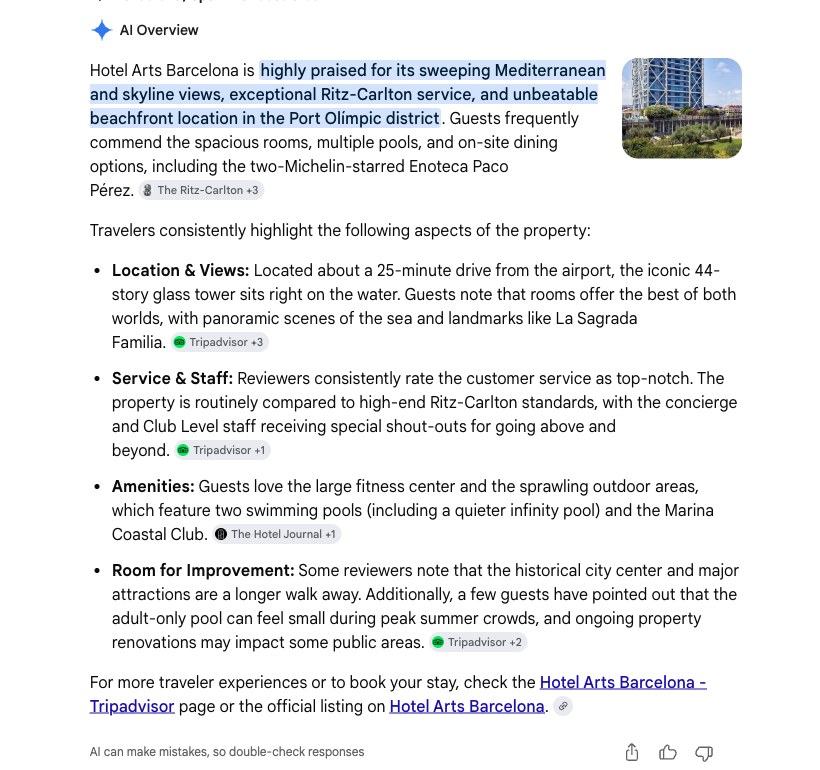
Why it works: the summary doesn't flatten the property into an average tone to sound polished. It names specific, sourced friction a prospective guest can weigh against the praise, close to how a careful reader working through the actual reviews would read them. Done honestly, that's what "based solely on user reviews" produces 5.
Example 2: what the platforms themselves are willing to specify
None of this needs to be a black box, even where it's genuinely underdocumented. Booking's Partner Hub is precise about the one mechanic hoteliers can verify and act on directly: the Guest Review Score's three-month recency window 3. A named window beats a vague "recent reviews matter" every time, because you can actually plan around it. When a platform documents a mechanic precisely, take it at its word and act on that exact mechanic. When it doesn't, say so instead of guessing at what its model weighs.
Common failure modes
The same summarizer can smooth over the same problem twice
TripAdvisor's AI summary for a Cape Verde resort flagged in the Which? investigation described "spacious rooms," "diverse restaurants," and cleanliness as "spotless," against a corpus containing 102 mentions of food poisoning and a legal claim from 412 former guests 1. At the time of the investigation, Google's AI Overview for the same property surfaced the problem instead, warning of "outbreaks of illness" 2. One structural explanation for why a summarizer smooths criticism over: models like this tend to sand down harsh language because most of their training data leans bland and polite, according to Duncan Brumby, a professor of human-computer interaction at UCL 13.
We went back to that same property ourselves, three weeks after the story broke, and searched it again 14. Google's AI Overview no longer mentioned illness as a concern. Its "Health Concerns" note now read that past reviews mention anxiety about stomach bugs, framed as usually tied to guests skipping hand-washing at the buffet rather than food handling, and that careful guests report no problems.
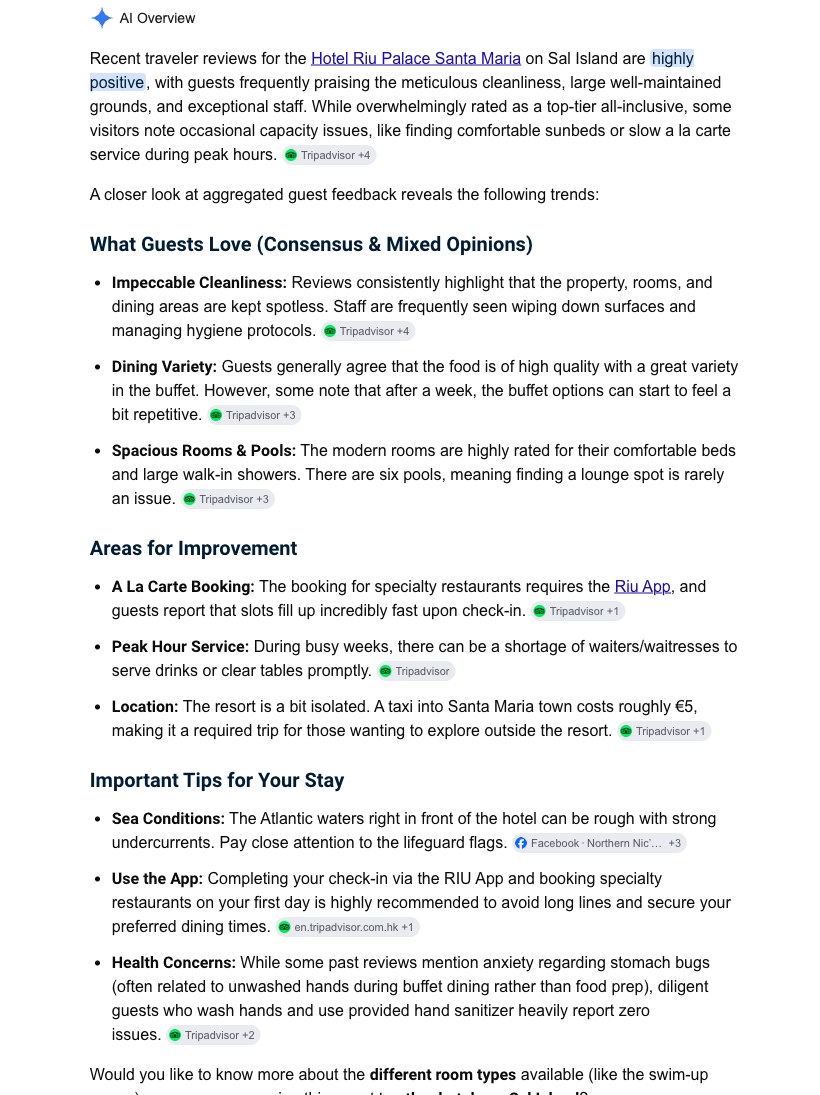
What's wrong: we don't know whether the underlying review mix genuinely shifted in three weeks or the summarizer weighted the same corpus differently on a second pass. Either way, the lesson isn't "TripAdvisor got it wrong and Google got it right." It's that an AI summary is a snapshot, not a permanent verdict. TripAdvisor refreshes its summary monthly from a flat 12-month window, weighting reviews equally regardless of star rating 2. That's exactly how 14 recent food-poisoning reviews get diluted into "spotless." Booking and Expedia don't publish a refresh interval at all. A property that fixes a real problem can't assume the summary reflects that immediately. One that hasn't fixed anything can't assume today's flattering summary holds tomorrow either.
How it hurts: an operator who checks a summary once, good or bad, and calls it settled is making a decision on data that may already be stale by the time the next guest reads it.
A second, independently confirmed divergence
For the Britannia International hotel in London, the same investigation's coverage found Google's overview accurately describing it as frequently rated among the worst hotel chains in the UK, using guest language like "filthy" and "horrendous," while TripAdvisor's summary for that property said guests "often praise the clean rooms" and described the atmosphere as "charming" 2. Two properties, two platforms, the same direction of divergence. Name the pattern: it is not proof that TripAdvisor's summaries are broadly unreliable. The investigation sampled five flagged properties, not a representative slice of the platform 1.
Treating "the AI summary" as one product
Booking's Review Summaries, Expedia's Guest Review Summary, and TripAdvisor's static summary and chat assistant are four separate features built by three separate companies on three separate models 6 7 2. Advice written for "the AI summary," singular, is advice that won't survive contact with any one of them specifically. Ask which platform, which feature, and what it actually documents before you act on anything you read about influencing it.
Step-by-step fix
- Pull your last 90 days of reviews on every platform you use, sorted by star rating. This is the raw material any summarizer on that platform is most likely reading right now, per the recency language the platforms that disclose anything actually disclose 3 4.
- Respond to every 1- and 2-star review inside the platform's stated moderation window. Booking's moderation can run up to 72 hours, per the moderation mechanics covered in Responding to Negative Reviews; plan for that, not the older 48-hour rule of thumb a lot of hoteliers still use.
- Treat any safety-adjacent complaint (illness, injury, security) as a same-day priority, not a queue item. TripAdvisor's own stated suppression criteria for AI summaries name death, drugging, and sexual assault specifically 4. Food poisoning, per the company's own stated criteria, is not automatically on that list. Don't assume a serious-sounding complaint gets special handling from the platform. Assume it doesn't, and respond like it's on you.
- Check your own listing's AI summary on each platform where one appears, at least monthly, matching TripAdvisor's own refresh interval 2. The Riu Palace Santa Maria case above shows the exact same summary can read differently three weeks apart, in either direction.
- Screenshot it and note the date every time you check. Only TripAdvisor publishes a refresh interval, monthly, from the trailing 12 months 2. Booking and Expedia don't, so a dated screenshot is the only record you'll have of what a guest actually saw on a given day, which matters if a dispute ever comes up.
- Keep responding to a sample of positive reviews too, at a lower rate than negatives. The response corpus itself is what these summaries and the underlying scores are reading. A corpus with nothing but defensive responses to complaints reads differently than one showing routine, human engagement across the board.
- Don't build a strategy around gaming a specific summarizer. None of the five platforms documents response text as an input today. Optimize what's actually documented: recency, response rate, response speed. Let the summary follow a healthier corpus, because that's the one lever every platform here confirms exists.
If you only fix one thing from this article, fix your response time on negative reviews. Everything else here is secondary to that.
Soft recommendations
- If you run a channel manager (SiteMinder, Cloudbeds, Mews, RezGain), check whether it surfaces any AI-summary text in its dashboard yet. Most don't. Knowing that gap now avoids a surprised conversation with an owner later.
- Try a quarterly exercise where front-desk or ops staff read your listings' current AI summaries out loud. Staff who talk to guests daily often catch a stale or wrong line faster than a monthly report will.
- If your property has ever had a genuinely serious complaint (illness, safety, security), keep your own dated log of it and your response, independent of whatever any platform's summary currently says. That record may matter for reasons that have nothing to do with search visibility.
Self-audit checklist
Run this on your own listing without our product:
- I've read my own AI-generated summary, where one exists, on Google, Booking, Expedia, and TripAdvisor in the last 30 days.
- My response rate on 1- and 2-star reviews is at or near 100 percent.
- I respond inside each platform's stated moderation window, not one I've assumed.
- Every safety-adjacent complaint in my last 90 days got a same-day response, not a queued one.
- I have a dated screenshot of my current AI summary on file, not just a memory of what it said.
- I'm not assuming any platform's summarizer reads my response text. I'm treating recency and response rate as the levers I actually control.
How OTALift surfaces this
EngagementValidator measures response rate and response time directly off the reviews OTALift has scraped for your property, not off any platform's AI-generated summary text. It has no visibility into, and makes no claim about, what Booking, Expedia, or TripAdvisor's summarizers do with that same corpus. One of its shipped action items already leans on the Ipsos MORI impression-lift research and Booking's recency-weighted score to explain why slow responses cost you 9 3. This article is the honest complication to that assumption, not a contradiction of it: a guest reading an AI summary first doesn't stop reading the reviews underneath it, and the response-rate math the validator tracks still feeds the score regardless of what sits above the review list. For a deeper read on how to look at that same review corpus for recurring themes rather than just its star average, see Review Theme Clouds: Reading Mention-Weighted Guest Feedback.
Related articles
- Responding to Negative Reviews: Templates That Recover Bookings. The response templates and 48-72 hour timing mechanics this article assumes you're already running.
- Reviews Plus Owner Answers: The Combined Booking Economics Under 2026 OTA Ranking. The Cornell and Ipsos MORI research behind why response rate and valence still move your score and your conversion.
- Review Signal Quality and Corpus Shape: When Your Average Rating Is Lying to You. Why the shape of your underlying corpus, not just its average, is what any summarizer, human or AI, is actually reading.
- Pillar: The Hotel Revenue Flywheel: Photos to Reviews to Ranking to Price Power. How reviews fit into the full chain from listing quality to price power.
Frequently asked questions
Does responding to reviews still matter now that AI summaries show up first?
Yes. Your response still feeds the recency-weighted score that drives ranking, and it's still visible to any guest who reads past the summary. No platform we checked documents response text as a summary input, but recency and response rate still are 3 4.
Does Booking.com's AI review summary use my management responses?
Undocumented either way as of this research. Booking's numeric Guest Review Score is explicitly recency-weighted since January 2025, but that's a separate feature from its GenAI Review Summaries, which was still in testing as of its October 2024 announcement 3 6.
Does TripAdvisor's AI summary update if I resolve a guest complaint?
TripAdvisor refreshes its summary monthly from the previous 12 months of reviews, weighted equally regardless of rating 2. A resolved complaint ages out gradually as it drops out of that trailing window, and the summary can still lag up to a month behind reality even after it does.
What do Booking, Expedia, and TripAdvisor's AI summaries actually read?
Guest reviews, per every platform's own documentation. Google is the most explicit, stating its summaries are "based solely on user reviews" 5. The others describe function without scoping input as precisely. None state that management responses are part of it.
Did AI review summaries hide safety problems at real hotels?
Yes, in one documented case. TripAdvisor's summary called a resort "spotless" against a corpus with 102 mentions of food poisoning; Google's AI Overview flagged "outbreaks of illness" for the same corpus 1 2. The lesson: the corpus behind the summary, not the summary, is what you control.
Sources and methodology
Authored by Anya Cortez.
Anya Cortez is OTALift's hospitality researcher, covering how independent hotels sell, operate, and rank across the OTA ecosystem.
Footnotes
-
Which?, "TripAdvisor AI tool gives glowing reviews to dangerous hotels, Which? finds," July 2026. Investigation of 5 properties including Riu Palace Santa Maria (Cape Verde): TripAdvisor's AI summary described the resort as "popular with many travellers" with "spacious rooms" and cleanliness "spotless," against a corpus containing 102 mentions of food poisoning and 14 of the most recent 32 one- and two-star reviews describing serious illness. 412 holidaymakers reported becoming ill, with 7 deaths reported since 2023 tied to a group legal claim. https://www.which.co.uk/policy-and-insight/article/tripadvisor-ai-tool-gives-glowing-reviews-to-dangerous-hotels-which-finds-adbnO9E3Dr2O — accessed 2026-07-20. ↩ ↩2 ↩3 ↩4 ↩5 ↩6
-
Euronews, "Tripadvisor AI summaries give glowing reviews to dangerous hotels, consumer watchdog finds," July 3, 2026. Confirms Google's AI Overview flagged "outbreaks of illness" for the property Which? investigated, and reports a second divergence at the Britannia International hotel, London (Google: frequently rated among the worst hotel chains in the UK, guest words "filthy"/"horrendous"; TripAdvisor: guests "often praise the clean rooms," atmosphere "charming"). Also carries TripAdvisor's own account of its method: its summaries "use large language models and natural language processing to read recent reviews, identify the most common themes and then turn those themes into short, plain-English overviews," and TripAdvisor's statement that summaries "are updated on a monthly basis and are rooted in the previous 12 months of reviews at the time of each update," with reviews "treated equally regardless of rating." https://www.euronews.com/travel/2026/07/03/tripadvisor-ai-summaries-give-glowing-reviews-to-dangerous-hotels-consumer-watchdog-finds — accessed 2026-07-20. ↩ ↩2 ↩3 ↩4 ↩5 ↩6 ↩7 ↩8 ↩9 ↩10 ↩11 ↩12 ↩13
-
Booking.com Partner Hub, "Improving your Guest Review Score." Direct quote: "As of January 2025, your overall Guest Review Score is weighed by recency, which means the most recent review has the biggest impact on your property's overall score." https://partner.booking.com/en-us/help/guest-reviews/general/improving-your-guest-review-score — accessed 2026-07-20. ↩ ↩2 ↩3 ↩4 ↩5 ↩6 ↩7 ↩8 ↩9 ↩10
-
Travel Weekly (UK), "Tripadvisor defends AI hotel summaries against claim they can mislead," July 2026. Full TripAdvisor spokesperson statement includes: "Our systems automatically suppress AI summaries for listings that feature warnings from travellers about serious safety incidents such as death, drugging or sexual assault... Our AI-powered chat assistant draws from a selection of reviews based on detail and recency, and matches by language and context." https://travelweekly.co.uk/news/tripadvisor-defends-ai-hotel-summaries-against-claim-they-can-mislead — accessed 2026-07-20. ↩ ↩2 ↩3 ↩4 ↩5 ↩6
-
Google, Places API documentation, "AI (review) summaries." Scope statement: "AI-generated summaries of places based solely on user reviews." Requires a "Summarized with Gemini" disclosure string; supported in English (18 regions), Japanese, Portuguese (Brazil), and Spanish (13 regions) as of this research. https://developers.google.com/maps/documentation/places/web-service/review-summaries — accessed 2026-07-20. ↩ ↩2 ↩3 ↩4
-
Booking.com news, "Booking.com enhances travel planning with new AI-powered features." Confirms Review Summaries as a distinct GenAI feature, in testing as of this release: "Booking.com is testing Review Summaries... the tool will further distill reviews into tailored summaries to highlight what matters most to them, whether that is parking availability or wheelchair accessibility." https://news.booking.com/bookingcom-enhances-travel-planning-with-new-ai-powered-features--for-easier-smarter-decisions/ — accessed 2026-07-20. ↩ ↩2 ↩3 ↩4
-
Expedia Group Tech (Medium), "Traveling just got a whole lot smarter with Romie." Guest Review Summary described as summarizing "what guests liked and didn't like about a property right up front," live since 2023 and enhanced in the 2024 Spring Release; a separate feature from Romie, Expedia's trip-planning assistant from the same release wave. https://medium.com/expedia-group-tech/traveling-just-got-a-whole-lot-smarter-with-romie-dfb9b21c07c5 — accessed 2026-07-20. ↩ ↩2 ↩3
-
Airbnb Newsroom, "New ways to discover, plan, and travel on Airbnb" (2026 Summer Release). Direct quote: "Our models synthesize reviews for each listing and highlight things you care about the most including location, amenities, family-friendliness, and more." Does not scope guest-only versus guest-and-host review input. https://news.airbnb.com/airbnb-2026-summer-release/ — accessed 2026-07-20. ↩ ↩2
-
TripAdvisor / Ipsos MORI joint study, December 2019. 77 percent of travelers more likely to book after seeing owner responses to reviews; 89 percent report a thoughtful response to a negative review improves their impression of the business. https://tripadvisor.mediaroom.com/2019-12-12-TripAdvisor-Study-Reveals-77-of-Travelers-More-Likely-to-Book-When-Business-Owners-Respond-to-Reviews — verified in
reviews-plus-answers-combined-effect/research/sources.md. ↩ ↩2 -
Anderson, C. K., and Han, S., "Hotel Performance Impact of Socially Engaging with Consumers," Cornell Center for Hospitality Research, 2016. Responding to all negative reviews lifts review score 1.65 percent ("if they also then started responding to all positive reviews their score would drop by 2.46 percent"); the response-rate inflection point sits near 40 percent — both figures re-verified directly against the source PDF, 2026-07-20. https://hdl.handle.net/1813/71227 — accessed 2026-07-20. (The
sha.cornell.eduURL previously cited here and inreviews-plus-answers-combined-effect/research/sources.mdnow 301-redirects to an unrelated Cornell page; this is the current permanent link via Cornell eCommons.) ↩ -
Jia, S., Chi, O. H., and Chi, C. G. (2025), "Unpacking the impact of AI vs. human-generated review summary on hotel booking intentions," International Journal of Hospitality Management. DOI 10.1016/j.ijhm.2024.104030. Bibliographic record confirmed via Crossref; abstract paywalled at ScienceDirect. https://doi.org/10.1016/j.ijhm.2024.104030 — accessed 2026-07-20. ↩
-
Google Search AI Overview for "Hotel Arts Barcelona reviews," screenshot captured by OTALift research, 2026-07-20. ↩
-
Digital Trends, "AI wants to summarize it all. TripAdvisor's misleading reviews show AI will also ruin your travel plans." Duncan Brumby, professor of human-computer interaction at UCL, on why summarizers soften harsh feedback: AI models tend to sand down harsh criticism because most of their training data leans bland and polite. https://www.digitaltrends.com/computing/ai-wants-to-summarize-it-all-tripadvisors-misleading-reviews-show-ai-will-also-ruin-your-travel-plans/ — accessed 2026-07-20. ↩
-
Google Search AI Overview for "Riu Palace Santa Maria Cape Verde reviews," screenshot captured by OTALift research, 2026-07-20, roughly three weeks after the Which? investigation published. ↩