
Reading Time-Based Parity Signals: Lead Time, Day-of-Week, and Channel Sync Lag
Sources: Abrate et al. and Guizzardi et al. peer-reviewed studies on hotel dynamic pricing, STR data on day-of-week performance via Revenue Hub and HospitalityNet, Prostay channel-manager sync guide, Booking.com Connectivity developer documentation, SiteMinder rate-parity explainer, AltexSoft and Cloudbeds bed-bank references. Last reviewed: 2026-05-11.
Key takeaways
Rate parity by lead time, by day of week, and by channel can all shift for legitimate reasons. Hong Kong hotel pricing data shows 96.83 percent of properties adjust their rates at least once inside the 0-7 day pre-arrival window, with a modal frequency of five price changes per week 1. A separate 705-hotel U.S. study found rate dispersion peaks around 60 days before arrival across most hotel classes 2. Prices move by design. The question a parity audit actually answers is whether YOUR channels agree with each other on the same day, not whether the market agrees with itself.
Three time-shaped signals show up in every rate-parity report: parity by lead time (does the gap between direct and OTAs change as the check-in date approaches?), parity by day of week (do the gaps differ on weekends vs weekdays?), and rate dispersion across channels (how spread out are the prices at one moment in time?). Each of the three looks like it could be a sync break or intentional revenue management.
Accept that legitimate variation exists. Then look for the specific pattern that signals a real sync problem: a persistent same-channel same-sign gap that survives the sync window.
Why "30 OTA channels moving together" is a misread of how the market works
Consider the adjustment data. In the Hong Kong study, 96.83 percent of hotels changed price at least once during the 0-7 day window, with a mode of five changes across seven days 1. That is roughly one adjustment per property per day in the immediate-arrival window. A hotel pushes a rate change into its PMS, the PMS publishes to the channel manager, each OTA applies its own rate-plan logic, and the rendered price lands on Google Hotels at a different moment for every channel.
Industry guidance puts PMS-to-Expedia propagation in the 10-to-15-minute range. Prostay's sync guide is explicit: "if the PMS updates inventory every 10-15 minutes, a room sold on one OTA may still appear on another," and notes Airbnb specifically "may take hours to reflect" pushes 3. Booking.com publishes no public push-frequency spec; its Rates & Availability API instructs partners to send delta updates and break batches to one month per request 4, leaving throughput to the PMS + channel manager implementation. SiteMinder claims "in seconds" across the full footprint 5, vendor marketing without independent benchmarks.
Inside the 0-7 day window, a property that changes its direct rate daily (within the 96.83 percent norm) will on most scrapes show some channels synced and some still displaying the prior rate. That is not a parity break. That is the clock. Stop reading every gap in the audit as a broken clause.
The three time dimensions and what each one measures
Every rate-parity audit reports on three dimensions that vary with time, and each measures something different.
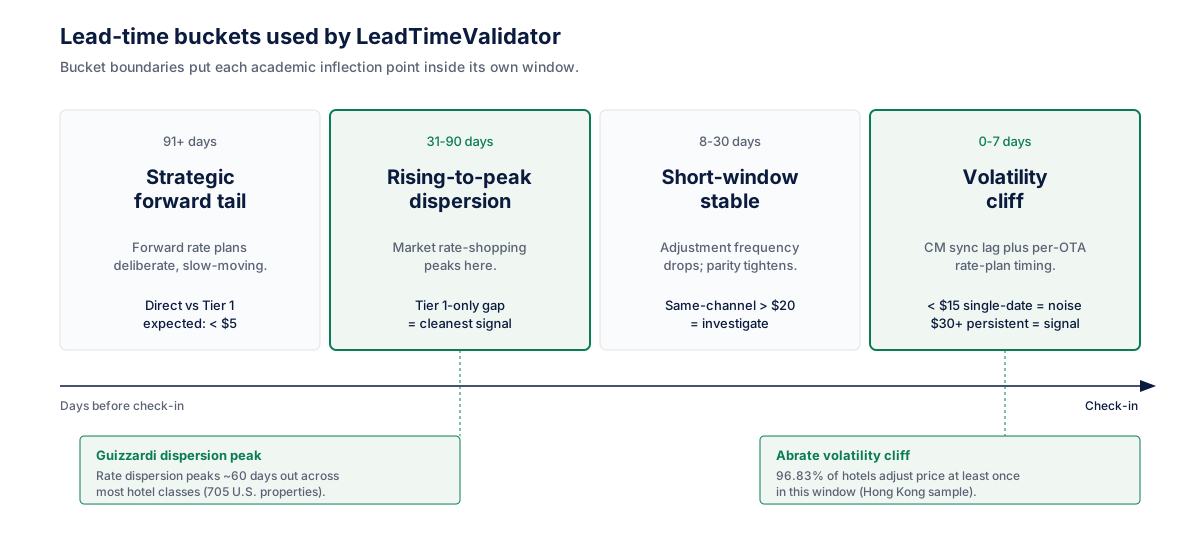
Lead-time parity, measured by the LeadTimeValidator, is the gap between direct rate and the lowest Tier 1 OTA, bucketed by how many days remain until check-in. Answers: does parity hold differently for next-week bookings versus two-months-out bookings? A healthy rate plan shows tight parity at 90+ days (strategic forward pricing is deliberate and stable) and acceptable drift inside 0-7 days (the volatility cliff).
Day of week rate parity (WeekendParityValidator). The same gap, bucketed by whether the check-in date is a weekday (Mon-Thu) or weekend (Fri-Sat) per STR's classification 6. Answers: does parity hold differently on high-demand days? STR data from Revenue Hub shows the absolute rate variance is large: Houston runs a 23.1 percent / $56.38 spread weekday-vs-weekend; NYC shows 9.1 percent / $56.81 despite higher baseline occupancy 7. That variance is about WHEN rates differ across the week, not whether they agree across channels on the same day.
Rate dispersion (RateDispersionValidator). The spread of prices across all channels on a given date. A high number here means the channels disagree. Guizzardi et al. found that dispersion peaks around 60 days prior to arrival across most hotel classes in their 705-property U.S. sample 2. Rising dispersion in the 30-to-90-day window is a market signal (revenue managers are rate-shopping aggressively), not a synchronization failure.
The validator outputs look similar but the diagnostic is different for each. Operators conflate these three signals constantly. Don't.
Rate parity by lead time: four buckets from volatility cliff to forward tail
The LeadTimeValidator splits audit dates into four windows chosen to land the two academic inflection points inside their own buckets:
- 0-7 days: the volatility cliff. Abrate et al. show 96.83 percent of properties adjust price at least once in this window 1. Channel manager sync lag plus per-OTA rate-plan timing produces legitimate drift. Single-date single-channel gaps under fifteen dollars are noise. Sustained same-channel gaps of thirty dollars or more across multiple dates are signal.
- 8-30 days: short-window stable. Price-change frequency drops. Parity should tighten. A same-channel gap above twenty dollars on most dates is worth investigating.
- 31-90 days: rising-to-peak dispersion. Guizzardi et al. place the dispersion peak around 60 days out 2. The market is rate-shopping itself. YOUR channels should still agree with each other on the same date even while the market spread widens. A Tier 1-only divergence (not Tier 3) in this window is the cleanest "real problem" signal.
- 91+ days: strategic forward tail. Your forward-booking rate plans are deliberate and slow-moving. Parity should be tight (under five dollars between direct and Tier 1). A gap of ten dollars or more on most dates implies an incorrectly-loaded forward rate plan.
These thresholds are not industry benchmarks. They are working practitioner heuristics derived from the academic findings plus the sync-latency framing. We ship them because operators need a rule. We will tighten them when we can publish our own benchmark data.
Day-of-week rate parity: separating ADR variance from parity variance
Operators looking at a report that says "parity breaks more on weekends" often read the sentence as "my weekend rate is broken." It usually is not. Two different metrics share similar-sounding language.
The first is day-of-week ADR variance: the fact that the same room sells for different prices on different days. STR's classification treats Mon-Thu as weekdays and Fri-Sat as weekends 6. Urban business markets (NYC, Chicago, downtown Houston) pay more mid-week because business travelers pay more; leisure markets (New Orleans, Nashville, Miami) pay more on weekends. STR data from Revenue Hub shows this is a large and legitimate spread: Houston 23.1 percent, NYC 9.1 percent 7. That spread is the revenue manager's job. It is not a parity problem.
The second is day-of-week parity variance: whether the GAP between direct and the lowest Tier 1 OTA changes by day of week. This is what the validator actually measures. If direct is 321 on every night, and Tier 1 OTAs average 321 on Mon-Thu and 295 on Fri-Sat, then something is applying a weekend discount to the OTAs that is not applying to direct. That is a sync break, and the fix is in the channel manager's day-of-week rate plan rules or in the direct booking engine's promotion configuration.
Treat "ADR varies" and "parity varies" as two axes. ADR variance across days is expected. Parity variance across days is not. Conflate the two and you'll fix a non-problem (flattening ADR across the week) while missing the real one (weekend rate plans out of sync with direct).
Hotel rate dispersion: tier matters before the number does
A headline rate-dispersion number like "48.5 percent spread across channels" looks alarming. It only becomes a real signal once you know WHICH channels are contributing to the spread.
Dispersion across Tier 3 channels (the long tail of wholesale-fed and affiliate-network resellers) is structural. Super.com and Vio.com source inventory from bed banks 8, and the supply chain between a bed-bank contract and a Tier 3 display surface produces a wide natural spread. The OTA channel tiers article covers this in detail. High Tier 3 dispersion on any given day is a sign that your wholesale contracts are active, not that your pricing is broken.
Dispersion across Tier 1 channels is the signal that matters. When Booking.com, Expedia, Hotels.com, Agoda, and Trip.com disagree with each other by more than five dollars on the same date, something is pulling rates from different plans. The most common causes are an opaque rate accidentally public-facing, a member-rate fence misconfigured in one Tier 1 extranet, or an affiliate brand (Hotwire, Orbitz, Travelocity inside Expedia Group) pulling from a different rate plan than its parent. Each fix lives in the relevant Tier 1 extranet.
Our RateDispersionValidator currently reports a single total-spread number. The research for this article surfaces a product recommendation: split dispersion into per-tier numbers so the signal is cleaner. That change lives in the backlog; for now, when you see a high dispersion number in your report, mentally decompose it by tier before acting.
Common failure modes
The most common false alarm: a single channel dipping five-to-ten dollars below direct on one date inside the 0-7 day window. That is the sync drift envelope, not a leak. Two rules filter the noise out. Require the same channel to show the gap on ≥2 dates before investigating, and require at least 30 minutes between audit runs before declaring a break.
The second most common error is reading "weekend parity gap" as a weekend ADR problem. The validator measures direct-vs-OTA gap on the same day. It does not measure the weekend-minus-weekday ADR difference. If direct holds flat and OTAs flex, that is an OTA pricing rule firing, not a parity violation. Fix the OTA rate plan, not your weekend ADR.
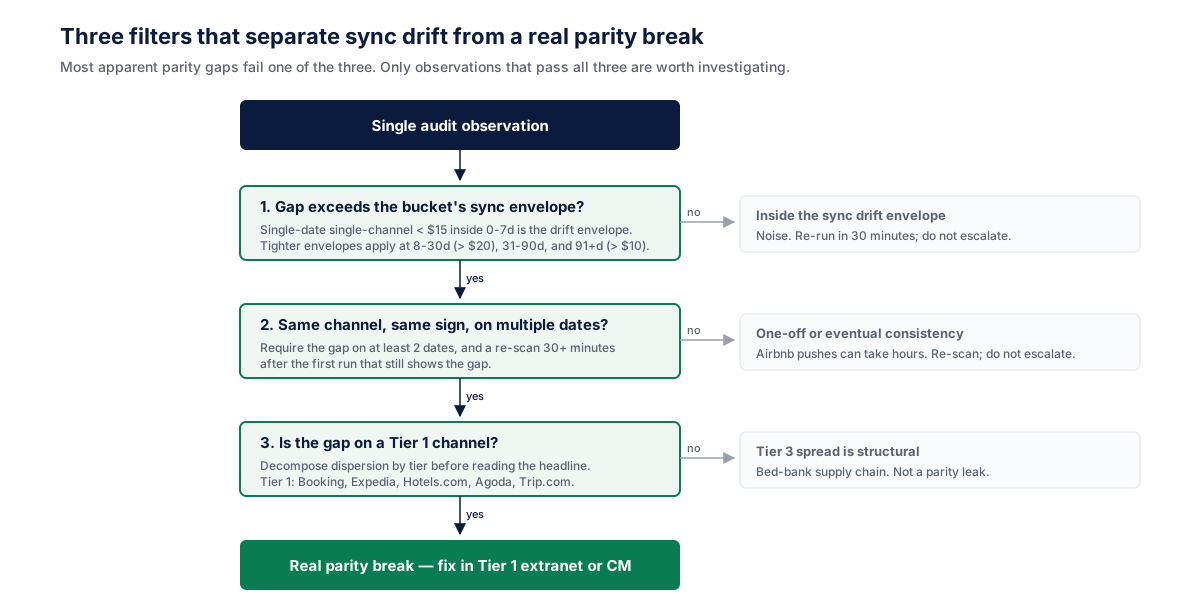
Conflating high dispersion with broken parity. A 22 percent dispersion might be entirely Tier 3, with wholesale-fed channels bracketing the range while Tier 1 stays tight. Decompose by tier first; if Tier 3 only, see the OTA channel tiers article.
Channel-manager latency gets blamed for gaps that are actually just OTA lag. Airbnb can take hours to reflect pushes 3. A gap that appears on one audit and resolves on the next scrape is eventual consistency. Persistent gaps across multiple scrapes are real.
Setting direct rates flat while the market flexes. STR data shows legitimate ADR variance of 9-23 percent across urban and leisure markets 7. Holding direct flat while the market flexes leaves money on the table, but the audit won't flag it because both sides of the parity check move together. Parity-tight-but-wrong is a hole the audit cannot detect alone.
From the field. A 42-room downtown property running on a SiteMinder + Mews stack saw direct rate hold steady at $321 mid-week, then watched Booking.com and Expedia drop to roughly $295 every Fri-Sat for three consecutive weeks. The rate-parity report flagged "weekend parity gap" with a clean Tier 1 isolation. Root cause was a CM-side weekend discount rule applied to two OTA-facing rate plans but not mirrored to the direct booking engine's promo configuration. Fix took six minutes inside SiteMinder once they knew where to look. The audit found the pattern. The fix lived upstream.
How to act on each signal
| Signal | Action |
|---|---|
| LeadTimeValidator, 0-7 day gap under fifteen dollars | Do nothing. Re-run in 30 minutes; if the gap persists, escalate to a rate-plan audit in that Tier 1 extranet. |
| LeadTimeValidator, 31-90 day Tier 1-only gap above ten dollars on most dates | Fix is upstream in the Tier 1 extranet. OTA channel tiers walks the investigation order. |
| WeekendParityValidator, weekday-vs-weekend parity gap (not ADR difference) | Check the channel manager for day-of-week rate plan rules. Most weekend-only parity gaps trace to a weekend discount on the CM that does not mirror to the direct booking engine. |
| RateDispersionValidator, high spread | Decompose by tier first. Tier 3 contribution is structural; Tier 1 contribution is a real fix in a Tier 1 extranet. |
| Anything else | Treat the gap as a lead, not a conclusion. Root cause lives in the extranet, channel manager, or wholesale contract. |
Soft recommendations
Not part of the strict fix path. Experiment when hard signals are already addressed.
- Stagger your audit cadence across the volatility cliff. If most bookings originate inside 7 days, run audits Monday and Thursday rather than once weekly. The two-point pattern reveals rate-plan timing a single snapshot misses.
- Track your own
tierlabels inside the channel matrix. Keep a personal mapping of every channel you see in reports to Tier 1 / Tier 2 / Tier 3 / wholesale-fed. The mental classification speeds up every new audit. - Pair the weekend-parity finding with your RevPAR data. Compare the parity gap against your weekday vs weekend RevPAR spread. A gap wider than your RevPAR spread suggests OTA-side flexing; a gap that tracks it suggests you are the variance source.
- Use the 60-day dispersion peak as a rate-shop trigger, not an alarm. Dispersion peaks around 60 days out, when competitors are most active. Rate-shop 45-75 days out monthly to avoid losing compset-driven demand.
- Consider a slow-scan control channel. Pick one Tier 1 channel you exclude from day-of-week promotions. Watching it drift relative to promoted channels establishes a noise floor for sync drift in your environment.
Self-audit checklist
Run this on your own data without our tools:
- I know the date range my Google Hotels rate audit covers, and it includes at least one date in each of: 0-7 days, 8-30 days, 31-90 days, 91+ days
- I re-run any concerning audit at least 30 minutes later before declaring a sync break
- I read "parity gap varies by day of week" as a channel-sync question, not an ADR question
- I decompose my dispersion number by tier (Tier 1 vs Tier 3) before acting on the headline
- For each Tier 1 OTA I work with, I know which rate plans are set to public and which are fenced
- I know my channel manager's documented push cadence to each Tier 1 OTA (and for Airbnb specifically, that it is slower than the CM-side claim)
- I do not expect to control rates on channels I did not sign with (see OTA channel tiers)
How OTALift surfaces this
The rate-parity report splits time into four lead-time buckets (0-7, 8-30, 31-90, 91+) so the volatility window and the dispersion peak each sit in their own row. LeadTimeValidator classifies each bucket's gap as normal, watch, or investigate using thresholds derived from the Abrate and Guizzardi findings plus our own sync-latency framing. WeekendParityValidator explicitly distinguishes ADR variance from parity variance in its narrative, because conflating the two was a real source of operator confusion in early reports. RateDispersionValidator today ships a single total-spread number; splitting it into per-tier dispersion is on the backlog alongside the matrix tier field surfaced in the OTA channel tiers article.
Related articles
- Rate Parity: What You Can't Do, What You Legally Can. The legal substrate under what parity means and what contract-allowed variance looks like.
- Dynamic Pricing for Independent Hotels: A Practical Framework. The revenue-management lens on lead time and day-of-week rate decisions.
- OTA Channel Tiers: Why You Don't 'List On' Half the Channels Selling Your Rooms. The supply-chain map that explains why Tier 3 dispersion is structural.
- Pillar: How OTA Ranking Algorithms Actually Work. The ranking-signal framing that makes parity a business priority in the first place.
Sources and methodology
Authored by Anya Cortez · Reviewed by Tim Anastasiou · Last reviewed: 2026-05-11
Anya Cortez is OTALift's hospitality researcher and writes The Labs.
Footnotes
-
Abrate, G., et al. "Last-minute hotel-booking and frequency of dynamic price adjustments of hotel rooms in a cosmopolitan tourism city." Journal of Hospitality and Tourism Management, ScienceDirect. Hong Kong pricing data; 96.83 percent of hotels adjust within 7 days; modal 5 changes. https://www.sciencedirect.com/science/article/abs/pii/S144767701930083X ↩ ↩2 ↩3
-
Guizzardi, A., et al. "How does room rate and rate dispersion in U.S. hotels fluctuate?" Journal of Hospitality and Tourism Management, ScienceDirect. 705 U.S. hotels; 60 days prior to arrival shows largest rate dispersions across most hotel classes. https://www.sciencedirect.com/science/article/abs/pii/S1447677020301674 ↩ ↩2 ↩3
-
Prostay, "Prevent Overbookings: Channel Manager and PMS Sync Guide." Quote: "if the PMS updates inventory every 10-15 minutes, a room sold on one OTA may still appear on another," plus the Airbnb-specific note that pushes "may take hours to reflect." Verified live 2026-05-11. https://www.prostay.com/blog/channel-manager-pms-sync-issues-preventing-overbookings-rate-errors/ ↩ ↩2
-
Booking.com Connectivity, Rates & Availability API documentation. Delta-update guidance, one-month-per-request batching. No published push-frequency spec. https://developers.booking.com/connectivity/docs/ari ↩
-
SiteMinder, "Hotel rate parity: What it is and how to manage it." Vendor claim that "rate changes are reflected across your entire digital footprint in seconds." https://www.siteminder.com/r/hotel-rate-parity/ ↩
-
HospitalityNet editorial citing STR, "Weekdays vs. Weekends." STR classification of weekdays as Mon-Thu and weekends as Fri-Sat; urban-versus-leisure pattern attribution. https://www.hospitalitynet.org/editorial/4001750.html ↩ ↩2
-
Revenue Hub, "Redefining weekday hotel business." Houston ADR variance 23.1 percent / $56.38 and NYC ADR variance 9.1 percent / $56.81 between weekday and weekend. https://revenue-hub.com/redefining-weekday-hotel-business/ ↩ ↩2 ↩3
-
AltexSoft and Cloudbeds bed-bank explainers. Hotelbeds 250,000+ hotels / 71,000 distributors; WebBeds 500,000+ hotels. Tier 3 channels source inventory from bed-bank contracts. https://www.altexsoft.com/blog/bed-banks/ and https://www.cloudbeds.com/articles/bed-banks/ ↩