
The First 90 Days: Ranking a Brand-New or Stalled OTA Listing
Sources: OTA partner documentation (Booking.com Partner Hub, Expedia Partner Central, Airbnb Help Center, all verified June 2026 via headless Chromium), Cornell Center for Hospitality Research, peer-reviewed hospitality research, and OTALift product behavior verified against the codebase on 2026-06-05. Last reviewed: 2026-06-05.
Key takeaways
If you have a new hotel and no bookings on Booking.com, the algorithm is not punishing you. It just has nothing to rank you on yet. A fresh listing enters the search pool the moment its calendar opens, but it scores low on the two ranking signals that need history: conversion rate and guest review score 1. That is cold-start, and it is the most acute problem an independent listing ever faces.
Here is the part the guides get wrong. Most articles promise a "booking.com new property boost" that hands you free placement for a few weeks. We checked the current partner docs directly. Booking does not publish one, and neither does Expedia 12. Airbnb does, and says so in plain text 3. So treat your launch window not as a boost you were handed, but as a short grace period of attention you have to convert into real signal fast.
This article is the playbook for that window. It walks the cold-start mechanic, then gives a dated 90-day sequence: completeness and launch (Days 0-14), review velocity (Days 15-45), freshness and iteration (Days 45-90). It runs without our product.
Why it moves bookings
Cold-start is a catch-22. Guests hesitate to book a property with no reviews, but reviews require bookings first 4. Both Airbnb and Vrbo refuse to display an overall rating score until a listing has at least three reviews 4. So a brand-new listing shows up in search with a blank where its social proof should be, competing against listings that have spent years filling that space.
Booking ranks on five signals it names on its own partner page: conversion, average daily rate, the number of cancellations, your property page score, and your Guest Review Score 1. Two of those five (conversion and review score) are functions of history you do not have on day one. ADR and cancellations you can set sensibly from the start. Property page score you control completely. So three of the five levers are available immediately, and two stay shut until guests start moving through. The whole game in the first 90 days is opening those two before the window of attention fades.
The cliff is steep. On Expedia, the top ten results take 62 percent of all clicks 5. A new listing that lands on page three is not getting a slow trickle. It is getting close to nothing.
Now the honest part about the boost, platform by platform.
Airbnb publishes a real one. Its Help Center states that "the algorithm is designed to make sure new listings show up well in search results" and that "new listings usually show up in search results within 24 hours" 3. Host guidance describes roughly two weeks of automatic visibility, plus a separate lever: a 20 percent discount on your first three bookings, usable anytime within 90 days of launch, which triggers its own visibility window 4. The two do not stack, which is a planning detail worth knowing (more on it below).
Booking does not. Its visibility page lists the five ranking factors and exactly one "temporary boost," the Visibility Booster, which is paid: you raise your commission to stand out "to bookers searching in specific countries on certain dates" 1. The "New to Booking.com" label is real, but it is a search badge, not a documented ranking weight. What Booking does give a cold-start operator is bridges: it can display review scores you earned on other sites before your first Booking.com guest reviews you, and it runs a quality rating that helps travelers find a property "even if you don't have any guest reviews yet" 6. Those close the social-proof gap. They do not boost your rank.
Expedia does not either. Its algorithm explainer contains no mention of new-property boosts or grace periods 2. New properties rank on the same Offer Strength and Guest Experience factors as everyone else from day one. Accelerator can buy visibility, but it is a pay-per-stay commission tool, not a free launch window 2.
The practical model: on the hotel OTAs you get seen, not boosted. A blank profile converts poorly, which feeds a weak conversion signal, which sinks your rank. The 90-day job is to fill the profile and earn the first reviews before that loop hardens against you.
What "great" looks like
A listing that beat cold-start has three visible traits by day 90: content complete enough to read as trustworthy, at least three fresh reviews on the board, and a calendar open far enough ahead that it shows up for the searches that matter 1. Not all three need to be perfect at once. Two strong ones usually pull the third up.
Look at any mature search grid and the established listings dominate it.
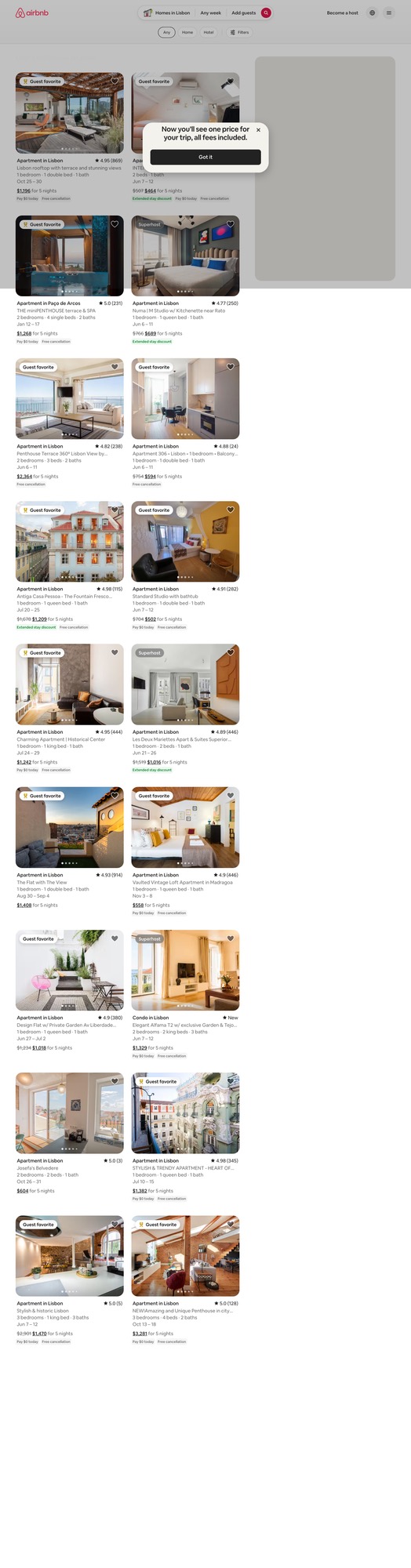
Why it matters: This is the cold-start picture in one screen. Almost every card carries a "Guest favorite" or "Superhost" badge earned over time. The lone listing tagged "New" (a Lisbon condo, right column) is the one fighting for attention with no track record. Airbnb is the platform that openly badges and boosts that new listing for a couple of weeks 3. On Booking and Expedia, the same new listing would sit in the same grid with no badge and no boost, ranking purely on how complete and competitive it looks. Great, on the hotel OTAs, means looking like the established listings before you have their history.
The other half of "great" is knowing what the platform actually offers a new property, so you do not waste the window chasing a boost that does not exist.

Why it matters: This is Booking's own "improve visibility" page. Read the "advanced boosters" row near the bottom. The Visibility Booster is a paid commission lever. Genius and the Preferred Partner Program are eligibility-gated and favor properties with a track record (Preferred Partner advertises "65% more views and 35% more bookings on average," but you apply for it after you perform, not on launch day) 1. Nothing here is a free new-property boost. A great launch works the four basic steps at the top of this page, completeness, calendar, photos, facilities, and treats the boosters as later moves.
Common failure modes
Most failed launches die at one specific point. Naming it tells you the fix.
A note on figures: the cleanest illustration here is a real new-and-complete listing beside a real new-and-thin one. Booking's consumer search bot-blocks headless capture, and a specific new low-review listing rotates out of Airbnb's results too fast to grab reliably. The "New"-tagged listing in the grid above is the live cold-start state; a curated thin-versus-stale pair is deferred to the next revision, captured on real inventory rather than faked from a thin page. Author sign-off, Anya Cortez.
The half-finished launch. The operator opens for bookings before the listing is complete. Three photos, a sparse facility list, a two-line description. The listing goes live, ranks low on property page score, converts the little traffic it gets poorly, and the conversion signal it builds is the wrong one. You only launch once. Launching thin burns the window. Booking's own data says 63 percent of guests use photos as their primary source of information while searching 1; a listing that opens with three photos is invisible to most of them before they read a word.
The price-too-high cold opener. A new listing with no conversion history and a premium price is asking guests to pay top rate for an unproven property. They will not. The clicks that do arrive bounce, conversion stays flat, and the listing never builds the signal that would justify the rate. Airbnb names this directly: listings priced below comparable ones "tend to rank higher in search," which is why it pushes new hosts toward a launch discount 3.
The review desert. Ninety days pass, the listing has one or two reviews, and it never crosses the three-review line that makes a rating display at all 4. Without a visible score, every browsing guest sees a blank, and a blank loses to a 9.1 every time. This is the single most common way a launch stalls.
The stalled relaunch. This one is for existing listings, not new ones, but a stalled relaunch is cold-start all over again. It is the quietest failure. The listing booked well two years ago, the operator stopped soliciting reviews, and the newest review is now 14 months old. Under Booking's 2025 recency-weighted scoring, reviews older than 36 months are excluded and the most recent quarter carries the most weight 7. A property coasting on old reviews is ranking on stale signal even though its lifetime average looks fine. We tracked a 40-room independent through exactly this: 8.7 overall on roughly 1,100 lifetime reviews, but only 8 reviews in the trailing 90 days. It dropped from roughly position 12 to the low 30s within 90 days of the scoring change 7. We only have the one property's data here, so read the magnitude as illustrative, not a benchmark. The lifetime score barely moved. The recent-signal score collapsed.
Step-by-step fix
The 90-day sequence. Three phases, each with a different job. Do them in order; the later phases depend on the earlier ones landing.
Days 0-14: completeness and launch
Get the listing whole before a single guest sees it. This is the only phase you fully control. If you run a channel manager (SiteMinder, Cloudbeds, Mews, RezGain), do this work there and confirm it propagated to each OTA; editing one extranet by hand leaves the others thin.
- Hit the photo floor before you open. Cover photo plus full room-type coverage plus common areas. Booking recommends a minimum that the photo count article breaks down per room type; aim at or above it, not at the bare minimum to publish. Lead with your single strongest image. 63 percent of guests treat photos as their primary information source 1.
- Fill the facility list completely. Every amenity a guest can filter for. Parking, wifi, kitchen, pets, breakfast. A missing facility does not just look incomplete; it removes you from the filtered searches where families and travelers with specific needs actually find you 1.
- Write a real description. Not two lines. Cover what the photos cannot say: neighborhood, who the property suits, what is within walking distance. The description and amenities article has the length and structure targets.
- Open the calendar 12 to 24 months ahead. Booking advises availability "as far as 24 months ahead" because travelers book that far out, and if you are not available for their dates you do not appear at all 1. A calendar open three months out is invisible to anyone planning a year ahead.
- Set a launch price you can defend, then discount the cold opener. You have no conversion history to justify a premium. Price at or just below your competitive-set median for the first few weeks, the way Airbnb's launch-discount mechanic assumes 3, then raise it as reviews start covering you. A modest opening discount that earns three early reviews is worth more than full rate on zero bookings.
Days 15-45: review velocity
Now the locked signals. The priority is crossing the three-review threshold first, then keeping a steady cadence.
- Turn on a post-stay review prompt at 24 hours and again at 7 days. The 24-hour prompt catches memory-fresh impressions; the 7-day catches the considered ones. This is the single highest-impact habit for review velocity 8.
- Treat the first three reviews as the milestone. Until you cross three, you have no displayed score on Airbnb or Vrbo and a thin one everywhere else 4. Front-desk mention at checkout, a follow-up email, an in-room card. Get to three, then keep going.
- Respond to 100 percent of negative reviews. Cornell's data is specific: responding to all negatives lifts the property's review score by about 1.65 percent, and under recency weighting that lift now shows up within a quarter instead of over years 97. Do not respond to every positive; revenue actually suffers above roughly 85 percent response rate, and the inflection sits near 40 percent overall 9.
- Stay under the burst line. Booking suppresses unnatural review spikes. Keep month-over-month volume within roughly 2x your trailing baseline 8. Going from 4 reviews to 8 is fine. Going from 4 to 40 in a month draws scrutiny. A genuine launch ramp rarely trips this; incentivized bursts do.
Days 45-90: freshness and iteration
By now you have data. Read it, fix the weakest signal, and set the maintenance cadence that keeps the listing from drifting back to cold.
- Pull your Booking Ranking Dashboard. Extranet, then Analytics, then Ranking dashboard. (Expedia's equivalent is Partner Central's performance view; Airbnb's is your listing's insights panel.) Look at click-through rate and conversion against your market. Low CTR points back to photos or hero; healthy CTR with low conversion points to price or description 1.
- Pull your property page score. It moves fastest of all your signals because it responds to content you control. If it is below 90 percent, walk the breakdown and fix the lowest subscore. Booking observes that a 100 percent score is associated with up to 18 percent more bookings than incomplete listings, which it presents as an internal observation, not a controlled study, so treat the number as directional 10.
- Fix one signal, not all of them. Pick the weakest and work it for the next 30 days. Spreading effort across five signals at once produces no measurable movement on any of them.
- Calendar a monthly content review and re-check at 30 and 90 days. A new listing decays like any other. The listing freshness article has the monthly cadence. Algorithms average signals across windows, so a change you make today shows up in 30 days, not tomorrow. Judge results at 90.
Soft recommendations
The sequence above is sufficient to beat cold-start. Once it is running, a few optional experiments are worth trying.
- Bank Airbnb's second visibility window. Because the automatic new-listing boost and the 20-percent-first-three-bookings discount do not stack 4, you can delay activating the discount until the automatic boost fades, giving yourself a second visibility push a few weeks in rather than one combined burst at launch. Useful if you launch in a soft season and want the discount working when demand returns.
- Track property page score weekly, not monthly, during the window. It is the fastest-moving signal you have and the one most under your control. A weekly glance tells you whether your content work is landing before the monthly cadence would.
- If you go multichannel from launch, instrument a weekly feed-health check. A Google Hotel Ads or connectivity feed that silently fails can drop a new listing before it ever gains traction, and on a property with no history you will not notice from booking volume.
Self-audit checklist
Run this on your own listing, without our product:
- My calendar is open at least 12 months ahead (24 is better).
- My listing content (photos, facilities, description) is complete on every OTA I am on, not just one.
- My photo count is at or above the recommended minimum for my room types, not the bare minimum to publish.
- If I use a channel manager, my photos, facilities, and description pushed through cleanly to every OTA, and I have eyeballed each live listing to confirm.
- I have crossed three reviews on each platform, so a rating score actually displays.
- I have an automated post-stay review prompt firing at 24 hours and again at 7 days.
- My launch price sits at or below my competitive-set median while I have no conversion history.
- I have responded to 100 percent of my negative reviews and well under 85 percent of positives.
- My month-over-month review volume has stayed within about 2x my trailing baseline.
- I have pulled my Booking Ranking Dashboard and property page score in the last 30 days.
- I can name my single weakest ranking signal right now and what I am doing about it.
How OTALift surfaces this
OTALift does not have a "new-listing window" detector today, and it does not run automated re-syncs. What it does is measure the three legs of this plan independently, so a new or stalled operator can see which one is weak. The honest shape: the report names the gap, you run the cadence.
The completeness leg is two listing-audit validators. PhotoPresenceValidator scores a listing's photo coverage against the recommended set and emits an "upload photos for N uncovered slots" action; on a brand-new property it asks you to generate the ideal photo set first, because there is no coverage target until then. ContentFacilitiesValidator scores facility declaration, photo verification, and description completeness, and emits "declare N missing facilities" and "add or expand description" actions. Together they are the Days 0-14 checklist in report form.
The velocity leg is ReviewVelocityValidator, in the quarterly review report. It buckets reviews into Booking's 2025 recency tiers, tracks trailing 3-month and 12-month intake, and emits up to four action cards: intake below healthy pace, score stuck on stale data, velocity slowing, and velocity spiking (the burst guard). Because it lives in the quarterly report, it is most useful at the Days 45-90 re-check, not launch week. The three-review display threshold is an OTA-side rule, not our number.
The freshness leg is ListingSyncRule reading the FreshnessCollector signals, with a 7-day fresh and 30-day stale band per OTA. When a listing drifts, it surfaces a "Re-sync N listings" recommendation routed to that listing. Re-syncs are operator-triggered; the report tells you which OTA slipped so you are not logging into Booking, Expedia, and Google separately to find out. A listing-audit report flags these signals alongside the rest of the scorecard.
Related articles
- Review Velocity and Its Effect on OTA Ranking. The Days 15-45 engine in depth: how the recency-weighted score rewards a steady review cadence.
- Listing Freshness and OTA Ranking Signals. The Days 45-90 maintenance cadence that keeps a launched listing from drifting back to cold.
- The Hotel Revenue Flywheel. Why the three legs compound: photos earn clicks, clicks earn reviews, reviews earn rank and rate power.
- Pillar: How OTA Ranking Algorithms Actually Work. The full signal map underneath the 90-day plan.
Sources and methodology
Authored by Anya Cortez · Reviewed by Tim Anastasiou · Last reviewed: 2026-06-05
Anya Cortez is OTALift's hospitality researcher and writes The Labs.
Footnotes
-
Booking.com Partner Hub, "Improve visibility and ranking." Verified 2026-06-05 via headless Chromium (the recalled
.../basics-improving-rankingURL redirects here). Source for: the five officially-named ranking factors ("focusing on conversion, ADR, the number of cancellations, your property page score, and your Guest Review Score"), the paid Visibility Booster as the only documented "temporary boost," the Preferred Partner "65% more views and 35% more bookings on average" figure, the "63% of guests use photos as their primary source of information" stat, and the "as far as 24 months ahead" calendar guidance. https://partner.booking.com/en-us/advice/improve-visibility-and-ranking ↩ ↩2 ↩3 ↩4 ↩5 ↩6 ↩7 ↩8 ↩9 ↩10 ↩11 -
Expedia Group Blog, "Decoding our algorithm: A guide to boosting your hotel's visibility." Verified 2026-06-05 via WebFetch. Source for: the absence of any new-property boost, grace period, or special new-listing ranking treatment; the Offer Strength and Guest Experience factor lists; and Accelerator being a pay-per-stay (paid) visibility tool, not a free launch window. https://partner.expediagroup.com/en-us/resources/blog/travel-marketplace-visibility-guide ↩ ↩2 ↩3
-
Airbnb Help Center, "How search results work" (article 39). Verified 2026-06-05 via WebFetch. Direct quotes: "the algorithm is designed to make sure new listings show up well in search results" and "New listings usually show up in search results within 24 hours, but in some cases they may take longer." Also the price/quality/popularity ranking factors, including that listings priced below comparable ones tend to rank higher. https://www.airbnb.com/help/article/39 ↩ ↩2 ↩3 ↩4 ↩5
-
Triad Vacation Rentals, "Overcoming the Cold Start Effect: How Airbnb and Vrbo Promotions Boost New Listings." Practitioner summary citing Airbnb/Vrbo host documentation. Source for: the three-review display threshold ("Both Airbnb and Vrbo require at least three reviews before displaying an overall rating score"), the cold-start catch-22, the ~14-day automatic new-listing visibility boost, and the 20%-on-first-three-bookings 90-day discount that does not stack with the automatic boost. Aggregator citation, disclosed; the load-bearing new-listing boost claim is independently confirmed against Airbnb's primary Help Center in 3. https://triadvacationrentals.com/blog/overcoming-the-cold-start-effect-how-airbnb-and-vrbo-promotions-boost-new-listings ↩ ↩2 ↩3 ↩4 ↩5 ↩6
-
Expedia Group internal data (June-December 2023), reported in "Decoding our algorithm." Source for the 62 percent of clicks going to the top ten results. Cross-anchored from the OTA Ranking Algorithms pillar. https://partner.expediagroup.com/en-us/resources/blog/travel-marketplace-visibility-guide ↩
-
Booking.com Partner Hub, new-partner resources surfaced via the partner help index, verified 2026-06-05 via headless Chromium. Source for Booking's cold-start bridging tools for properties without a Booking.com review history: displaying review scores from other websites, the quality rating system that "helps travelers find your property even if you don't have any guest reviews yet," and the "New to Booking.com" search label. https://partner.booking.com/en-us/learn-more/new-partner ↩
-
Booking.com January 2025 review-score update (recency-weighted), reconstructed from third-party coverage (Mara Solutions, Hospitality Net, Shiji Insights); Booking has not published a primary specification for the tier bands, so treat the direction (more weight on recent reviews, exclusion beyond 36 months) as established and the specific bands as approximate. The 40-room independent rank-drift example (position 12 to 31 within 90 days; 8.7 lifetime on ~1,100 reviews, 8 in the trailing 90 days) is an OTALift Barcelona field observation, Q1 2026, identity withheld pending consent. Both cross-anchored from Review Velocity and Its Effect on OTA Ranking. https://insights.shijigroup.com/booking-coms-new-review-scoring-explained-what-hoteliers-need-to-know-in-2026/ ↩ ↩2 ↩3
-
Review-velocity mechanics (post-stay prompt cadence at 24h/7d; the ~2x trailing-baseline burst guard against Booking's fraud suppression) cross-anchored from Review Velocity and Its Effect on OTA Ranking, which carries the primary and aggregator sourcing for both. https://www.mara-solutions.com/post/booking-review-score-update-2025 ↩ ↩2
-
Anderson, C. K., & Han, S. Hotel Performance Impact of Socially Engaging with Consumers. Cornell Center for Hospitality Research. ~10,000 quarterly hotel observations across NYC and Orlando. Source for: the 1.65 percent score lift from responding to all negative reviews, the ~40 percent overall response-rate inflection point, and the finding that revenue is lower for hotels responding to more than ~85 percent of reviews. https://sha.cornell.edu/wp-content/uploads/sites/4/2019/03/anderson-engaged-consumers.pdf ↩ ↩2
-
Booking.com Partner Hub, "Using the property page score to attract more guests." Source for the observation that properties with a 100 percent property page score get "up to 18% more bookings than properties with incomplete content." Presented by Booking as an internal observation with no published sample size or methodology; treat as directional. Cross-anchored from Listing Freshness and OTA Ranking Signals. https://partner.booking.com/en-us/help/commercial-insights/keys-success/using-property-page-score-attract-more-guests ↩