
What Booking.com, Expedia, Airbnb, and Google Actually Allow for AI-Enhanced Hotel Photos
Sources: Expedia's, Airbnb's, Google's, and Booking's own partner and content policies, the EU AI Act Article 50 text and named legal analysis, a June 2026 forensic study of 25,550 hotel photos, and a verified real-world enforcement case.
Key takeaways
Two of the four OTAs hoteliers actually sell on, Expedia and Airbnb, now name AI-generated content directly in their prohibited-content rules. The other two, Booking and Google, never say the word AI anywhere in their published photo policy. That silence is not permission. Google bans "elements that aren't real" 1. Booking's General Delivery Terms define your photos as contractual "Accommodation Information" that must stay "true, accurate and not misleading" at all times 2.
We traced a live case. A guest's June 2026 stay at a Toronto Airbnb didn't match the listing photos. She complained, and Airbnb refunded the booking and suspended the listing 3. An industry forensic study of 25,550 European hotel photos published the same month found close to one in five already carrying an AI-generation signal 4. This is not a five-year-out compliance question. It is already showing up in real listings and real refund requests.
Every platform we checked draws the same real line: cosmetic edit versus generative addition, not AI versus not-AI. Brightening a dim room passes everywhere. Adding a window that was never there fails everywhere. The step-by-step test below walks the three-tier check you can run on any photo before it publishes, and where the EU's August 2, 2026 disclosure duty already reaches you.
Key numbers
- Expedia and Airbnb, 2 of the 4 platforms researched, explicitly name AI-generated or AI-edited content in their prohibited-content policy 56.
- Roughly 19% of 25,550 hotel photos across 7 European destinations carried at least one AI-generation signal, per an industry forensic study (a marketing agency and a detection vendor) published June 27, 2026 4.
- The EU AI Act's deployer deepfake-disclosure duty (Article 50(4)) takes effect August 2, 2026 and is not covered by the provider-marking extension to December 2, 2026 78.
- 0 of the 4 platforms publish a specific "these edits are OK, these aren't" list. Every platform's test is outcome-based: does the photo misrepresent the property 5612.
Why this isn't a hypothetical compliance question
Can I get flagged for using AI on my own hotel photos?
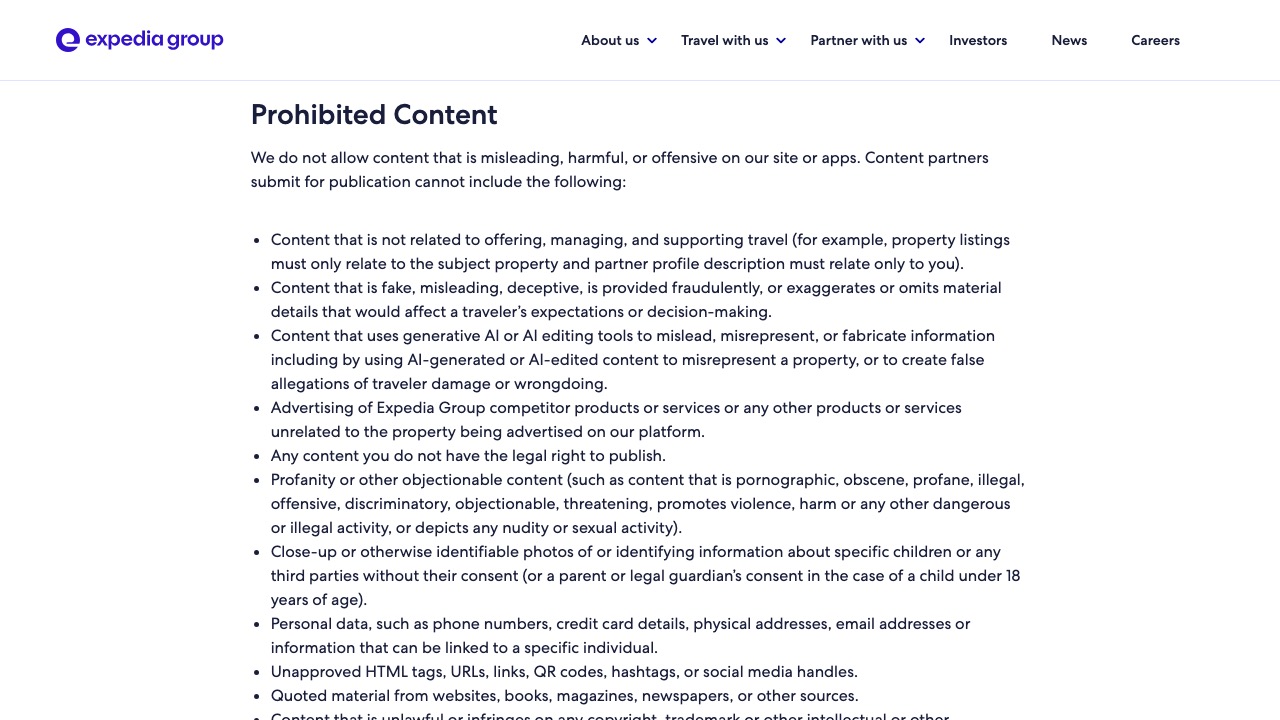
Yes, Expedia and Airbnb ban AI-generated hotel photos by name; Google and Booking ban the same outcome without naming AI. Expedia and Airbnb both name AI-generated or AI-edited content as prohibited when it misrepresents a property. Google and Booking never use the word AI, but both already ban the outcome an AI edit produces when it fabricates something that isn't real.
This matters for conversion, not just policy compliance. Peer-reviewed research on the mechanism is blunt: when the photos a property posts don't match what guests later see and share, that inconsistency measurably lowers booking intention, through perceived risk and negative emotion 9. Guests don't distinguish between "the room changed since the shoot" and "the room was never like that." They just feel misled, and a misled guest books elsewhere next time, or disputes the stay after arrival.
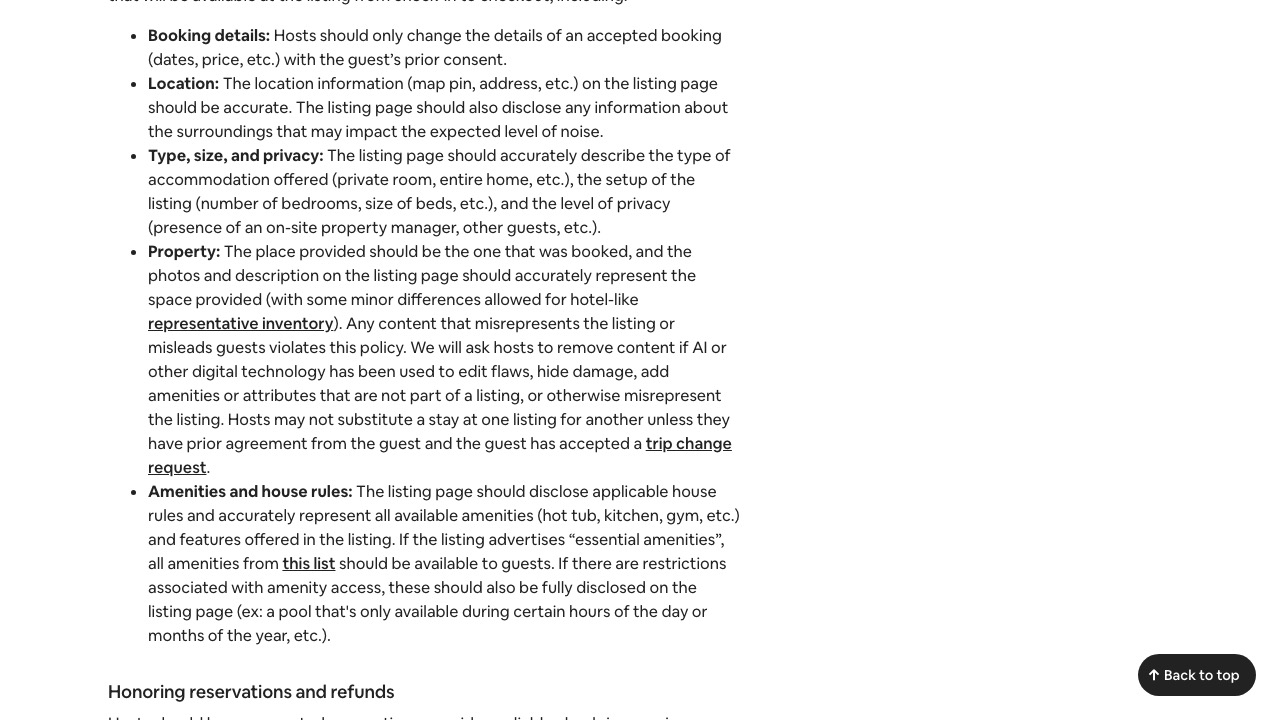
Airbnb's own enforcement language names the mechanism directly: "we will ask hosts to remove content if AI or other digital technology has been used to edit flaws, hide damage, add amenities or attributes that are not part of a listing" 6. The word "or" is doing real work in that sentence. Airbnb isn't drawing a line at the tool. It's drawing a line at the outcome. A Photoshop clone-stamp job that hides a water stain gets the exact same treatment as a generative fill that does the same thing.
Two supply-side pressures are converging on the same window right now. Forensic image-detection tooling has gotten cheap enough that a marketing agency, not just an OTA's trust and safety team, can run it across tens of thousands of listings and publish the results 4. And the EU AI Act's disclosure duty for deployers of AI-generated or manipulated content takes effect August 2, 2026 7. Neither of those was true eighteen months ago.
What each OTA's photo policy actually allows
Read the four side by side and the same pattern holds, named or not.
Expedia: the strictest, and the most explicit
Expedia Group's Partner Provided Content Policy states plainly that partners cannot submit "content that uses generative AI or AI editing tools to mislead, misrepresent, or fabricate information including by using AI-generated or AI-edited content to misrepresent a property, or to create false allegations of traveler damage or wrongdoing" 5. That last clause is worth sitting with. It isn't only about listing photos. It reaches AI-generated "evidence" a guest might submit in a damage dispute too, which tells you Expedia is thinking about AI fabrication as one problem, not two.
One caveat: this isn't expedia.com/legal/ai-terms, a separate page governing Expedia's own generative-AI tool outputs, not what a hotelier uploads. Easy to find, easy to misquote as the partner-content rule. It isn't.
Airbnb: explicit, with the clearest enforcement trail
Airbnb's Ground rules for home hosts carry the article's strongest single quote: "The place provided should be the one that was booked, and the photos and description on the listing page should accurately represent the space provided... We will ask hosts to remove content if AI or other digital technology has been used to edit flaws, hide damage, add amenities or attributes that are not part of a listing, or otherwise misrepresent the listing" 6.
Enforcement runs a ladder: education, then a warning, then required removal, then suspension for repeat or severe violations 6. That ladder is public. Whether it actually catches a violation before a guest does is a separate question, and the failure mode section below has a real answer.
Airbnb's hard line on fabrication isn't limited to listing photos, either. A separate April 2026 terms update excludes AI-generated content from what counts as valid evidence in a Host Damage Protection claim 10. Different problem, same posture: Airbnb doesn't trust AI-generated visuals it can't verify, whether a host is showing a guest what a room looks like or proving what a guest allegedly broke.
Google and Booking: silent on AI, loud on accuracy
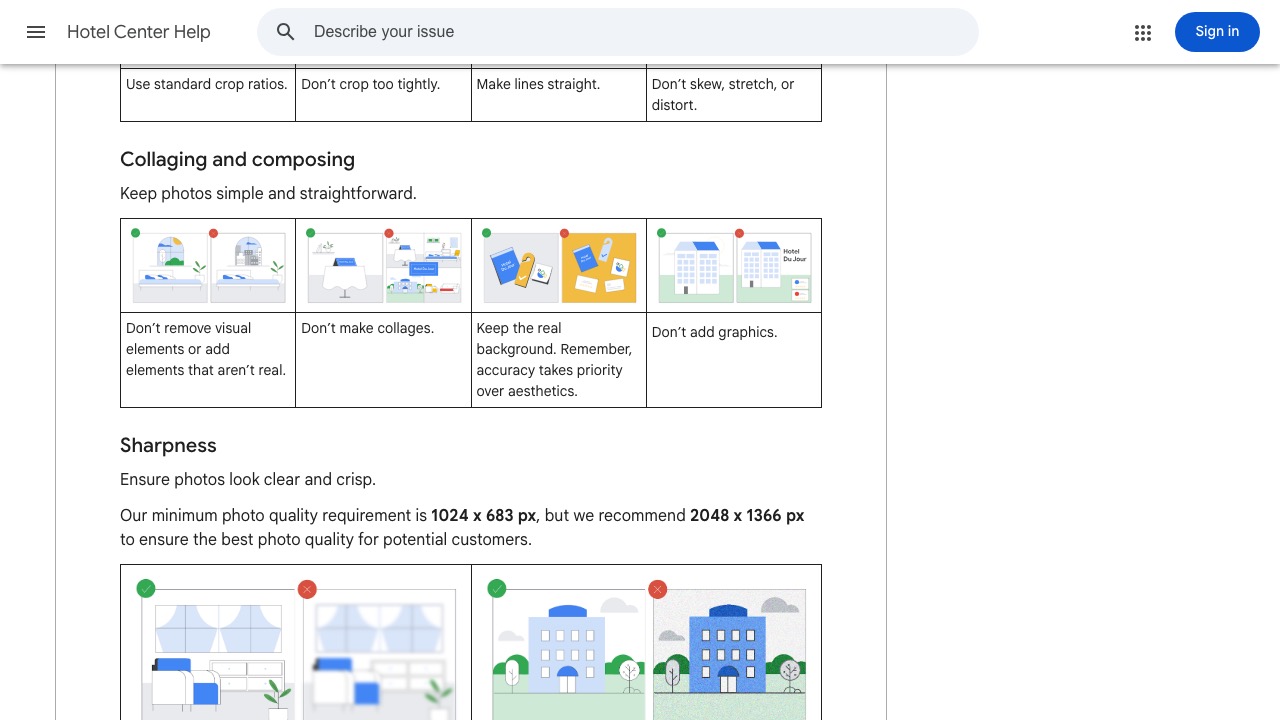
Google Hotel Center's photo guidance never says the word AI. It doesn't need to. "Don't remove visual elements or add elements that aren't real" and "accuracy takes priority over aesthetics" 1 reach a generative addition just as cleanly as a manual one. A photo that fails this check gets dropped from the Prices tab carousel, the surface most travelers actually compare properties on.
Booking is the most interesting case because it looks, at a glance, like the one platform with nothing to say. It has no AI-specific clause anywhere in its public documentation. But its General Delivery Terms define "Accommodation Information," explicitly including "pictures, photos and descriptions," and require that information stay "true, accurate and not misleading" at all times, as a signed contractual representation 2. That's a stronger instrument than a help-center guideline. Booking's real position isn't "we have no policy." It's "we already have a general policy broad enough that we never needed a specific one."
Common failure modes
Four patterns account for most of the risk here, and none of them require a hotelier to be doing anything malicious.
1. Reading platform silence as permission. Booking's and Google's help pages don't mention AI, so it's tempting to assume they're the safe ones. Wrong instinct. Both already prohibit the exact outcome an unchecked generative edit produces.
2. Blurring cosmetic and generative edits. Brightening, straightening, and removing a stray cable are cosmetic. Adding a window, a pool, or furniture that doesn't exist in the room is generative. The failure isn't using AI. It's letting a tool cross from one category into the other without anyone checking, because most AI photo enhancers don't draw that line for you.
3. Assuming enforcement is proactive. A Toronto Airbnb listed as "Warm Downtown Suite" showed a warmly lit room with houseplants, a rug, and gold bathroom fixtures. The guest arrived to a bare room with none of it and different fixtures 3. Airbnb's own policy should have caught a mismatch this large before the listing ever went live. It didn't. Enforcement happened after a guest complained to the press, not before a guest booked.
Airbnb's statement on the record: "While this type of experience is rare, we understand how frustrating it can be when a listing does not meet expectations, and we have fully refunded the guest for their booking and suspended the listing while it is reviewed" 3. Airbnb never confirmed or denied AI involvement. The company acted on the mismatch, reactively, after the fact. That gap between a published rule and proactive detection is the actual operating reality every hotelier should plan around, not the published rule alone.
4. Misreading who owes the EU disclosure. A common assumption is that the AI tool vendor handles labeling, so the hotelier doesn't have to think about it. Under the plain text of Article 50, the machine-readable marking duty sits with the AI system's provider, but the deepfake-disclosure duty sits with the deployer, the party publishing the content 711. A hotelier publishing an AI-edited photo to a listing reads as a deployer under that plain text. This is a legal reading of the statute, not a court-tested one, and counsel should confirm it for your specific situation. Treat it as the cautious assumption, not a settled fact you can ignore. The duty attaches to what's published, not to when it was uploaded, so a photo already live on August 2 is in scope too, not grandfathered in under this same reading.
Step-by-step fix
A three-tier test, in order, for every photo before it goes live or stays in your gallery.
- Tier one, cosmetic: always safe. Brightness, white balance, straightening a crooked frame, removing a stray cable or a wastebasket, mild noise reduction. None of this changes what the room contains. Every platform we checked permits it without qualification.
- Tier two, staging and people: legitimate, with two hard limits. AI-composited people in a lobby or pool scene sits in the same category real estate photography has used for decades, staged shots with hired models, not property misrepresentation by itself. Two limits keep it that way: disclose AI use where a platform's terms ask for it, and never imply a service or amenity your property doesn't actually offer. No generated bartender if you don't run a staffed bar, no masseuse if you don't offer treatments, no implied nightlife at a quiet property. Cross that line and it's the same misrepresentation every platform bans.
- Tier three, structural or amenity additions: never. An added window, a pool that doesn't exist, furniture that isn't in the room, a view that isn't real. This is the one category all four platforms reject without exception, named AI clause or not. If you find one of these already published, pull it today, not at your next photo refresh.
- Check the platform-specific line, not just the general test. Expedia and Airbnb ban this outcome by name 56. Google's "elements that aren't real" rule and Booking's contractual accuracy duty reach the same outcome without naming AI 12. Run every photo against your strictest platform, not your most lenient one, and it clears all four.
- If you push photos through a channel manager, clear this before it leaves your PMS. SiteMinder, Cloudbeds, Mews, RezGain, and the rest all work the same way: one uploaded image syndicates to every connected platform at once. That's exactly why you check it against your strictest platform first, not after it's already live on all four.
- If you publish to EU travelers, assume the deployer disclosure duty applies to you. August 2, 2026 is the date, per the current reading of Article 50(4) 711. The exact visible-label format the EU expects hasn't been fully itemized in public guidance as of this writing; don't invent a badge or icon that isn't published anywhere. State plainly, wherever your platform allows a note, that a photo has been AI-edited whenever tier two applies. Most OTAs give you no per-photo disclosure field today, so in practice the note goes in the room or property description, or a photo caption where one exists. Where no surface exists at all, the cautious read is to skip the tier-two composite rather than publish an AI scene you have no way to label.
- Keep the paper trail. Save the original alongside the edited version, and note which tool or prompt produced the edit. If a guest disputes a stay or a platform asks a question, you want an answer in minutes, not a scramble through old phone backups.
Soft recommendations
- Re-run the three-tier test on your existing gallery once a quarter, not just on new uploads. Tools change faster than photo libraries get refreshed.
- If you use an AI photo-enhancement vendor, ask directly what disclosure or provenance metadata it attaches to output. Most don't attach any today, and you're the one holding the risk if that gap ever gets tested.
- Track guest messages that mention the room "not matching the photos" as a leading indicator, separate from your general review score. It surfaces a drifting gallery before a platform's own enforcement does.
Self-audit checklist
Run this on your own gallery, every photo, before push:
- Every AI-touched photo has been sorted into cosmetic, staging, or structural, and nothing structural has shipped
- No AI-composited scene implies a staffed amenity, service, or experience the property doesn't actually offer
- The photo would clear Expedia's and Airbnb's explicit AI clauses, not just Google's or Booking's silent ones
- Original, unedited versions of every AI-touched photo are saved somewhere you can find them in minutes
- You know, in one sentence, who at your property owns the EU AI Act disclosure question if a guest or platform ever asks
- You haven't assumed your enhancement vendor's tool handles compliance for you, because none of the four platforms' policies mention a vendor exemption
How OTALift surfaces this
Here's the honest state of our own product, because this article exists partly to answer that question for our own customers. OTALift's listing-audit report scores every photo through PhotoQualityValidator, and that scoring has no AI-authenticity check in it today. Worse, the same validator recommends AI enhancement as a quick win whenever it detects photos that could be improved, with nothing downstream distinguishing a compliant brightening pass from a generative one.
The First Look report's ConversionValidator has the same blind spot from a different angle. It blends your hero photo and overall photo craft into most of its conversion score, both scored by our own Gemini-based photo analyzer. A fabricated photo that clears our craft bar cleanly, because it looks great, scores exactly the same as a genuine one. We're measuring composition and quality, not whether what's in the frame is real.
Our own Photo Enhancer runs a hallucination check on generated drafts, and that check is advisory only. A draft flagged as adding something that wasn't in the original photo still gets kept and shown to the hotelier, who can accept or reject it. Nothing blocks a flagged photo from being finalized and published to a live listing, and nothing today records which finalized photos were AI-edited once they land on your gallery. We built the flag as a warning, not a gate, and that's a real gap between what we show you and what we currently enforce.
Related articles
- What OTAs Reject in Hotel Photos, and Why
- Accessibility Photography for Hotel Listings
- Hotel OTAs Content Capability Matrix
- Pillar: How OTA Ranking Algorithms Actually Work
Frequently asked questions
Can I use AI to enhance my Booking.com or Airbnb listing photos without getting flagged?
Yes, for cosmetic edits like brightening or straightening. AI-added furniture, windows, or amenities that don't exist gets flagged on every platform we checked, named AI clause or not 5612.
Do individual hotels have to label AI-generated photos under the EU AI Act?
Under the plain reading of Article 50(4), the deployer, the party publishing the content, carries the deepfake-disclosure duty starting August 2, 2026 711. This is a legal reading, not a court-tested ruling; confirm with counsel for your situation.
Does Booking.com have a policy on AI-generated hotel photos?
Not a named one. Its General Delivery Terms define your photos as contractual information that must stay true, accurate, and not misleading at all times, which already reaches AI misrepresentation without naming AI 2.
What's the actual difference between AI photo enhancement and AI-generated hotel photos?
Enhancement changes how a real room looks: lighting, color, straightening. Generation adds something that isn't in the room: a window, a pool, furniture. Every platform's real test is that second category, not whether AI was involved at all 5612.
Sources and methodology
Authored by Anya Cortez.
Anya Cortez is OTALift's hospitality researcher, covering how independent hotels sell, operate, and rank across the OTA ecosystem.
Footnotes
-
Google Hotel Center Help, "Photo recommendations and best practices," Collaging and composing section. Verbatim: "Don't remove visual elements or add elements that aren't real." "Keep the real background. Remember, accuracy takes priority over aesthetics." Re-verified live via WebFetch 2026-07-20 (quote confirmed unchanged); originally captured 2026-04-27 in
what-otas-reject-and-why/research/sources.md. https://support.google.com/hotelprices/answer/13483115 ↩ ↩2 ↩3 ↩4 ↩5 ↩6 -
Booking.com General Delivery Terms, §2.1.1-2.1.2, accessed via a property-hosted signed copy of the standard Accommodation Agreement (Booking's own portal-gated copy requires Extranet login). Verbatim: "Information provided by the Accommodation for inclusion on the Platforms shall include information relating to the Accommodation (including pictures, photos and descriptions)... (the 'Accommodation Information')." "The Accommodation represents and covenants that the Accommodation Information shall at all times be true, accurate and not misleading." No occurrence of "artificial intelligence," "AI," "generative," or "synthetic" anywhere in the extracted document text. Accessed and extracted via
pdftotext2026-07-20. https://www.executiveapartments.co.za/uploads/1/3/3/4/133477765/booking.com_agreement.pdf ↩ ↩2 ↩3 ↩4 ↩5 ↩6 ↩7 -
CP24 (Bell Media), "This family thought they booked an 'amazing' Toronto Airbnb. They say AI was used to generate the photos," by Alex Arsenych, published July 14, 2026. Booking date June 15, 2026; listing "Warm Downtown Suite," Toronto, $616 CAD. Guest quote, Christine MacMillan: "These pictures don't depict at all what we... booked on Airbnb. So, we're pretty well sure these were AI-generated photos." Airbnb spokesperson, verbatim: "While this type of experience is rare, we understand how frustrating it can be when a listing does not meet expectations, and we have fully refunded the guest for their booking and suspended the listing while it is reviewed." Airbnb did not confirm or deny AI use. Accessed 2026-07-20 via
/browse. https://www.cp24.com/local/toronto/2026/07/14/this-family-thought-they-booked-an-amazing-toronto-airbnb-they-say-ai-was-used-to-generate-the-photos/ ↩ ↩2 ↩3 -
ABCD Agency and ContentGuard.me, AI-signal prevalence study, published June 27, 2026. 25,550 hotel photos analyzed across 7 European destinations, 100 hotels per destination; approximately 19% (4,778 photos) carried at least one AI-generation or AI-editing signal via pixel-pattern anomalies and metadata markers. Named methodology lead: Jens Kramosch, ContentGuard.me founder. Reported via trade press; treat as Tier 3 industry research, not an independently peer-reviewed study. Accessed 2026-07-20 via WebFetch. https://www.travelandtourworld.com/news/article/70uifdln52qq/ ↩ ↩2 ↩3
-
Expedia Group, "Partner Provided Content Policy," Prohibited Content section. Verbatim: "Content that uses generative AI or AI editing tools to mislead, misrepresent, or fabricate information including by using AI-generated or AI-edited content to misrepresent a property, or to create false allegations of traveler damage or wrongdoing." Accessed 2026-07-20 via WebFetch and
/browse. https://www.expediagroup.com/content/expediagroup/live-copies/en-us/marketplace-policies/partner-provided-content-policy.html ↩ ↩2 ↩3 ↩4 ↩5 ↩6 -
Airbnb Help Center, "Ground rules for home hosts," Property clause. Verbatim: "The place provided should be the one that was booked, and the photos and description on the listing page should accurately represent the space provided... We will ask hosts to remove content if AI or other digital technology has been used to edit flaws, hide damage, add amenities or attributes that are not part of a listing, or otherwise misrepresent the listing." Accessed 2026-07-20 via
/browse. https://www.airbnb.com/help/article/2895 ↩ ↩2 ↩3 ↩4 ↩5 ↩6 ↩7 ↩8 -
EU AI Act, Article 50, full text. Paragraph 2 (provider duty): outputs of AI systems generating synthetic image, video, audio, or text content "shall be marked in a machine-readable format and detectable as artificially generated or manipulated." Paragraph 4 (deployer duty): "Deployers of an AI system that generates or manipulates image, audio or video content constituting a deep fake, shall disclose that the content has been artificially generated or manipulated." Entry into force 2 August 2026, per Article 113. Accessed 2026-07-20 via WebFetch. https://artificialintelligenceact.eu/article/50/ ↩ ↩2 ↩3 ↩4 ↩5
-
Sidley Austin, Data Matters, "EU AI Act Transparency Obligations: Preparing for Compliance by 2 August 2026." Verbatim: "the marking obligations contained in Article 50(2) of the EU AI Act... will be delayed until 2 December 2026." The same analysis confirms Article 50(4) deployer deepfake-disclosure obligations remain on the original August 2, 2026 deadline; the extension reaches only Article 50(2) provider marking. No exemption found for individual or non-professional deployers. Accessed 2026-07-20 via WebFetch. https://datamatters.sidley.com/2026/06/24/eu-ai-act-transparency-obligations-preparing-for-compliance-by-2-august-2026/ ↩
-
Zhang, S., Liu, W., Zhang, T., Han, W., and Zhu, Y. (2024), "Harms of inconsistency: The impact of user-generated and marketing-generated photos on hotel booking intentions," Tourism Management Perspectives, 51, 101249. DOI: 10.1016/j.tmp.2024.101249. Four experiments, 810 participants; finds inconsistency between marketer-generated and user-generated hotel photos lowers booking intention via perceived risk and negative emotion, moderated by tourists' price preferences. Full text is paywalled and returns 403 to automated access on ScienceDirect; the citation, authorship, and finding were verified via Crossref bibliographic metadata (correcting a misattributed author list found in a sibling article's research notes) and corroborating abstract-level summaries, not a direct primary-text read. Accessed 2026-07-20. ↩
-
Airbnb Help Center, "About the updates to our Terms." Confirms "AI generated content" is excluded from Airbnb's definition of "Legitimate and Verifiable Evidence" for Host Damage Protection claims, effective for existing users April 20, 2026. A separate, damage-claim-specific policy, not the listing-photo standard cited above. Accessed 2026-07-20 via WebFetch. https://www.airbnb.com/help/article/2877 ↩
-
European Commission, "Code of Practice on Transparency of AI-Generated Content," published June 10, 2026. Confirms providers must mark outputs in a machine-readable format and deployers must disclose deepfake content; references a set of EU-standardized icons for visible labeling without itemizing the exact spec on this page. A voluntary compliance tool operationalizing Article 50, not the statute itself. Accessed 2026-07-20 via WebFetch. https://digital-strategy.ec.europa.eu/en/policies/code-practice-ai-generated-content ↩ ↩2 ↩3